Chinese authorities are putting robot traffic police and unmanned patrol vehicles to work on street-level public security—adding cameras, visual recognition, remote police warnings, data uploads, cloud-issued commands, and violation capture to ordinary traffic control.
AI Policing Moves Onto the Street
In Changsha, capital of Hunan Province, unmanned patrol vehicles and robot traffic police went on duty in the city’s Wuyi commercial district on April 1, according to Hunan Changan, a website run by the Hunan provincial political-legal system.Unmanned patrol vehicles collect street images through vehicle-mounted high-definition cameras and return data to a command center. Police officers can issue remote voice warnings, and the vehicles can automatically capture illegal parking and preserve evidence, according to the report.
The same report said the robot traffic officer uses AI and visual-recognition technology, obtains traffic-light information, reproduces traffic-control gestures, and identifies helmet, stop-line, and red-light violations before issuing voice prompts and gesture-based warnings.
In Wuhu, Anhui Province, the city’s Industrial Innovation Center said the “Wuyou” Smart Police R001 robot went on duty at an intersection in the city on Jan. 10. The center said the robot was jointly introduced by the Wuhu public-security traffic-management department and Chery Mojia Robot.
Data Uploads and Cloud Commands
A Nanjing Jianye District government page described a robot traffic-management system released by Duolun Technology and EngineAI as a connected public-security tool.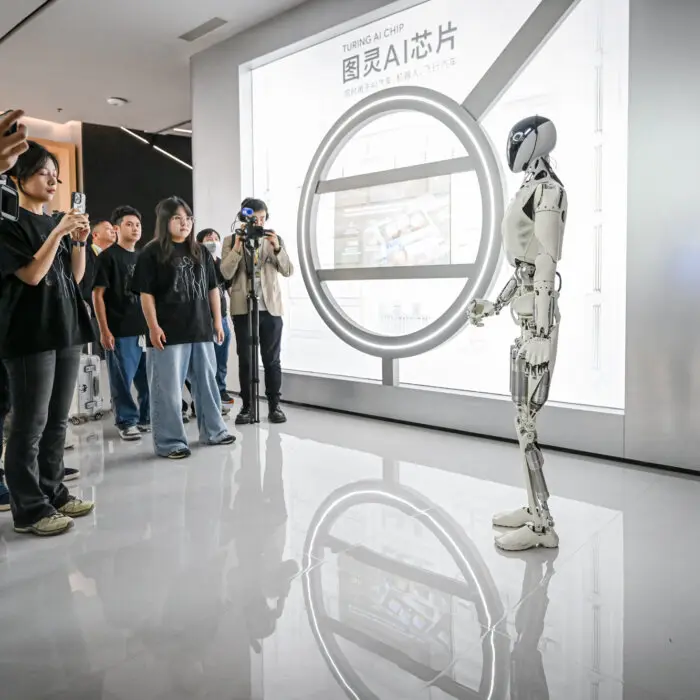
The article said the system uses multimodal visual AI to identify traffic lights, no-helmet violations, stop-line violations, and running red lights. The system also uses 5G and smart devices to connect traffic-management platforms, roadside equipment, and signal-light systems, enabling real-time data upload and cloud-issued commands.
In April, more than 10 smart traffic-management robots went on duty in Shenzhen, Nanjing, Changsha, Jingzhou, and other places, carrying out routine traffic-assistance duties, according to the Jianye government.
Malfunctions and Human Staff
Official reports cast the systems as a way to reduce human workload. Videos and interviews reported by the Chinese edition of The Epoch Times instead showed scenes in which human staff had to follow, steady, or remove the robots.In videos circulating on Chinese social media, some robots kicked bystanders during demonstrations, while others fell to the ground and had to be carried away as onlookers laughed, according to the report.
A video from Changsha showed a humanoid robot wearing a fluorescent yellow “Changsha traffic management” vest and walking near a crosswalk while several staff members followed behind it. Online commenters mocked the scene as “several people serving one robot,” with one calling it “a remote-control toy” needing “nanny-style service.”
A restaurant owner surnamed Zou, who works near Changsha’s Wuyi Square, told the Chinese edition of The Epoch Times that a robot stopped in the road on June 11 and blocked traffic.
“Cars couldn’t get through,” he said. “Later they carried the robot away.”
The report also cited online comments questioning whether the robots would take up staffing quotas, replace human traffic police, or create new costs while still requiring people to operate, escort, maintain, and carry them.
A Shenzhen software engineer surnamed Xu told the Chinese edition of The Epoch Times that China’s robot industry has been pushed by government subsidies and publicity, while performance remains unstable. He said software updates and data-receiving systems had not kept pace with deployment.
Inside China’s Surveillance System
The robot traffic-police deployments add a visible street-level layer to a public-security system that already relies heavily on cameras, databases, and digital monitoring.Paul Scharre, executive vice president and director of studies at the Center for a New American Security, made that broader point in May 2023 testimony before the U.S.-China Economic and Security Review Commission at a hearing titled “Rule by Law: China’s Increasingly Global Legal Reach.”
Scharre told the commission that the CCP uses technology to build “a dense web of digital and physical surveillance” to track and monitor citizens. He cited AI tools such as facial, voice, and gait recognition; biometric databases; license-plate readers; police cloud-computing centers; and software that tracks individuals’ movements, car and cell phone use, gas-station use, electricity use, and package delivery.
The China-linked surveillance system also has a legal and regulatory layer.
On Jan. 31, China’s Ministry of Public Security published a 68-article Draft Law on Cybercrime Prevention and Control. Human Rights Watch said in a March 17 analysis that the draft law would bring telecommunications, internet, and banking systems under one framework, strengthening authorities’ ability to trace user activity across platforms.
The rights group said the draft would also expand authorities’ ability to suspend access to financial accounts and communication services and bar certain people from leaving China. Yalkun Uluyol, a China researcher at Human Rights Watch, said the draft law would “further undermine online anonymity, chill free speech, and restrict access to information.”
Beijing’s Robotics Push
The robot traffic-police systems are emerging from two overlapping policy tracks: Beijing’s long-running AI plan and its more recent push for humanoid robots.The State Council issued its New Generation Artificial Intelligence Development Plan in July 2017, setting broad AI goals through 2030. The plan called for China to become a major global AI innovation center by 2030 and for the value of China’s core AI industry to exceed 1 trillion yuan.
A separate humanoid-robot guidance document published through China’s National Center for Science and Technology Information said China aimed by 2025 to establish a preliminary humanoid-robot innovation system, achieve batch production, and demonstrate applications in special, manufacturing, and public-service scenarios.
The humanoid-robot document also called for robots to develop AI-based “brains” and “cerebellums,” improve environmental perception, behavior control, and human-machine interaction, and promote cloud-edge coordination.
The Ministry of Public Security has separately promoted broader smart-policing systems. In an April 2025 article on its official website, the ministry described efforts to build smart-policing innovation centers and integrate police resources, social information, and positioning-terminal data into networked systems for unified alerts, dispatch, and handling.
The official robot traffic-police reports reviewed describe cameras, recognition functions, data links, remote warnings, traffic-platform connections, cloud commands, and the use of robots to reduce routine police work. They do not publicly identify procurement costs, data-retention rules, safety-testing records, liability procedures, cybersecurity safeguards, procedures for citizens to challenge captured footage or warnings, or who can access data collected through the systems.