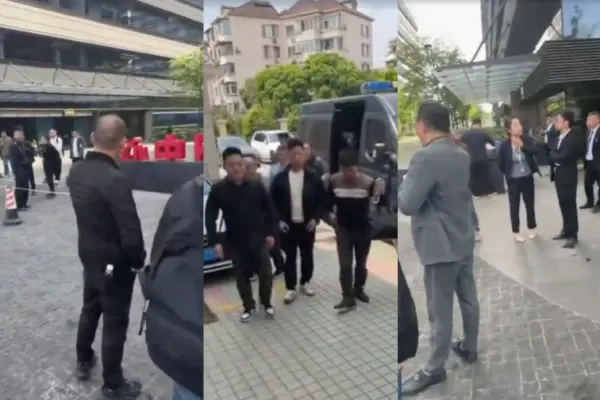
For years, Zhou Lubao lived on the margins of China’s economy, earning the equivalent of about $512 a month as a construction site gatekeeper and sending most of it home to support his family.
Now, the man in his 30s faces a potential prison sentence longer than many corruption cases under the communist regime—not for theft or violence, but for reposting messages online.
Zhou has been charged with “picking quarrels and provoking trouble,” a broadly defined public-order offense often used to target those who criticize the regime. He shared roughly 25 posts on Chinese social media platform Weibo, highlighting China’s rural migrant workers seeking unpaid wages. Prosecutors have recommended a sentence of seven years, six months in prison, along with a fine of 50,000 yuan ($7,300), according to his defense lawyer’s posts in online group chats among rights defenders.
Critics say the case, recently heard in a district court in Lanzhou, China, underscores how China’s legal system treats grassroots activism and online speech.
A Broader Pattern
Zhou’s lawyer described him in court as a low-income worker struggling to make ends meet. Earning about 3,500 yuan ($512) a month, Zhou sends roughly 90 percent of his income home to his family, leaving little for himself.The proposed fine alone, the lawyer argued, would be a heavy burden. Zhou has spent years working as a rural migrant worker far from home, usually forgoing visiting his family during holidays.
“To keep this job watching over a construction site, he hasn’t gone home for the holidays in six years,” his lawyer posted.
Another lawyer says the charge against Zhou reflects a broader pattern.
“The offense of ‘picking quarrels and provoking trouble’ has long become a ‘catch-all’ charge used against rights defenders and internet users,” Liu, a human rights lawyer based in southern China, told The Epoch Times.
Zhou’s case, Liu said, highlights how courts often impose harsher penalties on those at the bottom of society who attempt to defend their rights.
His financial situation—earning little while supporting a family—is far from unusual, Liu added, calling it “a painful reflection of many lower-income households in China.”
A journalist in Lanzhou, China, questioned the proportionality of the recommended sentence.
“This is hard to justify,” he told The Epoch Times. “Officials who take bribes worth millions sometimes receive similar sentences. Yet Zhou merely reposted online messages speaking up for migrant workers—actions that do not even constitute a crime—and prosecutors are recommending seven and a half years.”
Concerns Over China’s Judiciary
The controversy comes as the Chinese Communist Party’s (CCP) top judicial authorities recently revised sentencing guidelines for corruption-related offenses.On April 10, China’s Supreme People’s Court and Supreme People’s Procuratorate raised the threshold for prosecuting officials for “property of unclear origin” from 300,000 yuan (about $44,000) to 3 million yuan ($440,000). Under the new rules, cases involving between 3 million and 10 million yuan (about $1.5 million) may result in sentences of up to five years, while larger amounts could bring five to 10 years.
For one Chinese legal scholar, the contrast with Zhou’s case is striking.
“This is no longer just a matter of judicial discretion—it reflects a misalignment between power and punishment,” a female legal scholar in central China told The Epoch Times. “The signal is deeply distorted. A government official with nearly 3 million yuan in unexplained assets might not even face criminal charges under the new threshold. Even with much larger sums, the starting sentence may be less than five years.”
By comparison, she noted, Zhou faces more than seven years for reposting online messages.
Such disparities raise fundamental questions about how harm to society is assessed within China’s legal system, the scholar said, warning that continued inconsistencies could erode public confidence in the law.
Zhou’s case is not isolated. In recent years, the same charge has been used in a number of cases involving online speech and activism.
Together, these cases span a wide cross-section of Chinese society, from professional journalists to grassroots activists and everyday internet users.