The insider and analysts spoke to The Epoch Times on the condition of anonymity out of fear of reprisal.
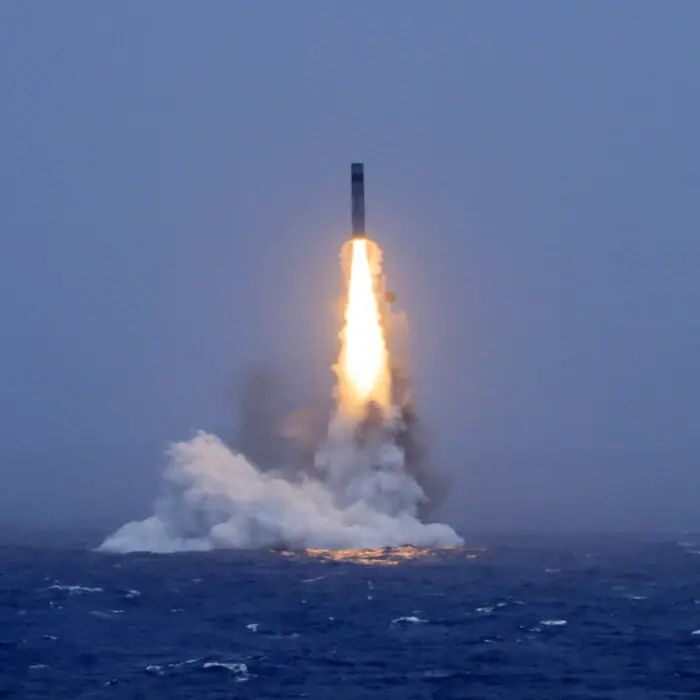
The insider, who has ties to the People’s Liberation Army (PLA), told the publication that the missile tested was an upgraded JL-2 submarine-launched ballistic missile rather than the next-generation JL-3 as some have speculated. The insider said the launch was intended to demonstrate China’s ability to threaten targets beyond the second island chain, even if that capability remains limited.
“The PLA wants the United States to believe that the Chinese navy can already conduct long-range strikes beyond the second island chain,” the insider said. “In reality, it has not yet reached that level.”
According to the insider, the upgraded JL-2 has been in service for only about a decade, and Beijing is seeking to counter growing criticism of the PLA navy by showcasing the credibility of its sea-based nuclear deterrent.
“The message is directed not only at neighboring countries but also at the United States—that China’s submarine force can now threaten areas beyond the second island chain,” he said.

Debate Over Which Missile Was Tested
The Chinese regime has not disclosed the type of missile used in the launch, leading to competing assessments among outside observers.Washington-based think tank the Center for Strategic and International Studies said that if the missile was a JL-2, the test would have approached the weapon’s maximum range, and if it was a JL-3, the missile’s range could exceed 10,000 kilometers (6,214 miles).
The PLA insider disputed those assessments, saying information he received indicated the missile was an upgraded JL-2 rather than the JL-3. He argued that Beijing is unlikely to publicly test the JL-3 at this stage because doing so could provoke a stronger response from the United States and its allies.
The JL-2 is China’s second-generation submarine-launched ballistic missile and is typically deployed aboard China’s Type 094 Jin-class nuclear-powered ballistic missile submarine. The original version has an estimated range of more than 7,000 kilometers (4,350 miles), which limits its ability to strike the continental United States when launched from waters near China’s coast. Those submarines must also contend with anti-submarine defenses concentrated along the First Island Chain.
A China-based military commentator told The Epoch Times the standard JL-2 lacks sufficient range to threaten much of the U.S. mainland if a Type 094 submarine remains in waters near China or in the South China Sea. From those positions, he said, the missile could potentially reach Guam, parts of Hawaii, and portions of Alaska.
To strike targets deeper inside the United States, the commentator said, Chinese ballistic missile submarines would have to move beyond both the first and second island chains into the central Pacific.
“If the upgraded JL-2 has a range of 8,000 to 9,000 kilometers, it could threaten the West Coast from beyond the second island chain,” he said. “To reach the East Coast from more distant launch areas, China would need the JL-3, with a range of at least 10,000 kilometers.”
The commentator also said he believes the latest launch involved the upgraded JL-2 rather than the JL-3. The original JL-2 completed multiple successful tests between 2005 and 2012 and entered operational service aboard China’s ballistic missile submarines in 2015, he said. By contrast, he said, the upgraded variant experienced at least two failed test launches during development.
A second Chinese military commentator told The Epoch Times that it remains unclear whether China’s Type 094 submarine fleet has developed the capability to reliably launch the JL-3.
Military Signaling Beyond the Missile Test
The missile launch comes amid heightened Chinese and Russian naval activity in the western Pacific.The second Chinese military commentator said the recent missile test and the joint naval exercise with Russia are part of Beijing’s broader effort to demonstrate its ability to conduct operations far from its coastline and to present a united front with Moscow against the West.
At the same time, he questioned the strategic value of highlighting military cooperation with Russia.
“Russia is already heavily tied down by the war in Ukraine,” the commentator said. “China has chosen the wrong partner.”
He said that Beijing’s military demonstrations are driven as much by domestic pressures as by strategic competition abroad.
“The greater its internal difficulties become, the more the Chinese regime wants to show that it still has the capability to wage a regional conflict,” the commentator said. “It wants to signal to the United States, Japan, and the Philippines that despite its economic problems, it can still create military risks in the western Pacific.”