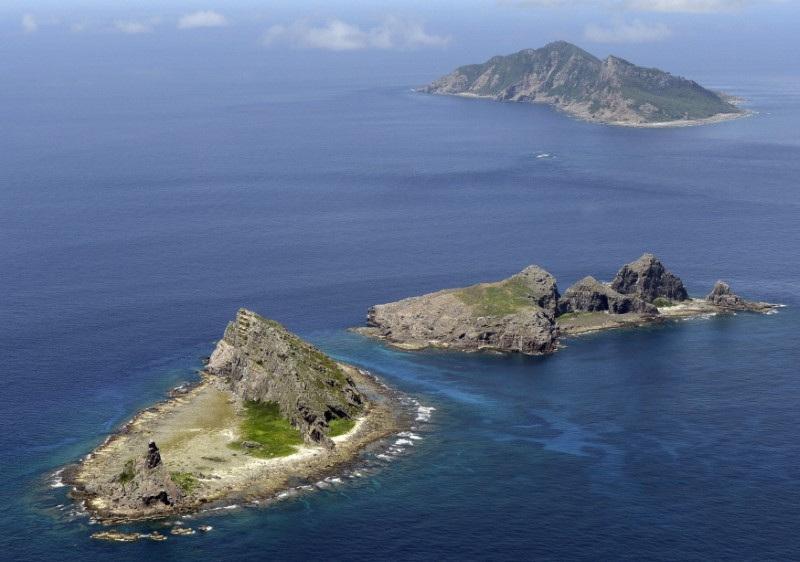
Coast guard vessels from Japan and China engaged in a confrontation on July 7 in the waters near the disputed islands known as the Senkaku Islands in Japan and the Diaoyu Dao in China. The latest incident shows rising tensions in the region between the Chinese regime and countries along the first island chain but it’s unlikely to turn into war, according to analysts who spoke with The Epoch Times.
Both China and Japan claimed to have driven away the other’s vessels for “intruding” into their territorial waters.
The Japanese coast guard stated that two Chinese vessels approached a Japanese fishing boat sailing in the area, and Japanese authorities immediately drove them away.
The Chinese coast guard stated that on July 7, the Japanese fishing vessel entered the territorial waters of Chiwei Yu, which is part of Diaoyu Dao, and that Chinese coast guard vessels warned and expelled the boat.
July 7 marks the 89th anniversary of the Marco Polo Bridge Incident during World War II, which is regarded by the Chinese side as the starting point of the full-scale war of China’s resistance against Japanese invasion.
The sovereignty dispute over the uninhabited islands in the East China Sea is long-standing. Japan, the Chinese communist regime, and Taiwan (formally the Republic of China) all claim sovereignty over the islands, known as the Senkaku-shoto in Japan, the Diaoyu Dao in China, and the Diaoyutai Lieyu in Taiwan.

The islands were under Chinese rule from ancient times until 1895, when Qing Dynasty China was defeated by Japan in the Sino-Japanese War and signed the Treaty of Shimonoseki to cede Taiwan (Formosa) to Japan “together with all the islands appertaining or belonging to the said island of Formosa.” Japan used the treaty to seize the Senkaku Islands. After Japan was defeated at the end of World War II in 1945, it relinquished Taiwan to the Republic of China, but the sovereignty over the Senkaku Islands was not clearly defined in any post-war treaty.
The United States affirmed the Japanese claim over the disputed islands in 1971 under the Okinawa Reversion Agreement, which was rejected by the Chinese regime on the mainland and the Republic of China in Taiwan.
Geographically, the Diaoyutai Islands rest on the East China Sea continental shelf and share a structural connection with Taiwan. They are separated from the Ryukyu Islands (Okinawa) by the Okinawa Trough.
“Therefore, logically, the Daoyutai Islands should belong to the Republic of China (Taiwan),” Shen Ming-shih, research fellow at Taiwan’s Institute for National Defense and Security Research, told The Epoch Times. “The Chinese regime claims sovereignty over Taiwan, asserting that Taiwan is part of China. So, it also considers Diaoyu Islands also belong to China.”
However, over time, parties involved have come to believe that the issue of sovereignty over the islands should be shelved for now and resolved in the future through international law, Shen said.
“China, meanwhile, continues to stir up controversy and dispatch coast guard vessels into the waters around the disputed islands, signaling its claim of sovereignty over the Diaoyu Islands,” he said.
First Island Chain Security
The move was condemned by countries in the Asia-Pacific, including those in the first island chain—Japan, Taiwan, and the Philippines.
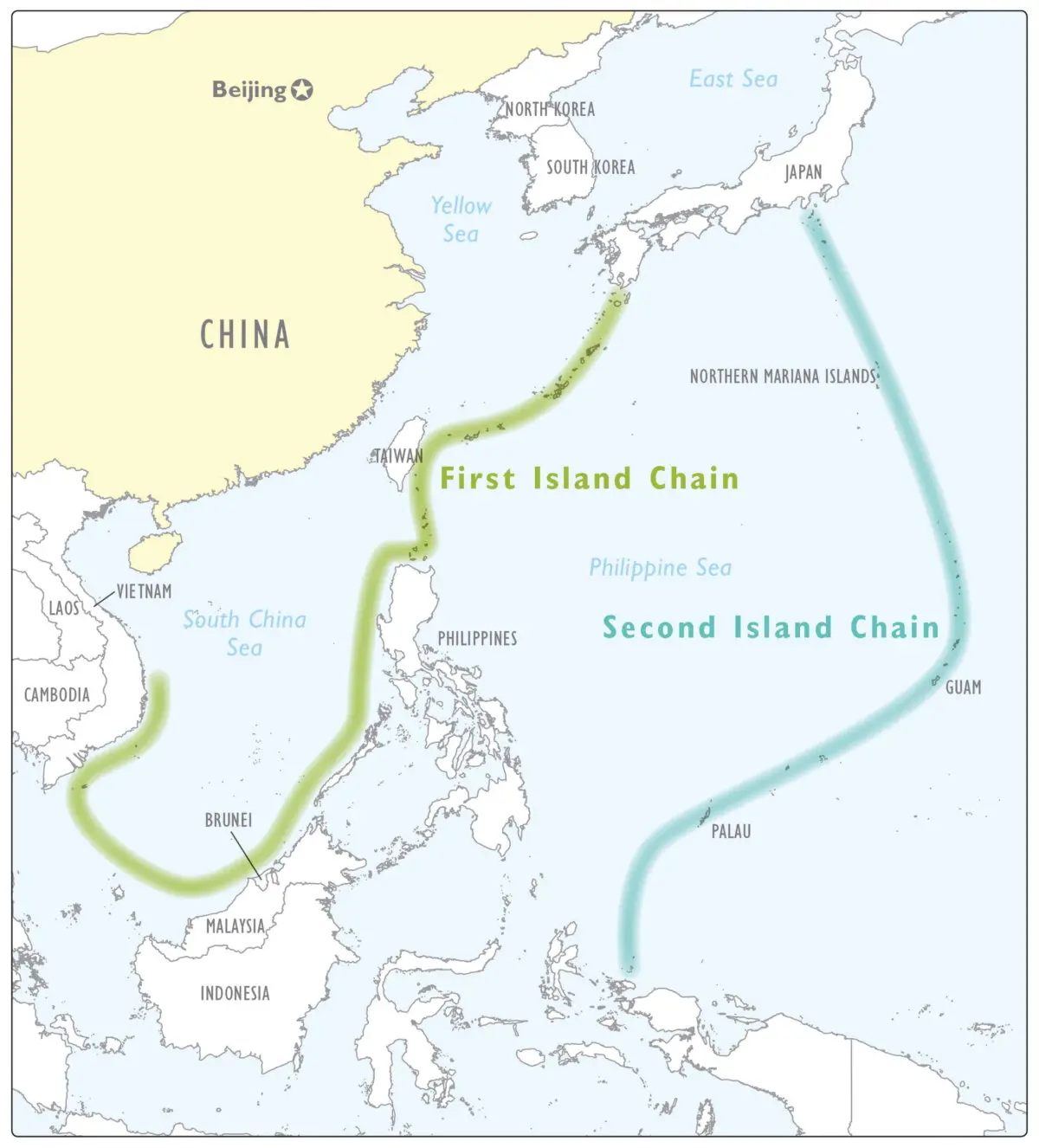
The first island chain is a strategic line in the Asia-Pacific that includes Japan, Taiwan, and the Philippines, designed by the U.S. military to contain the Chinese regime’s maritime expansion.
After Japanese Prime Minister Sanae Takaichi took office, the country strengthened its overall foreign policy and its alliance with the United States, joining forces in the first island chain to contain communist China’s expansion.
“Japan is now pushing for a more active stance in its defense policy, preparing to amend its Constitution, and adopting tougher defense measures,” Taiwanese military commentator Yuan Leyi told The Epoch Times. “All this is very difficult for China to accept. I believe China currently feels a strong sense of crisis.”
The conflict over the disputed islands encompasses historical and contemporary factors, as well as the strengthening of strategic coordination between Japan and the United States. It also involves the overall strategy regarding the first island chain. All these factors combined have created the current situation, Yuan said.
There are multiple territorial sovereignty issues within the first island chain, Shen noted, including the dispute between Japan and South Korea over Dokdo (Takeshima), issues concerning islands involving South Korea and North Korea, the Diaoyu Islands issue in the East China Sea, the Taiwan Strait issue, and disputes in the South China Sea between China, the Philippines, and other neighboring countries.
Given China’s current military expansion and disputes regarding island sovereignty and territorial waters, there is a possibility of China taking future military action, he said.
“It is important to note that the United States maintains alliance treaties with Japan, South Korea, and the Philippines. Consequently, if China were to engage in a military conflict with any of these nations over territorial or maritime issues, it would be tantamount to a conflict with the United States,” Shen said.
The territorial disputes between China and Japan are linked to the U.S. strategy of containing China via the first island chain, he said.
“However, a higher priority right now is for the nations along this chain to strengthen cooperation and jointly prevent the CCP from launching an external war under the pretext of territorial sovereignty issues,” Shen emphasized, adding that “there is no immediate urgency to resolve the sovereignty claims currently asserted by the various countries involved.”
From the perspective of U.S. defense strategy, “it is crucial to link together the nations of the first island chain to jointly defend the chain’s security through a strategy of denial, thereby deterring the CCP and preventing the outbreak of war,” he said.
The antagonism between China and the Japan–U.S. alliance in the region will continue to deepen, Yuan said.
“While this does not necessarily mean war will break out, mutual distrust will grow, and negative perceptions will continue to accumulate. In the long run, this is actually detrimental to China’s future development,” he said.