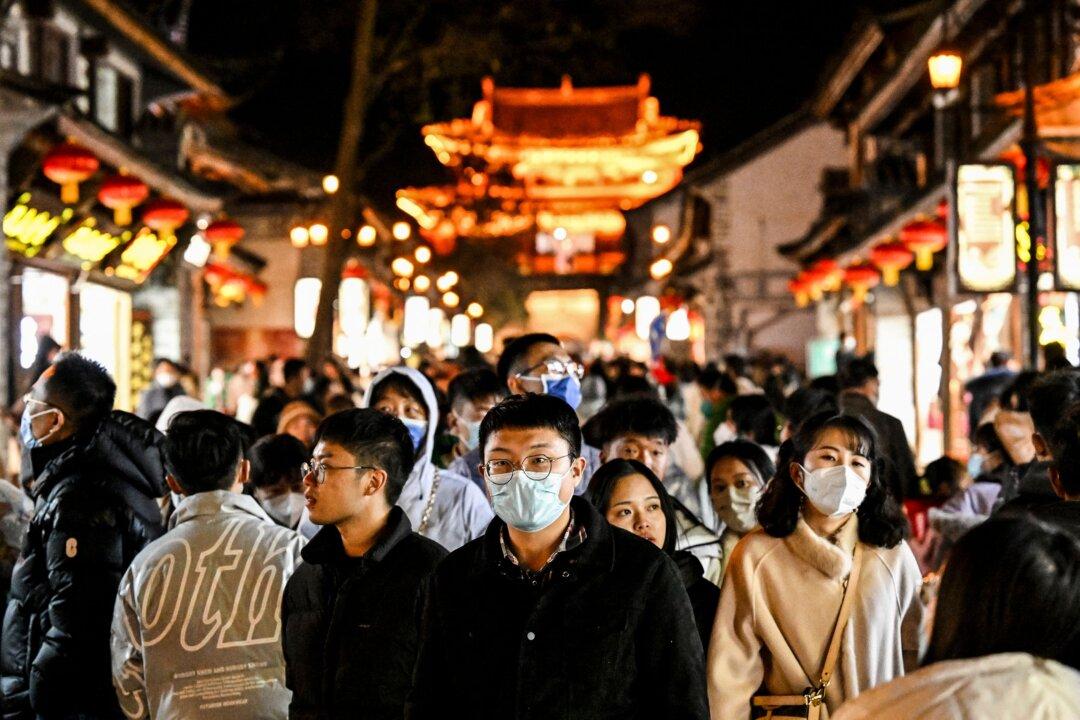
Chinese regime authorities have arrested several citizens for posting videos of overcrowded budget-class trains during Chinese New Year that reveal the hardship of everyday Chinese as the economy founders.
During the travel rush for the most important Chinese holiday—Lunar New Year, which fell on Feb. 17—videos posted on social media showing overcrowded old green trains with travelers filling the aisles and sitting on the floor attracted wide public attention and discussion about people’s struggle in the sluggish economy.
On Feb. 17, Chinese state media reported that five citizens were detained by police for posting such videos and their social media accounts have been shut down. They were accused of fabricating false information and disrupting public order for allegedly “splicing together videos from previous years’ Chinese New Year travel seasons and modifying the posting timestamps,” according to police.
Prior to the arrests, major Chinese media outlets had reported in early February the reignited popularity of the “old-fashioned” green trains, the main transportation means for residents in the 1980s and 1990s, especially during holiday travel. The old green trains take hours longer to reach their destinations and have dated facilities, but the price is a fraction of high-speed trains.
According to The Paper, during this year’s Lunar New Year travel rush, the green trains unexpectedly became the first choice for millions of Chinese to return home, with tickets selling out as soon as they went on sale.
Compared to high-speed trains, tickets for green trains cost a quarter or less, reported The Paper. For low- and middle-income groups, migrant workers, and students, it’s a real relief to their wallets. “The slow green trains may seem to be ‘going against the tide’ of railway development, but they are a necessity for many people’s travel,” the outlet stated.
Major Chinese online news portal 163.com reported that many Chinese posted on social media saying they had financial difficulties in celebrating the Chinese New Year.
The report said that more and more people chose green trains for holiday travel in recent years, while showing photos of empty high speed trains as comparison. The report cited a man who chose to take the green train to return home to Shandong Province in eastern China from Dongguan in southern China, saying that “the ticket on a high-speed train would cost 800 yuan [$115.80], but the green train only costs 200 yuan [$29]. Wouldn’t it be better to use the money saved to buy something to take home?”
Related videos, photos, and articles have sparked heated discussions online.
“High-speed train carriages that were once packed during the economic boom are now empty, and the once deserted green trains are now overcrowded. The decline of the Chinese economy is clearly visible!” one post on social media read.
“The severe economic recession has made it increasingly difficult for everyone to earn money. People would rather suffer a little longer on the way home than spend a few hundred yuan more,” another commented in a post.
Another post read: “When working people choose to take the old-fashioned green train home for the Chinese New Year, it’s not because they’ve become more rational in their spending, but rather—because they’ve become poor.”

Tightened Control
Wang Jiamin, a legal professional in Hebei Province, told The Epoch Times on Feb. 19 that in similar cases in the past, authorities would usually just delete the posted content, and that direct detention was rare.“Now, administrative detention by police is being imposed for posting videos of overloaded green trains, which is a significantly higher level of punishment and is considered one of the more severe types of public security penalties,” Wang said.
Wang pointed out that according to the police report, the persons involved allegedly spliced together old videos. “If it is just splicing old videos into new videos, it is not necessarily the same as ‘fabrication.’ From a legal perspective, spreading rumors usually refers to fabricating new facts, rather than simply changing the timestamp. There is a boundary between ‘splicing’ and ‘fabricating,’ which needs to be distinguished in law,” he said.
Liu, a media professional from Shaanxi Province who only gave his last name because of safety concerns, told The Epoch Times, “The Lunar New Year travel rush is a period of high attention every year, and the authorities are particularly nervous about online discussions during this time. As long as crowded scenes appear, they worry about the spread of public opinion, and often they arrest people first and then discuss the content.”
Liu said that amid rising unemployment pressure and escalating social discontent, the authorities’ public announcement of such detentions is an attempt to create a deterrent effect.
“Now, whenever discussions related to public order occur, the authorities become highly alert. A few days ago, when people were queuing to buy goods for Chinese New Year, the police acted as if facing a major crisis, monitoring and controlling people waiting in line outside the shop. I’ve never seen anything like it before,” he said.