In the final hour, and coming as somewhat of a surprise, representatives of the 194 member states at the Cancun climate change summit reached a deal—a nonlegally binding, yet balanced package of agreements.
The agreements include a promise to help poor countries build a sustainable future, encouraging the preservation of forests in developed nations, and staying below a two-degree temperature rise. Industrialized countries pledged $30 billion to support climate action in the developing world up to 2012 with an intention to raise it to $100 billion in the long-term by 2020.
At the same time, some of the biggest greenhouse gas emitters like Japan, Russia, and Canada opposed the continuation of the Kyoto Protocol, which legally obliges rich states to cut more emissions, and transfer knowledge and technologies to undeveloped nations. And the U.S., a top polluter, never signed on to Kyoto, arguing that it’s flawed because it doesn’t include top polluting developing nations like China in its mandatory emission targets.
COP 16 (Convention on Climate Change), the sixteenth annual summit of the member states of the United Nations Framework Convention on Climate Change (UNFCCC), was held between Nov. 29 and Dec. 10 in the Mexican resort of Cancun. COP 16 didn’t illicit big hopes after the disappointment of COP 15 in Copenhagen last December, but rather, it was anticipated inertly by cautious negotiators and frustrated civil organizations.
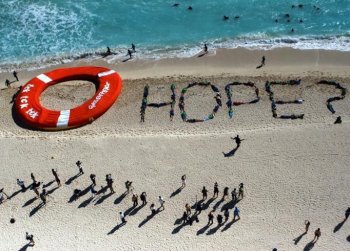
Environmental experts say that new global leadership with more conscience and greener thinking is needed to cope with climate change. They say that while it may already be too late to return Mother Nature to balance, there is still hope if the change starts now.
Georgi Stefanov, climate expert at World Wildlife Fund (WWF) in Sofia, Bulgaria, says that after Copenhagen, state parties and observers developed an “inactive inertia,” which made Cancun quite an “impersonal” event. This led to a delay in efforts to prevent the effects of climate change. COP 16, it was hoped, would turn the “inaction plan” into an “action plan” and make up for the delay.
Most optimistically, Cancun was meant to proceed to a consensus on a legally binding agreement to replace the Kyoto Protocol, which expires in the end of 2012. However, this didn’t happen.
Stefanov shares that he and his colleagues in environmental circles brainstormed about what might happen if no new legally binding agreement between UNFCCC member states was reached. He thinks it’s not necessarily a fatal outcome, given that they still have the Bali Roadmap signed in 2007.
“Even if no agreement is signed, dozens of countries have their own national programs for action, they are bound to the U.N. Framework Convention. Everything is based on one of the strongest COPs, in 2007, COP 13 in Bali, where a roadmap was developed, showing what the world must do in case of lack of global agreements.”
Stefanov explains that according to the roadmap, rich countries have to strive toward zero carbon-emission action plans, while underdeveloped countries, toward low-carbon plans.
“Bali roadmap gives a very clear direction for development: the rich have to take the leadership, guaranteed by a legally binding agreement, which we still do not have, after end of Kyoto.”
According to the World Bank’s “World Development Report 2010: Development and Climate Change,” many countries, both developed and developing, have set reduction goals nationally. The United States must scale back to 1990 levels by 2020, and scale that back to 80 percent of 1990 levels by 2050; Australia has pledged a 15 percent reduction from 2000 levels by 2020; Canada says it will drop to 20 percent of 2006 levels by 2020.
“So things are moving, it is just there is still no fixed agreement like Kyoto. But even if there is a fixed agreement, again there will be a several-months’ period of clarifications, [and] confirmations, so it may turn out we have knocked too late at the door [to ask for another chance], but this all depends on us.”
Continued on the next page...
The agreements include a promise to help poor countries build a sustainable future, encouraging the preservation of forests in developed nations, and staying below a two-degree temperature rise. Industrialized countries pledged $30 billion to support climate action in the developing world up to 2012 with an intention to raise it to $100 billion in the long-term by 2020.
At the same time, some of the biggest greenhouse gas emitters like Japan, Russia, and Canada opposed the continuation of the Kyoto Protocol, which legally obliges rich states to cut more emissions, and transfer knowledge and technologies to undeveloped nations. And the U.S., a top polluter, never signed on to Kyoto, arguing that it’s flawed because it doesn’t include top polluting developing nations like China in its mandatory emission targets.
COP 16 (Convention on Climate Change), the sixteenth annual summit of the member states of the United Nations Framework Convention on Climate Change (UNFCCC), was held between Nov. 29 and Dec. 10 in the Mexican resort of Cancun. COP 16 didn’t illicit big hopes after the disappointment of COP 15 in Copenhagen last December, but rather, it was anticipated inertly by cautious negotiators and frustrated civil organizations.
Environmental experts say that new global leadership with more conscience and greener thinking is needed to cope with climate change. They say that while it may already be too late to return Mother Nature to balance, there is still hope if the change starts now.
Georgi Stefanov, climate expert at World Wildlife Fund (WWF) in Sofia, Bulgaria, says that after Copenhagen, state parties and observers developed an “inactive inertia,” which made Cancun quite an “impersonal” event. This led to a delay in efforts to prevent the effects of climate change. COP 16, it was hoped, would turn the “inaction plan” into an “action plan” and make up for the delay.
Most optimistically, Cancun was meant to proceed to a consensus on a legally binding agreement to replace the Kyoto Protocol, which expires in the end of 2012. However, this didn’t happen.
If No New Kyoto, What’s Next?
Stefanov shares that he and his colleagues in environmental circles brainstormed about what might happen if no new legally binding agreement between UNFCCC member states was reached. He thinks it’s not necessarily a fatal outcome, given that they still have the Bali Roadmap signed in 2007.
“Even if no agreement is signed, dozens of countries have their own national programs for action, they are bound to the U.N. Framework Convention. Everything is based on one of the strongest COPs, in 2007, COP 13 in Bali, where a roadmap was developed, showing what the world must do in case of lack of global agreements.”
Stefanov explains that according to the roadmap, rich countries have to strive toward zero carbon-emission action plans, while underdeveloped countries, toward low-carbon plans.
“Bali roadmap gives a very clear direction for development: the rich have to take the leadership, guaranteed by a legally binding agreement, which we still do not have, after end of Kyoto.”
According to the World Bank’s “World Development Report 2010: Development and Climate Change,” many countries, both developed and developing, have set reduction goals nationally. The United States must scale back to 1990 levels by 2020, and scale that back to 80 percent of 1990 levels by 2050; Australia has pledged a 15 percent reduction from 2000 levels by 2020; Canada says it will drop to 20 percent of 2006 levels by 2020.
“So things are moving, it is just there is still no fixed agreement like Kyoto. But even if there is a fixed agreement, again there will be a several-months’ period of clarifications, [and] confirmations, so it may turn out we have knocked too late at the door [to ask for another chance], but this all depends on us.”
Continued on the next page...