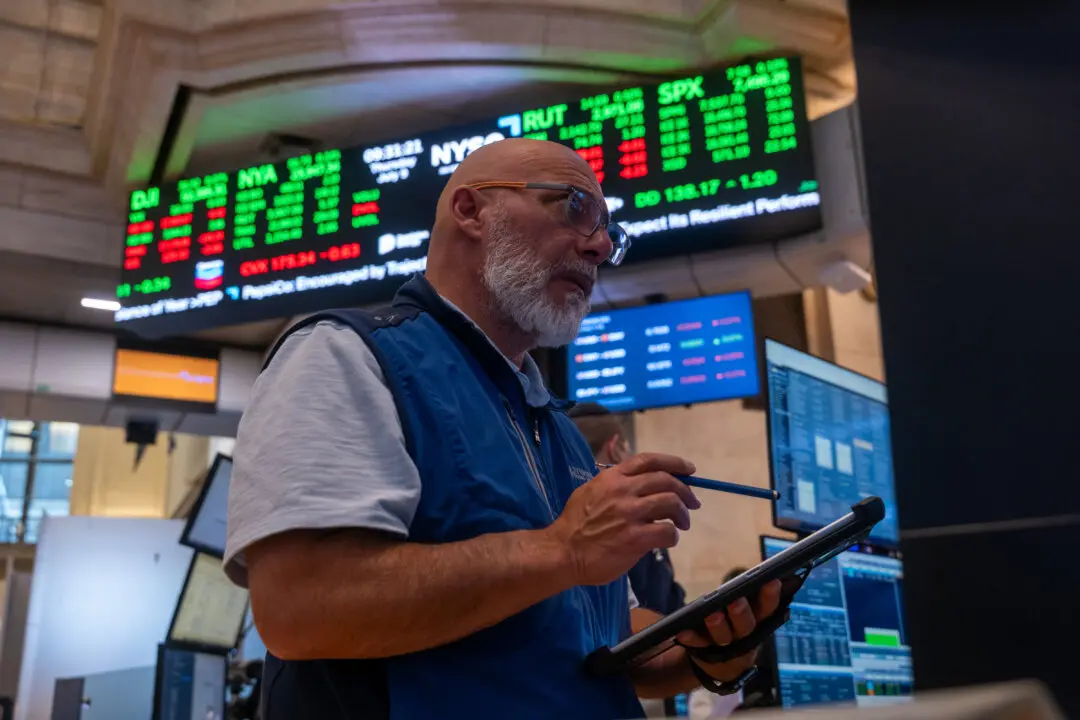
After a two-week rally that pushed the S&P 500 Index and the Nasdaq Composite Index to new highs, U.S. stocks mainly traded sideways last week.
They ended slightly lower because of profit-taking, rising Treasury bond yields, renewed trade tensions ahead of the new earnings season, and inflation reports.
The S&P 500 Index closed at 6,259 on July 11, down by 0.31 percent for the week. The Dow Jones Industrial Average declined by 1.02 percent to finish at 44,371. The Nasdaq Composite Index fell by 0.08 percent to 20,585, while the Russell 2000 lost 0.63 percent.
Wall Street began the new trading week with profit-taking, as traders and investors locked in some of the gains made in the previous two weeks.
Most of the selling was concentrated in the tech sector, which had gained the previous week, as well as in interest-sensitive sectors such as homebuilders and home furnishings companies.


Wall Street bulls returned by midweek, taking advantage of the market pullback—a pattern that has defined the current bull run. But there’s one notable difference: The pullbacks have become shorter, indicating a degree of complacency among traders and investors about the bull market’s fate.
Inflation expectations are a crucial indicator of future inflation and a significant driver of interest rates, which, along with earnings expectations, influence equity valuations based on conventional models, such as the Discounted Free Cash Flow model.
The Federal Reserve closely monitors inflation expectations to guide monetary policy in pursuit of its mandate of price stability. A lower reading on inflation expectations suggests that price pressures may ease, increasing the likelihood that the central bank will cut interest rates at its next policy meeting, scheduled for the end of July.
Bond traders and investors cheered this prospect, driving bond prices higher and yields lower, with the 10-year Treasury yield retreating to 4.30 percent.
Lower bond yields, in turn, triggered the “risk trade,” characterized by increased buying of highly speculative assets such as tech stocks, with Nvidia repeatedly hitting new highs and bitcoin reaching all-time highs.
However, major equity averages gave up most of their gains on July 11 because of renewed trade tensions and profit-taking ahead of the earnings season, which begins next week with reports from large U.S. banks and a flurry of new inflation data.
Michael Landsberg, chief investment officer at Florida-based Landsberg Bennett Private Wealth Management, sees stocks as vulnerable to negative trade headlines. However, he views the resulting volatility as an opportunity for investors who remain overly exposed to cash.
Meanwhile, Landsberg said he expects second-quarter earnings to be solid, but slightly weaker than those in the first quarter.
“Much of the second quarter was marked with tariff and trade issues, and that may have caused some dislocations in earnings for certain industries as their customers may have been in a holding pattern,” he told The Epoch Times.
“We think banks will have decent earnings, setting a healthy initial tone for the rest of earnings season, but we would expect banks with more exposure to the U.S. and trading operations to fare better.
“Market volatility was highly elevated in the second quarter, and that should help trading revenue.”
On the inflation front, he said he expects the July 15 consumer price index report to show a 2.5 percent reading for June, reflecting a slight acceleration from May, partially driven by price increases resulting from tariffs.
For the second half of this year, Landsberg expects markets to move higher because of the combination of better earnings and increased visibility into trade and regulatory policies.
“It wouldn’t surprise us to see the second half of the year clock positive market performance, just like the first half, and leading to a respectable high single-digit full-year 2025 market gain,” he said.