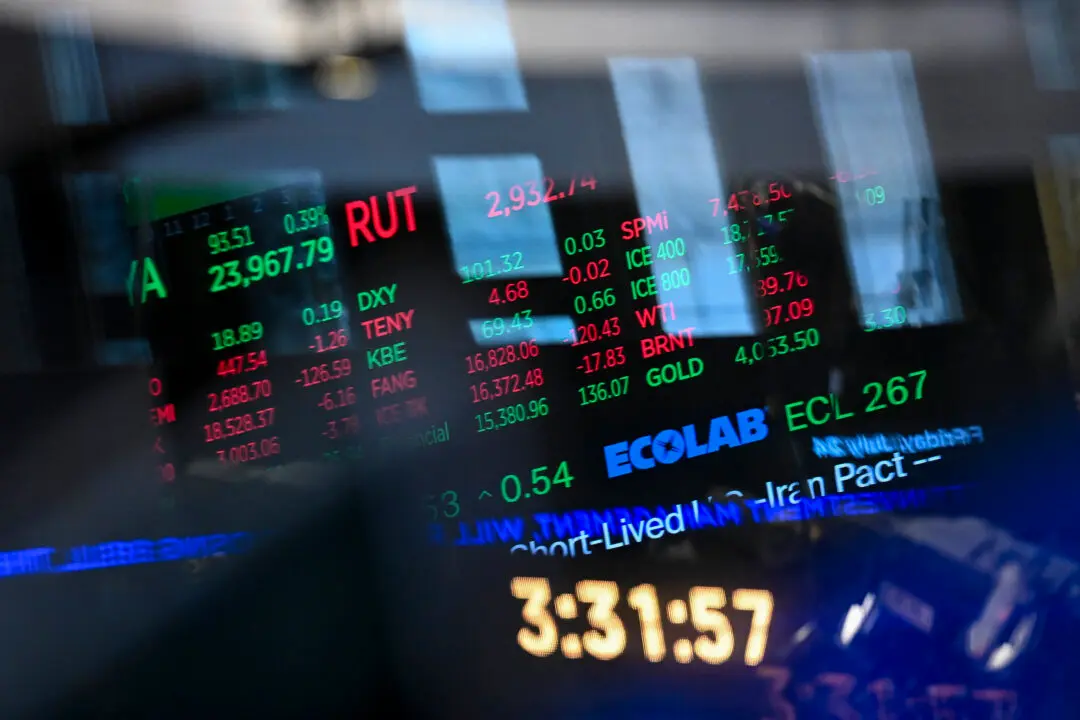
Wall Street ended the past volatile week mixed. Large caps ended with slight losses, retreating from record highs, while small caps held on to the rally of the previous two weeks amid mixed economic and corporate headlines.
Profit-taking ahead of September, which has historically been a choppy month for equities, added to market volatility.
The S&P 500 Index finished the week ending Aug. 29 at 6,460, down by 0.1 percent for the week after reaching an all-time high on Aug. 28. For the month, the index gained 1.4 percent.
The Dow Jones Industrial Average fell by 0.19 percent to end at 45,544, after hitting its first record of the year the previous week. It gained 2.04 percent for August.
The technology-heavy Nasdaq Composite Index also fell by 0.19 percent, closing at 21,455, while the Russell 2000 outperformed for a third straight week, edging up by 0.19 percent after gaining more than 6 percent over the previous two weeks. Both indices ended August higher.
Market volatility, as measured by the Chicago Board Options Exchange’s Volatility Index, rose sharply for the week, following a firm inflation reading on Aug. 29. Higher market volatility is a sign of growing anxiety among equity traders regarding the market’s direction.


After the previous week’s strong close, stocks opened lower on Aug. 25, as profit-taking accelerated and broadened in the afternoon.
Adding to the selling pressure were concerns over extended market valuations among AI-tech related shares, which were trading at a high price-to-earnings ratio, dragging all major equity averages lower for the day.
Stocks searched for direction most of the day on Aug. 26, as traders and investors were hesitant to commit new funds to the market ahead of Nvidia’s earnings, scheduled for release the afternoon of Aug. 27.
“Consumer confidence dipped slightly in August but remained at a level similar to those of the past three months,” said Stephanie Guichard, senior economist for global indicators at The Conference Board.
“The present situation and the expectation components both weakened. Notably, consumers’ appraisal of current job availability declined for the eighth consecutive month, but stronger views of current business conditions mitigated the retreat in the Present Situation Index.”
Guichard noted that pessimism about future job availability increased, and optimism about future income declined slightly.
“However, these were partly offset by stronger expectations for future business conditions,” she added.
Bret Kenwell, U.S. investment analyst at eToro, explained what weak consumer confidence means for consumer spending and investors.
“Consumers don’t appear afraid, but perhaps restrained. Corporate conference calls reveal what appears to be a resilient consumer, while retail sales echo similar reassurances,” he told The Epoch Times.
“With personal consumption accounting for more than two-thirds of U.S. GDP, investors need to see continued strength from consumers—and tariff relief would likely go a long way in easing consumers’ concerns about the future.”
Despite the weak consumer confidence reading, equity markets managed to end the trading session higher across the board, led by small caps, which continued to rally on prospects of lower interest rates.
Stocks continued to rise on Aug. 27 amid a few positive earnings headlines, with the S&P 500 hitting a record high, ahead of Nvidia’s second-quarter financial results, which were released after the market closed.
The tech giant, a bellwether for the AI sector, reported earnings and revenue that beat market estimates.
However, traders and investors were somewhat disappointed as data center revenues fell short of expectations. In addition, the earnings guidance lacks clarity regarding sales in China.
As a result, the company’s shares opened lower on Aug. 28 but rebounded with the rest of the market by early afternoon.
The second-quarter GDP reading marks a sharp rebound from the 0.5 percent contraction in the first quarter, primarily due to upward revisions to investment (5.7 percent versus 1.9 percent in the initial estimate) and consumer spending (1.6 percent versus 1.4 percent in the initial estimate).
“The second revision for Q2 GDP came in above economists’ expectations, helping to ease concerns that the US economy is teetering toward a recession,” said Kenwell, following the release of the GDP report.
“The big focus remains on personal consumption, which drives more than two-thirds of GDP. While the result may not necessarily wow investors, it shows a steady and resilient consumer—a rhetoric that’s being reflected in retail sales reports and corporate earnings calls.”
As it turned out, the GDP reading was big enough to wow investors, sending equities sharply higher across the board, with the S&P 500 reaching yet another record.
The Federal Reserve’s favored inflation gauge showed that headline inflation for July rose at an annual rate of 2.6 percent, unchanged from June and in line with market expectations.
However, core PCE, which excludes the volatile food and energy component, rose by 2.9 percent in the month, the highest in five months and in line with market expectations.
“While there might be some impact from tariffs, fears about spiraling inflation aren’t coming true yet. Strong personal income and spending also suggest consumers remain healthy, even if they’re anxious about the future,” David Russell, head of market strategy at TradeStation, told The Epoch Times.
“Today’s numbers keep us on track for a rate cut in September. Still, there’s significant uncertainty after that, given the strong consumer and core inflation well above the Fed’s target.”
Markets are sensitive to uncertainty, which could explain the broad sell-off following the release of the PCE numbers.
Adding to the selling pressure in the tech sector on Aug. 29 was a weak earnings outlook from Dell and Marvel, as well as another round of profit-taking ahead of September.