The number of individuals filing for first-time unemployment benefits declined for the second straight week and came in lower than the market estimate.
The previous week’s reading was revised slightly higher to 246,000 from 245,000.
Market estimates suggested jobless claims would come in at 245,000.
The four-week moving average, which strips out week-to-week volatility, also dipped to 245,000 from 245,750.
In recent weeks, applications for unemployment benefits have increased amid local factors.


For example, in several states, non-teaching staff can submit applications for jobless benefits at the end of the school year.
A separate program for initial claims submitted by federal workers decreased by 55 to 480, but it is up by 344 from a year ago.
Market watchers have been closely monitoring this metric, as it could indicate the extent of related actions by the Department of Government Efficiency, or DOGE.
Recurring jobless claims—a measure of unemployed individuals currently receiving jobless benefits—surged to a higher-than-expected 1.974 million, up from a downwardly adjusted 1.937 million in the previous week.
Second Half Labor Outlook
The latest employment data suggest that while companies are not laying off workers en masse, businesses are putting their hiring plans on ice and taking a wait-and-see approach to the broader economic landscape.“We’re seeing a lot of revised expectations: delayed hiring and investment, pared-back expansion plans, lowered key performance indicators,” Tom Hood, an executive vice president of business engagement and growth at the Association of International Certified Professional Accountants, said in a statement.
“The data shows a clear pivot from optimism to caution. Businesses are bracing for volatility, and the uncertainty around tariffs is amplifying that shift.”
Employee sentiment has declined in recent months, with the Glassdoor Employee Confidence Index reaching a record low in May.
The share of employees posting a positive six-month business outlook tumbled to 44.1 percent, says Daniel Zhao, the lead economist at Glassdoor.
“Consumers’ views of the job market are at a post-pandemic low,” Bill Adams, the chief economist for Comerica Bank, wrote in a note emailed to The Epoch Times.
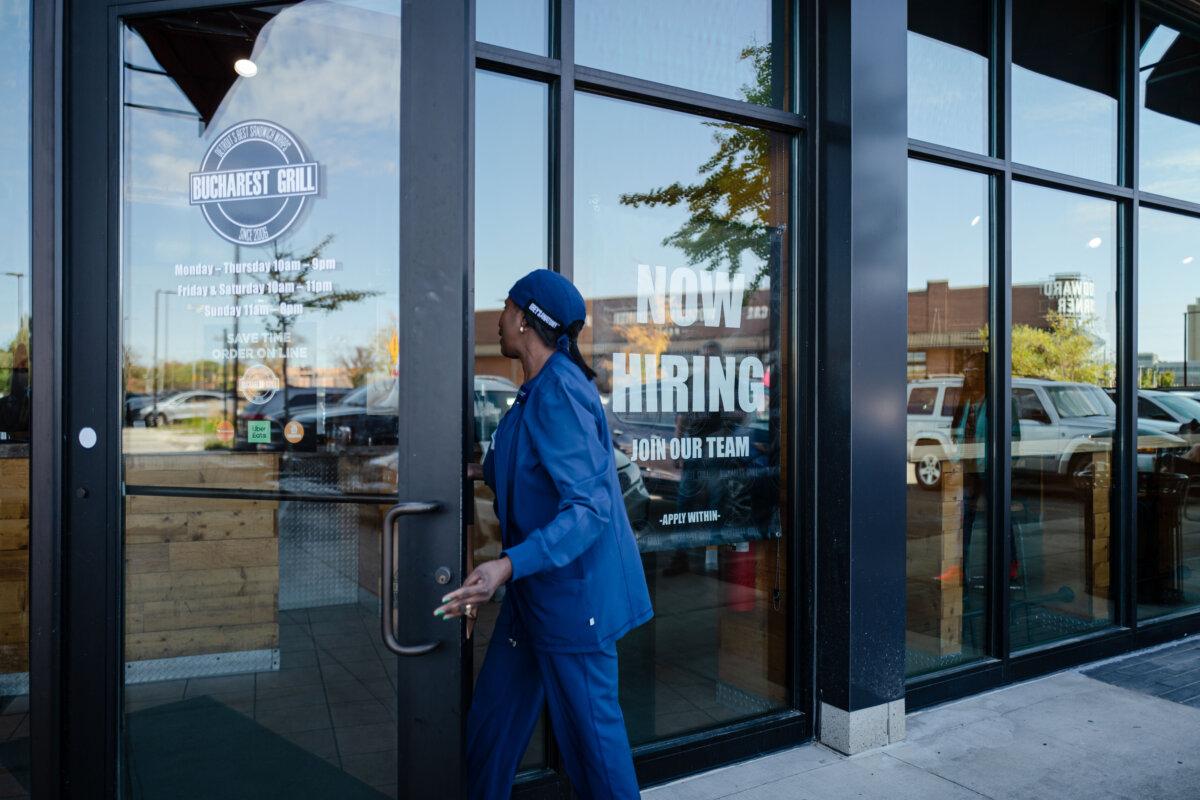
Still, Adams says, the unemployment rate is expected to remain steady in the second half of the year.
In the May jobs report, the unemployment rate remained unchanged at 4.2 percent.
For the most part, employment conditions remain solid amid uncertainty and the U.S. central bank’s tighter-for-longer monetary policy, says Arthur Laffer Jr., the president of Laffer Tengler Investments.
“On the good side, inflation readings and expectations continue to moderate,” Laffer said in a note emailed to The Epoch Times.
“The labor market continues to perform to the upside, and the economy continues to shrug off the Fed’s higher for longer program.”
The next major update for the U.S. labor market will be the June jobs report, which is scheduled to be released a day ahead of the Fourth of July holiday.
Early estimates suggest that the economy created 100,000 jobs this month, and the unemployment rate would be flat at 4.2 percent.