U.S. consumers were more cautious opening their wallets last month as retail sales recorded their smallest increase since January, new government data show.
June retail sales rose 0.2 percent, from an upwardly revised 1 percent gain in May, according to new data from the Census Bureau released on July 16.
This was in line with the consensus forecast.
Transactions were largely driven by motor vehicle and parts dealers and digital retailers, each of which climbed 1.9 percent. Electronics and appliance stores also rose almost 1 percent.
Amazon Prime Day contributed to the jump in digital sales, with industry experts estimating the four-day event would top $26 billion.
Conversely, retail sales fell at health stores (-0.8 percent) and food and beverage outlets (-0.2 percent).


On a 12-month basis, retail sales eased to 6.7 percent, from an upwardly revised 7.3 percent in May.
Consumer spending could be slowing as households wrestle with elevated gasoline prices.
Despite the sharp drop in global energy costs since early June, they have reaccelerated amid worries that the Iranian conflict is poised to intensify again as the United States reimposes a naval blockade.
Motorists are being squeezed at the pump again, with the national average for a gallon of gasoline reversing course and climbing about 10 cents over the past week to above $3.94.
Excluding automotive services and gasoline, retail sales decelerated last month, rising 0.4 percent from 0.8 percent in May.
The retail sales control group—a key measure that removes volatile categories such as car dealerships, gasoline, office supplies, and tobacco—advanced 0.5 percent, matching economists’ expectations. This was down from the 0.8 percent jump in May, also adjusted higher.
This metric contributes to the calculation of goods spending in gross domestic product (GDP).
“The report is constructive for second quarter real GDP. Not only were sales solid outside of gas stations, revisions were positive too. Sales were marked up in April and May,” Bill Adams, chief U.S. economist at Fifth Third Commercial Bank, said in an emailed note to The Epoch Times.
The second-quarter outlook, according to the Atlanta Federal Reserve’s widely watched GDPNow Model, suggests growth of 1.3 percent. \
Growth prospects are expected to be fueled by consumer spending and business investment.
Private-sector figures, meanwhile, are showing notable momentum among shoppers.
Total credit and debit card spending rose more than 6 percent year-over-year in June, the strongest growth in about four years, the Bank of America reported this month.
“With gasoline prices falling, the increase in spending growth is almost entirely a discretionary story,” the bank’s economists wrote.
Additionally, wages and spending have converged across income demographics in recent months, defying the K-shaped narrative of the last couple of years.
“In June, lower-income households’ after-tax wage growth rose above that of middle-income households,” they continued. “Whether these trends persist into the second half of the year will hinge on whether underlying labor market momentum is sustained.”
Some of the gains could be attributed to the FIFA World Cup and online promotions, with host cities witnessing sizable spending growth compared to other U.S. cities.
Back to School
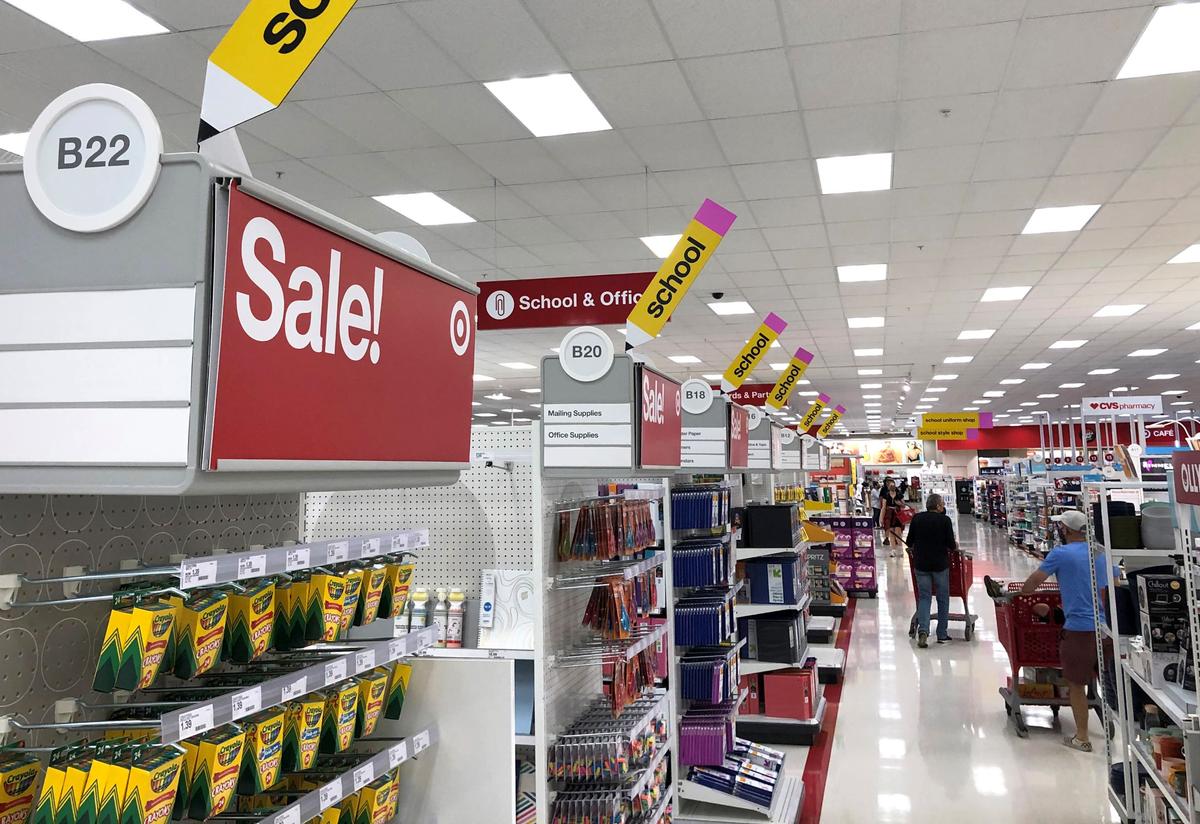
Summertime retail sales could receive a boost as more U.S. households are getting an early start on back-to-school shopping.
A new National Retail Federation survey found that 62 percent of shoppers have already started buying school items. While this is down from last year’s 67 percent, it is up from the 55 percent observed in 2024.
Affordability is top of mind for families, says Mark Mathews, chief economist at the National Retail Federation.
“Shoppers are keeping value front and center as they look for ways to make their dollars go further,” Mathews said in a July 14 news release.
“Retailers are responding with a strong assortment of products, promotional events and more convenient shopping options, helping families find what they need while saving time and money.”
The results also show that almost half (47 percent) of shoppers plan to purchase the essentials and replenish their school supplies throughout the year.
Other consumers, however, are still waiting for better deals.
Families with children in elementary through high school expect to spend about $864 on back‑to‑school items this year, a modest uptick from $858 in 2025.