This copy is for your personal, non-commercial use only. Distribution and use of this material are governed by our Subscriber Agreement and by copyright law. For non-personal use or to order multiple copies, please contact The Epoch Times Reprints.
President Donald Trump said on July 8 that he will impose tariffs of up to 200 percent on pharmaceutical products imported into the United States.
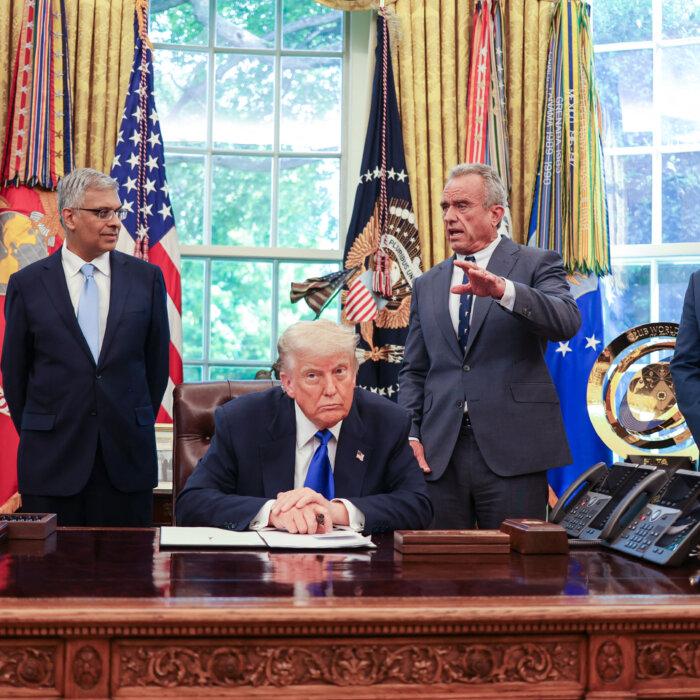
Trump told a Cabinet meeting that his administration will unveil the tariffs “very soon,” but they will not take effect immediately.
“We’re going to give people about a year, a year and a half, to come in, and after that, they’re going to be tariffed,” the president said, without specifying a date for when the tariffs may take effect.
“If they have to bring pharmaceuticals into the country, the drugs and other things into the country, they’re going to be tariffed at a very, very high rate, like 200 percent.”
Trump also announced plans to impose a 50 percent tariff on copper during the meeting, though it remains unclear when the tariffs will come into effect.
The Commerce Department launched a Section 232 investigation in April to determine the security implications of importing pharmaceutical products and their ingredients, which could lead to tariffs if those imports are deemed a national security threat.
Commerce Secretary Howard Lutnick told CNBC in a July 8 interview that the probe is still ongoing and further details on pharmaceutical tariffs will only be released by the end of the month.
“With pharmaceuticals and semiconductors, those studies are being completed at the end of the month. And so the president will then set his policies then. And I’m going to let him wait to decide how he’s going to do it,” Lutnick told the news outlet.
The probe examined the current and projected demand for pharmaceuticals and their ingredients in the country, the role of foreign supply chains in meeting that demand, and the impacts of foreign government subsidies and predatory practices on U.S. pharmaceutical industry competitiveness.
It also sought to assess the economic impact of “artificially suppressed prices” of pharmaceuticals and their ingredients resulting from “unfair trade practices and state-sponsored overproduction.”
Trump has sought to reduce U.S. dependence on foreign pharmaceutical supply chains. On May 5, Trump signed an executive order directing the Food and Drug Administration to streamline the approval process for domestic pharmaceutical manufacturing plants by eliminating unnecessary regulations and accelerating reviews to boost domestic production of prescription drugs.
The order also directs the Environmental Protection Agency to expedite the construction of facilities involved in producing prescription drugs, active pharmaceutical ingredients, and other critical raw materials.
“Critical barriers and information gaps persist in establishing a domestic, resilient, and affordable pharmaceutical supply chain for American patients,” the order stated. “Industry estimates suggest that building new manufacturing capacity for pharmaceuticals and critical inputs may take as long as 5 to 10 years, which is unacceptable from a national security standpoint.”