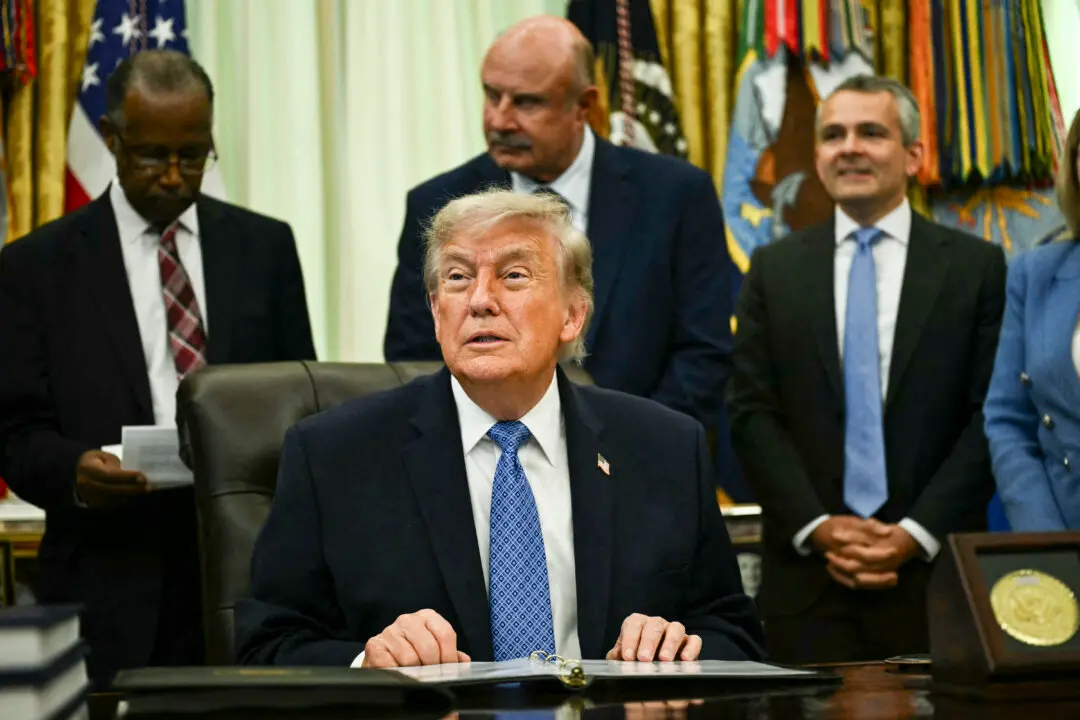
President Donald Trump suggested on Aug. 3 that his administration could distribute dividends from tariff revenues to Americans within certain income levels.
Speaking to reporters before boarding Air Force One, Trump said a distribution of dividends to selected U.S. households is possible, even as the government works to pay down the national debt.
“We have a lot of money coming in, much more money than the country has ever seen, by hundreds of billions of dollars,” he said. “There could be a distribution for dividends to the people of our country. I would say for people that would be middle-income people and lower-income people, we could do a dividend.”
“We‘ll be dropping drug prices, it will start over the next two to three months, by 1,200, 1,300, and even 1,400 percent,” he said. “We will pay as low as the lowest nation in the world.”
Treasury Secretary Scott Bessent said at last month’s Cabinet meeting that tariff collections could reach $300 billion by the end of the year as a result of Trump’s trade campaign.
Trump imposed a 10 percent baseline tariff on nearly all U.S. trading partners in April, along with reciprocal tariffs that vary depending on their trade barriers with the United States, as part of an effort to address trade deficits. He later implemented a 90-day pause on the reciprocal tariffs before extending the reprieve to Aug. 1 to allow time for negotiations.
In his order, Trump said that some trading partners have agreed to or are close to making “meaningful trade and security commitments with the United States,” while others have proposed terms that he thinks fail to adequately address trade imbalances or “align sufficiently with the United States on economic and national-security matters.”
“There are also some trading partners that have failed to engage in negotiations with the United States or to take adequate steps to align sufficiently with the United States on economic and national security matters,” the order reads.
The Trump administration is working on a trade deal with China, which is subject to an extended deadline through Aug. 12, following a May 12 agreement in which the two largest economies agreed to lower tariffs and roll back certain trade restrictions for 90 days.