The U.S. economy and the stock market have regained momentum following the uncertainty that prevailed in the aftermath of President Donald Trump’s global tariff plans.
Initial Uncertainty
In early April, shortly after Trump revealed a chart outlining reciprocal tariff rates with U.S. trading partners, financial markets plummeted as economists sounded alarm bells about slower growth, higher prices, and a rising unemployment rate.The University of Michigan’s Consumer Sentiment Index dropped to a three-year low, reflecting fears that the president’s tariff strategy would weigh on growth prospects, harm the job market, and reignite inflation pressures.
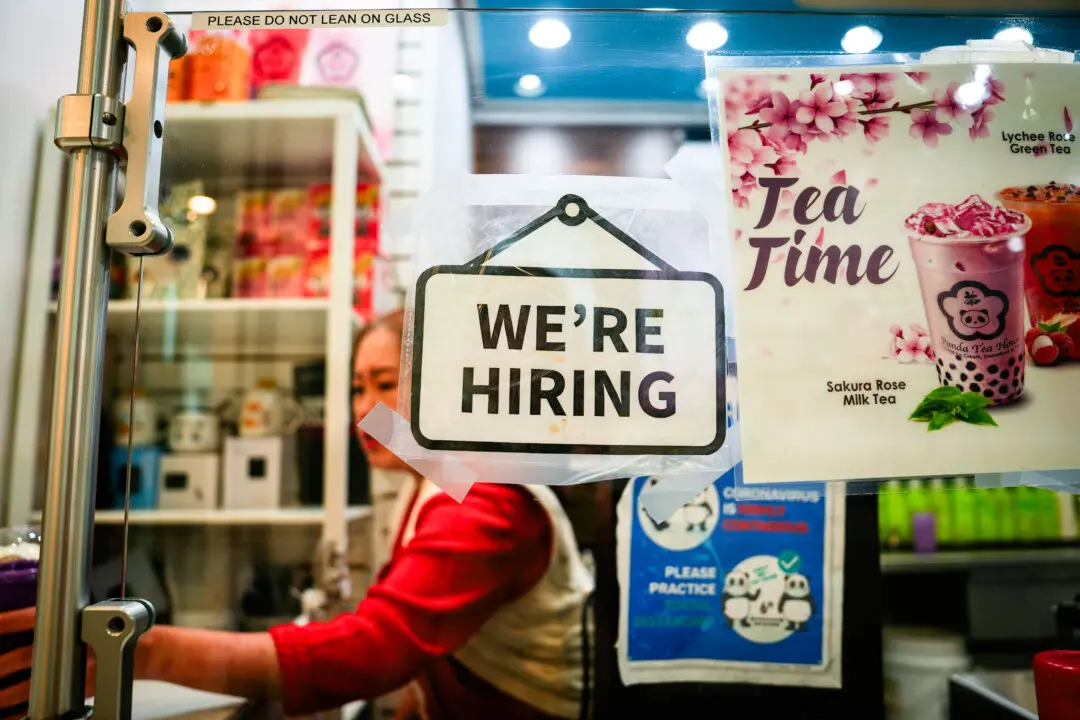
Entrepreneurs shared this consternation as the National Federation of Independent Business’s Small Business Optimism Index fell below the 51-year average in April.

Recession Fears Subside
The updated estimates have prompted many economists to revise their recession forecasts downward.Goldman Sachs now estimates the chance of a U.S. recession within the next 12 months at 35 percent, down from its previous prediction of 45 percent.
To date, tariff-driven inflation pressures have been limited.
Consumer prices rose by 0.3 percent in June, in line with market expectations. Core inflation, which strips out volatile energy and food prices, jumped at a smaller-than-expected rate of 0.2 percent.
Various pockets of tariff-sensitive indexes and items have sent mixed signals about the administration’s levies. More clarity could appear in the July figures. For now, the numbers highlight that inflation is in check.

In addition, the inflation outlook—for both consumers and market watchers—has stabilized to pre-tariff levels.
A more optimistic outlook among consumers has led them to open their wallets again.
“Consumers are flexing their spending muscle again. After May’s slump, a 0.6 [percent] jump in retail sales shows that the American shopper is alive and well,” Gina Bolvin, president of Bolvin Wealth Management Group, said in a note emailed to The Epoch Times.
“The staff’s inflation projection was lower than the one prepared for the May meeting,” the meeting summary stated.
Employment conditions have remained solid, even at the height of economic uncertainty.
U.S. stocks have responded favorably to both the economic data and the White House’s softening its trade stance and reaching new trade agreements.
Over the past three months, the blue-chip Dow Jones Industrial Average surged by more than 13 percent. The tech-heavy Nasdaq Composite Index rallied by 28 percent, while the broader S&P 500 advanced by close to 20 percent.
“We were coming from a place of abysmal terror and fear of a recession as it became clear that Trump was taking an aggressive stance on trade,” Giuseppe Sette, co-founder and president at Reflexivity, said in a note emailed to The Epoch Times. “That shifted to a more relaxed outlook once it appeared that actual deals were starting to come through.”
Since April, the United States has established deals with the UK, Vietnam, Indonesia, the Philippines, and Japan. The administration also put together a tentative agreement with China. Additionally, many of the letters that the president sent to his counterparts worldwide contain tariff rates lower than what he outlined in the spring.
While negotiating new agreements with major and minor trading partners, the United States is also collecting a record amount of tariff income.
Lagging Feeling
Federal Reserve Chair Jerome Powell, speaking to lawmakers on Capitol Hill in June, said that the effects of higher tariffs may not be apparent until the July data are released.“The effects of tariffs will depend, among other things, on their ultimate level,” Powell said in prepared testimony. “Expectations of that level, and thus of the related economic effects, reached a peak in April and have since declined. Even so, increases in tariffs this year are likely to push up prices and weigh on economic activity.”
Tariff policy operates with a lag, meaning that potential adverse effects could take months—or a year—to appear.
Before the president unveiled the contours of his tariff agenda, companies accelerated their imports to avoid additional costs from higher import duties. This allowed businesses to stock up their inventories, prepare for the future, and wait for more certainty in trade policy. At the same time, according to Hirt, the front-running effect may have prolonged possible side effects.

“It is worth noting that the front-running effect is not a free lunch—it has muted the near-term impact of increased tariffs but will modestly prolong their effects into 2026,” he said.
Tariffs continue to be on the top of consumers’ minds, according to Stephanie Guichard, senior economist of global indicators at The Conference Board.
“Consumers’ write-in responses revealed little change since May in the top issues impacting their views of the economy,” Guichard said. “Tariffs remained on top of consumers’ minds and were frequently associated with concerns about their negative impacts on the economy and prices.”
What occurs in the coming months will depend on what businesses—at home and abroad—plan to do.
For now, according to the Bank of America Institute, consumer spending patterns signal that Americans are cautiously optimistic.
Credit and debit card spending per household rose by 0.2 percent year over year in June, compared with the 0.8 percent year-over-year jump in May. Additionally, retail expenditures increased by 0.7 percent, while services spending declined by 0.1 percent.
With the back-to-school and holiday shopping seasons, the second half of 2025 will be pivotal in determining the effects—positive or negative—of Trump’s tariffs.