Two small businesses have filed a lawsuit to block new tariffs imposed by the Trump administration on dozens of trading partners.
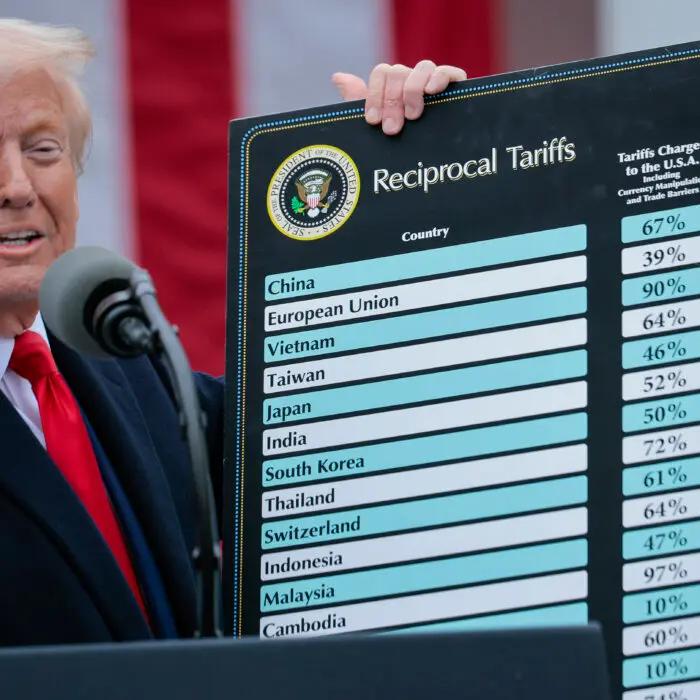
The latest tariffs, implemented by the administration under Section 301 of the Trade Act of 1974, took effect as temporary 10 percent global levies were due to expire.
The Liberty Justice Center, which previously secured a Supreme Court ruling against the president’s tariffs imposed under the International Emergency Economic Powers Act (IEEPA), filed the lawsuit on behalf of Burlap and Barrel, a New York-based spice retailer, and Collective Horology, a California-based watch retailer.
The lawsuit alleges that the U.S. Trade Representative (USTR) “acted arbitrarily and capriciously” by imposing nearly identical tariffs on 60 trading partners without offering a documented, well-reasoned explanation for its decisions.
The plaintiffs also argued that the tariffs exceeded authority granted by Congress under Section 301 because the USTR “did not validly determine that, with respect to each economy, a specific foreign act, policy, or practice is unreasonable or discriminatory and burdens or restricts U.S. commerce.”

“We know the makers we work with personally, and forced labor has no place in what they do,” Asher Rapkin, co-founder of Collective Horology, said in a statement.
“These tariffs level that accusation across entire countries, and it’s small businesses like ours writing the checks, alongside the very makers we champion, without anyone showing how taxing our imports fixes anything.”
Collective Horology sells watches made in Switzerland and the United Kingdom—both of which are affected by the tariffs—as well as other countries.
Burlap and Barrel imports single-origin spices from various countries, including Argentina, Canada, Guatemala, India, Mexico, and Vietnam, which are subject to the tariffs.
The USTR did not return a request for comment by publication time.
“The United States has had a forced labor import ban for nearly a century, and rigorously enforces it; it’s well past time for our trading partners to do the same,” U.S. Trade Representative Jamieson Greer said in the statement.
Trump last year invoked the IEEPA when imposing tariffs on trading partners, citing the need to regulate international transactions in response to “an unusual and extraordinary threat” to national security.