
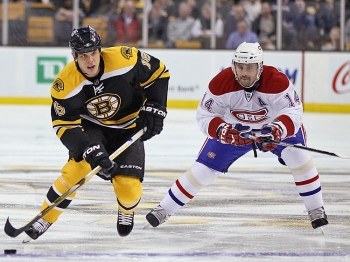
It seems the Habs and Bruins just can’t get enough of each other. Once again Montreal and Boston meet in the Stanley Cup playoffs. The NHL’s greatest hockey rivalry is set to write it’s 33rd chapter.
The Canadiens have won 24 of 32 prior playoff series against the Bruins but very recent history favors Boston. Two years ago, the first-place Bruins swept the eighth-place Canadiens. Montreal won the regular season series 4–2, however Boston won two of the last three meetings including a 7–0 drubbing on Mar. 24.
This chapter in the rivalry sets up particularly nicely given a series of highly talked-about events during the six-game regular season series between the two teams.
On Feb. 9, Boston beat Montreal 8–6 in a fight-filled game that brought back memories of the old-time hockey played in the 1970s when Don Cherry coached the Bruins and Scotty Bowman was in charge of the Canadiens.
Montreal bounced back to win the next meeting 4–1, but toward the end of the game Boston’s 6-foot-9-inch defenseman Zdeno Chara sent Montreal forward Max Pacioretty head first into the stanchion that demarcates where the glass begins on top of the boards. The devastating hit sidelined Pacioretty with a broken neck and concussion. Chara escaped any suspension.
Big, Bad Bruins?
Certainly, at first blush, it’s the big, bad Bruins against the smaller, faster Canadiens. The theme appears to be no different than what has been typical throughout the long history the two rivals share. Boston’s top six forwards average 6-feet-1-inches whereas Montreal’s are 5-feet-10.5-inches.
But if we scratch below the surface, we find that Montreal is far more undisciplined. While the two rivals put up roughly the same total penalty minutes, it was Montreal that was second worst in the league in taking minor penalties while Boston took the sixth fewest. Essentially, Boston took a lot more fighting majors and misconduct penalties, which don’t give the opposition a man advantage.
Then, the question becomes strength on special teams. Montreal has the edge here with a better penalty killing and power play unit (both ranking seventh best in the league) whereas Boston languishes in 20th and 16th place respectively.
Montreal can’t rely on its power play to win games and cannot give Boston chance after chance on its power play. If the regular season is a predictor of the post-season, the Bruins will give the Habs relatively few power play opportunities despite their tag of being the “big bad Bruins.”
What the Bruins lack in special teams is more than compensated for with their five-on-five play. The Bruins boast five players that are +25 or better while the Canadiens best in this category is Jaroslav Spacek at +9. With referees calling fewer penalties in playoff hockey, five-on-five play becomes more important than special teams.
Pacioretty Loss Hurts
In that famous 7–0 win, the talk leading up to the game revolved around retribution for Pacioretty and how the Habs would respond to Boston’s intimidation. While that game certainly is not a barometer for the Habs–Bruins matchup, it did show that Boston has some highly talented players and doesn’t need to use intimidation as a tactic. Montreal needs to prove that loss left no psychological effects.
Pacioretty had a terrific regular season against Boston. Josh Gorges was an important part of Montreal’s first two victories against Boston. Both players are not available for this series.