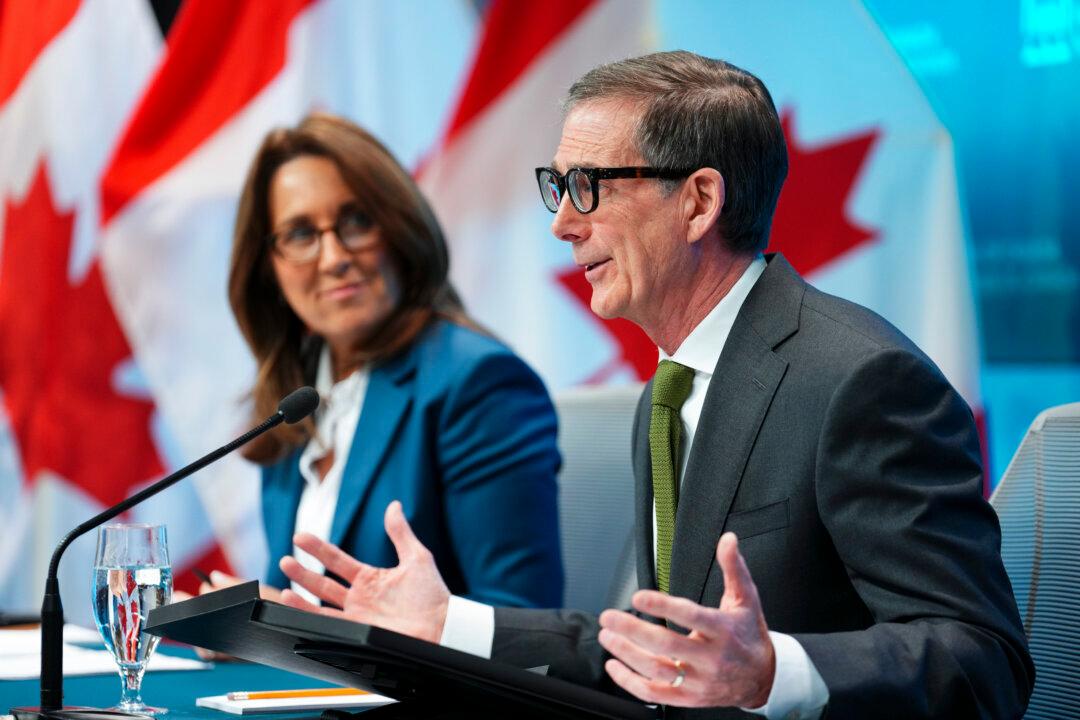
OTTAWA—As widely expected, the Bank of Canada raised its key policy rate by 0.25 percent to 0.75 percent on July 12, reflecting its greater confidence in the country’s recent strong economic performance. It’s the first time since September 2010 that Canada’s central bank has raised its overnight rate target.
The move is a culmination of comments made by the central bank’s two most senior officials since mid-June who questioned whether extremely low rates are still warranted. The BoC cut rates twice in 2015 in response to the plunge in oil prices, but the effects of that shock on the Canadian economy are largely a thing of the past.
In fact, Canada led the G7 in economic growth—averaging 3.5 percent—over the three quarters ending with the first quarter of 2017. Business investment, which nosedived during the oil price crash as the big oil companies withdrew operations and laid off workers, was up by the largest amount in almost five years in the first quarter of 2017. The Bank’s Business Outlook Survey showed hiring intentions are at an all-time high as firms expand capacity to meet higher demand.
The central bank forecasts the economy to grow 2.8 percent in 2017 before slowing to 2.0 percent in 2018, and 1.6 percent in 2019. Importantly, this near-term above-potential growth means the economy’s output gap will close around the end of 2017—earlier than the first half of 2018 projected in April’s Monetary Policy Report (MPR).
“This is good news for Canada … the growth in our confidence that the economy is on a solid trajectory,” Bank of Canada governor Stephen Poloz said at his press conference. “It [rate increase] is a symptom of an improving economy.”
Consumption, fueled by household spending, is the biggest reason for the increase in GDP, but the encouraging sign is that domestic growth is broadening and getting more support from exports and business investment. Consumer spending is supported by the strong job gains—100K in the last two months—increases in wages, and, of course, the rise in debt.
Global growth is also broadening and major central banks including the European Central Bank and U.S. Federal Reserve are likewise moving toward reducing stimulus in their respective economies. The BoC upgraded its forecast for global growth to 3.4 percent in 2017, up slightly from 3.3 precent in April’s MPR.
Economic Transformation
The Bank’s narrative surrounding the oil price shock is that the Canadian economy is undergoing a complex adjustment—that it is indeed diversified and non-energy exports are key to its transformation. By 2019, exports are projected to grow to account for half of GDP as foreign demand improves.
“As the adjustment to lower oil prices is largely complete, both the goods and services sectors are expanding,” according to the BoC’s press release. The rate hike comes even as the Bank used an oil price assumption that is 10 percent lower than the one used at the time of April’s analysis.
“We said it would take two years for the worst of the adjustment to take place,” Poloz said. Adjustments are ongoing and are most evident in the labour market, which still has pockets of unemployment. People have left high-paying jobs in the oil patch for lower-paying jobs elsewhere.