This copy is for your personal, non-commercial use only. Distribution and use of this material are governed by our Subscriber Agreement and by copyright law. For non-personal use or to order multiple copies, please contact The Epoch Times Reprints.

The Epoch Times
The Epoch Times
The Epoch Times
Sponsored Content

Where Nature Heals: South Korea’s Suncheon’s Journey From Wetlands to a Global Sanctuary

Google LogoMark Us Preferred on Google
Where Nature Heals: South Korea’s Suncheon’s Journey From Wetlands to a Global Sanctuary
Hooded cranes gather along the tidal flats of Suncheonman Bay at sunrise. Once endangered, these migratory birds have returned in greater numbers each year thanks to Suncheon’s long-term wetland restoration — a quiet symbol of the city’s trust with nature. Courtesy of Suncheon City
James Kim
10/21/2025|Updated: 11/1/2025
0:00
Sponsored Content

In the quiet dawn over Suncheonman Bay, the mist lifts slowly from the tidal reeds.

A flock of hooded cranes glides low across the water—wings stretching wide, their reflection rippling across the mirror-like mudflats. It is a sight that, not long ago, was fading from memory. Today, it has become the emblem of a city reborn through its bond with nature.

Located in South Jeolla Province, Suncheon has earned its title as Korea’s Ecological Capital by doing something few cities have dared: putting nature first.

In 2009, it made global headlines for an unprecedented act—removing electric poles from its wetlands to protect the endangered cranes that winter there. The decision, radical at the time, transformed Suncheon into a living laboratory for ecological restoration.

Over the years, Suncheonman Bay Wetland Reserve has turned into a haven for migratory birds, a breathing sanctuary where reeds whisper and tidal rhythms sustain life unseen in most cities.


Related Stories
The Epoch Times
Korean Beef Tacos
The Epoch Times
Korean Honey-Garlic Chicken 
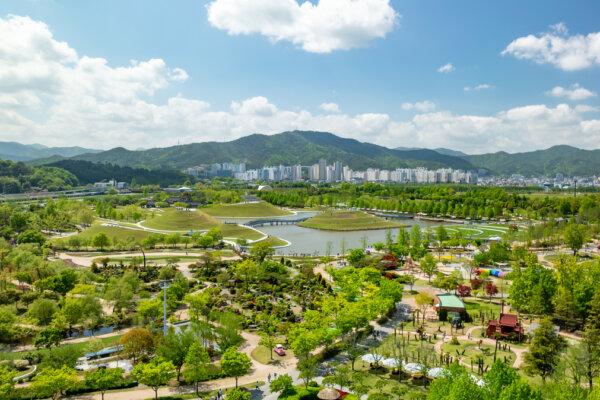
Suncheonman National Garden, Suncheon, South Korea. Established as Korea’s first national garden, the 1.12-million-square-meter green space serves as a buffer between the expanding city and the protected Suncheonman Bay wetlands, balancing ecological preservation with urban life. (Courtesy of Suncheon City)
Suncheonman National Garden, Suncheon, South Korea. Established as Korea’s first national garden, the 1.12-million-square-meter green space serves as a buffer between the expanding city and the protected Suncheonman Bay wetlands, balancing ecological preservation with urban life. Courtesy of Suncheon City

To safeguard this delicate landscape from overdevelopment, the city planted a living buffer—the Suncheonman National Garden—a vast mosaic of ponds, gardens, and walking paths connecting people gently back to the earth.

The garden’s success was immediate and profound: nearly 10 million visitors came to its international expositions in 2013 and 2023, witnessing firsthand how nature and economy can thrive together.

But Suncheon’s story doesn’t end with preservation.

In 2025, the city took a bold step onto the global stage, becoming the first local government in Korea to join the International Union for Conservation of Nature. At the World Conservation Congress in Abu Dhabi, Mayor Roh Kwan-kyu spoke of coexistence not as an ideal, but as a practiced reality—a city where humans and cranes share the same rhythm of life.
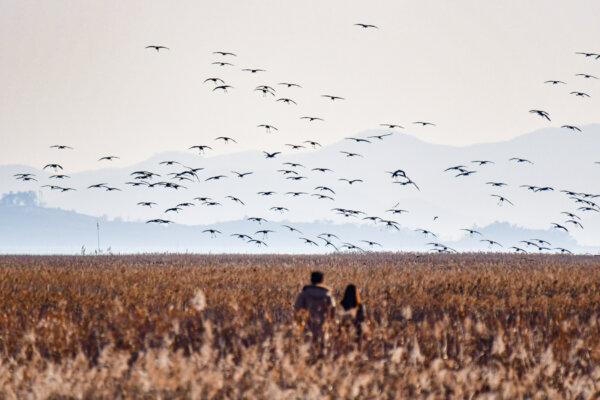
Flocks of hooded cranes descend over the golden reeds of Suncheonman Bay. Each autumn, the wetlands turn into a sanctuary for migratory birds—and for visitors seeking to witness one of Asia’s most poetic encounters between nature and life. (Courtesy of Suncheon City)
Flocks of hooded cranes descend over the golden reeds of Suncheonman Bay. Each autumn, the wetlands turn into a sanctuary for migratory birds—and for visitors seeking to witness one of Asia’s most poetic encounters between nature and life. Courtesy of Suncheon City

“We have learned to live not just alongside nature, but in trust with it,” said Roh. “Suncheon’s experience will become a bridge between ecology and healing for the world.”

The city’s new vision is to turn its rich natural and cultural heritage—from wetlands and forests to ancient temples like Songgwangsa and Seonamsa—into a foundation for healing tourism. Visitors will be invited to meditate by the tidal flats, walk barefoot through the reeds, and rediscover balance through sound, food, and stillness.

In a world where wellness has become a trillion-dollar pursuit, Suncheon offers something money can’t buy—the quiet restoration that only nature provides.

As cranes descend over the sunset-lit bay, Suncheon stands as a living testament to a future where cities heal, not harm—where the path to well-being begins not in walls or clinics, but in the wind, the soil, and the shared breath of all living things.

This article was written with the sponsorship of Suncheon City.
https://scbay.suncheon.go.kr/intro_2024.jsp

Google LogoMark Us Preferred on Google
James Kim
James Kim
Author
Author’s Selected Articles
Jeju Winter Radish: A Crop Defined by What Winter Refuses to Let Grow
Jun 16, 2026
Jeju Winter Radish: A Crop Defined by What Winter Refuses to Let Grow
The Equipment That Succeeds by Staying Invisible
Jan 20, 2026
The Equipment That Succeeds by Staying Invisible
Where Taste Begins: The Season of Korean Mandarins
Dec 26, 2025
Where Taste Begins: The Season of Korean Mandarins
South Korea’s Chungbuk Free Economic Zone: Asia’s Fastest-Growing Biotech Powerhouse
Oct 02, 2025
South Korea’s Chungbuk Free Economic Zone: Asia’s Fastest-Growing Biotech Powerhouse
Add to My List
Save
The Epoch Times
Copyright © 2000 - 2026 The Epoch Times Association Inc. All Rights Reserved.