



Jeju winter radish is not defined by cultivation technique, but by the limits of winter itself. Grown in Jeju’s open fields during South Korea’s cold-season agricultural cycle, it develops under conditions that resist control, acceleration, or containment.
Unlike greenhouse crops, it cannot be insulated from wind, rainfall, or temperature fluctuation. It grows in exposure rather than protection, and that exposure becomes part of its structure.
Outside Korea, it is still largely reduced to kimchi production. Within Korea, however, it is increasingly understood less as a vegetable and more as a seasonal material shaped by constraint.
What defines it is not rarity. It is a duration.
Soil That Drains Too Fast to Let Growth Be Easy
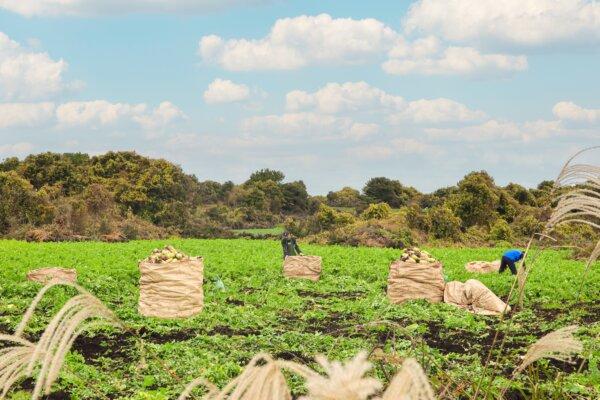
Jeju’s volcanic soil does not hold water long enough for rapid expansion. It drains quickly, forcing the radish to develop slowly and continuously rather than in bursts.
Combined with mild winter temperatures and constant wind exposure, the result is not controlled growth but enforced moderation. The plant cannot accelerate even when conditions briefly allow it.
Agricultural guidance in Jeju describes this indirectly: Stability in winter is not assumed. It is survived.
The radish that emerges is denser not because it is designed to be, but because nothing in its environment allows looseness to persist.
In practice, even within a single field, individual radishes can differ noticeably in density depending on subtle variations in wind exposure and soil depth.
That density eventually becomes flavor.
Raw, Jeju winter radish tastes sharp, clean, and almost mineral-like. Cooked slowly, it softens into a mellow sweetness that feels deeper rather than louder. Few vegetables change character so dramatically without losing their identity in the process.
What Heat Reveals Is Not Softness, but Resistance
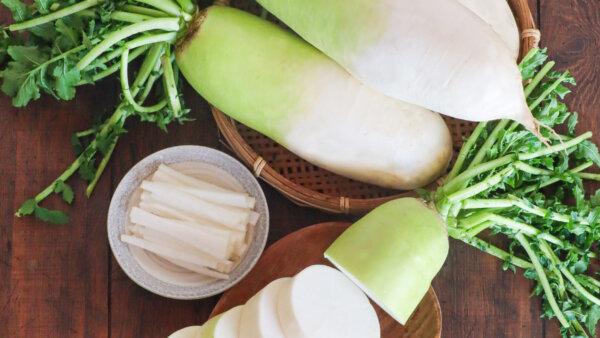
In cooking, Jeju winter radish behaves in ways that quietly contradict expectation.
It appears in soups, stews, braises, and fermented preparations where heat is prolonged rather than brief. Under those conditions, it does not disintegrate quickly. Instead, it softens while maintaining its structure, absorbing liquid without collapsing.
This creates a contradiction inside the dish itself: The radish becomes part of the broth without disappearing into it.
In practical terms, it behaves less like an ingredient added to a system and more like a component that reorganizes how that system holds together.
That is partly why Korean cuisine uses radish so broadly. Cubes of radish absorb broth in soups. Thin slices cool rich braised dishes. Fermented radish adds brightness and texture beside grilled meats and noodles.
It rarely becomes the loudest ingredient on the table.
Yet without it, many meals feel incomplete.
The Ingredient Is Not Transformed—It Is Pressured
In contemporary culinary documentation, Jeju winter radish is increasingly treated as something that must be tested rather than simply described.
In structured preparations, it is not confined to a single role. It may appear roasted, simmered, and reduced within the same dish, shifting states without losing identity.
This creates a subtle reversal in culinary logic: The dish is no longer the endpoint of the ingredient. The ingredient becomes a record of what the dish did to it.
Its sweetness intensifies under roasting. Long simmering draws out softness without structural collapse. Fermentation sharpens its acidity while preserving crunch.
The ingredient does not resist transformation.
It records pressure.
In Professional Kitchens, Stability Becomes the Metric
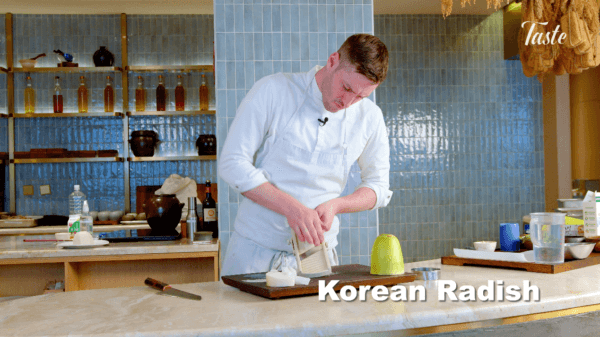
At Seoul-based restaurant Evett, chef Joseph Lidgerwood works with Korean ingredients, including Jeju winter radish, through a lens of structural behavior rather than decoration.
Evett, recognized with two Michelin stars, is noted in the Michelin Guide for its restraint-driven approach to composition.
In practice, radish is not treated as a supporting vegetable. It is evaluated through heat exposure, moisture loss, and textural persistence.
Roasting concentrates its sweetness. Slow simmering tests its endurance. Broth extraction reveals how much structure remains after flavor disperses.
What matters is not how it is presented, but how much of it survives each transformation.
One widely discussed preparation involves thick-cut radish cooked slowly and finished almost like a centerpiece protein rather than a side ingredient. The technique looks simple on the surface. The structural control behind it is not.
The dish helped shift perception of winter radish from background ingredient to compositional foundation.
Why Nutrition Science Keeps Returning to Radish
Modern nutrition research ended up validating something Korean households understood long before wellness branding existed: Radish is a simple food that makes heavy meals feel lighter.
Jeju winter radish is naturally high in water content, rich in fiber, relatively low in calories, and a notable source of vitamin C.
In Korean home cooking, it is frequently paired with rich or fatty foods for that exact reason.
A bowl of clear radish soup can feel restorative after greasy dishes. Cubed radish kimchi cuts through heaviness with acidity and crunch. Slowly braised radish remains comforting without becoming overwhelming.
It is comfort food without density.
That balance gives winter radish unusual staying power in modern diets increasingly organized around wellness, digestion, and ingredient simplicity.
The Dishes That Continue Carrying It
The most important winter radish dishes in Korea are rarely the most visually dramatic.
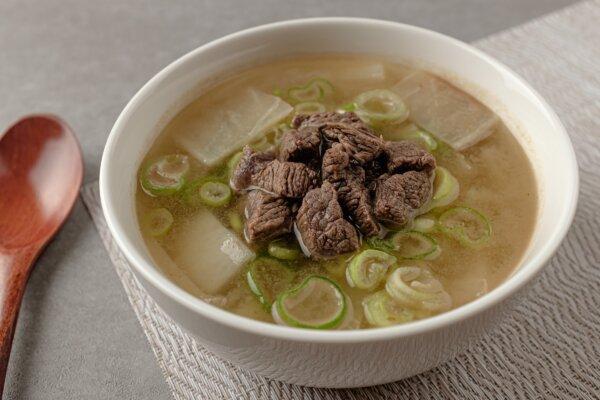
Muguk, or Korean radish soup, remains one of the clearest examples of the ingredient’s role in Korean cooking. Thin slices are simmered slowly in broth until they become translucent while still retaining shape.
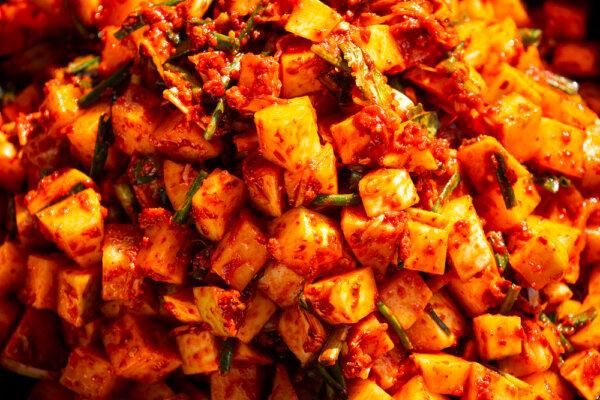
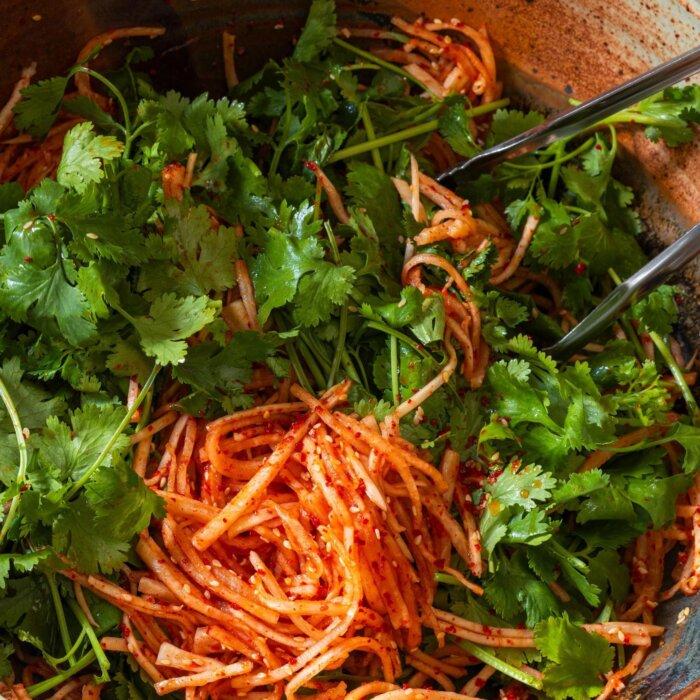
Kkakdugi transforms the same ingredient entirely differently. Fermentation sharpens the radish while preserving crunch, creating something cold, spicy, and intensely refreshing beside heavier foods.
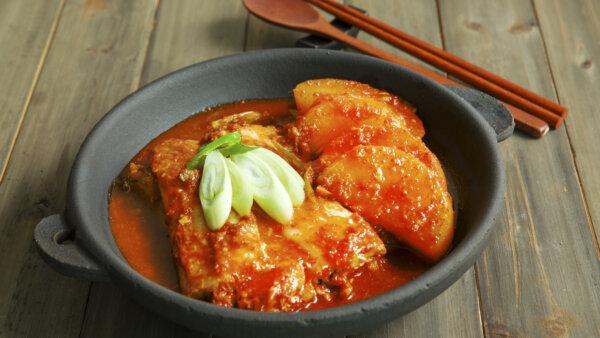
Braised radish with soy and Korean chili pepper sauce pushes the ingredient toward softness. Large pieces absorb broth gradually until the center becomes almost delicate while the exterior still holds together.
The recurring pattern across all three dishes is structural persistence.
The radish changes.
It simply refuses to disappear.
A Market That Expands Without Changing Its Center
In the United States, Jeju winter radish remains primarily distributed through Korean grocery networks and is still largely associated with kimchi production.
Its culinary use outside Korean contexts remains limited, but visibility is expanding in kitchens that prioritize ingredient structure over categorization.
This does not change its commercial center. It shifts its observational radius.
The radish is still sold for the same purpose—but is now being noticed for others.
At the same time, reducing it to a “Korean superfood” risks flattening the ingredient into marketing language detached from its history.
What made winter radish meaningful was never exclusivity.
It was endurance.
A Winter Crop That Does Not Negotiate With Seasons
Jeju winter radish does not extend beyond its season. It does not store easily outside the conditions that produce it, and it does not preserve the same structure once removed from winter’s pressure.
Its sweetness, firmness, and stability are not independent traits. They are consequences of constraint.
Once winter ends, what defined it stops forming.
What remains is not a product that adapts to the world—but one that records the conditions it passed through before disappearing from them.
And perhaps that is why even the simplest bowl of radish soup can feel larger than the ingredient itself.
Not because it is luxurious.
Because it endured.
This article was produced by Korean Radish Export Corporation.


