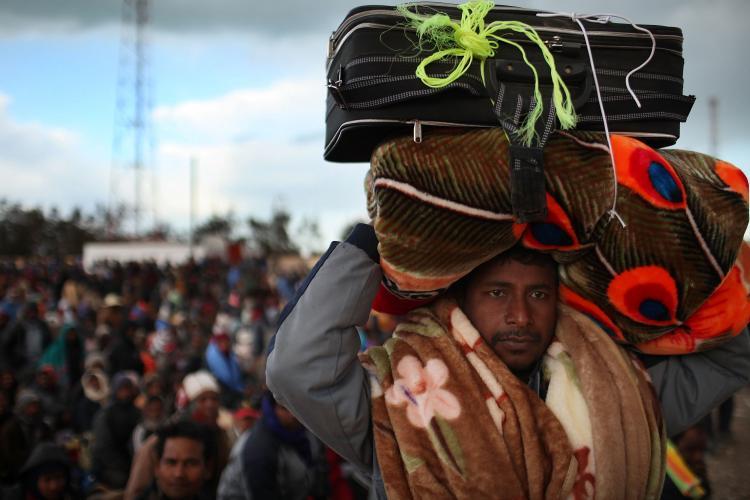
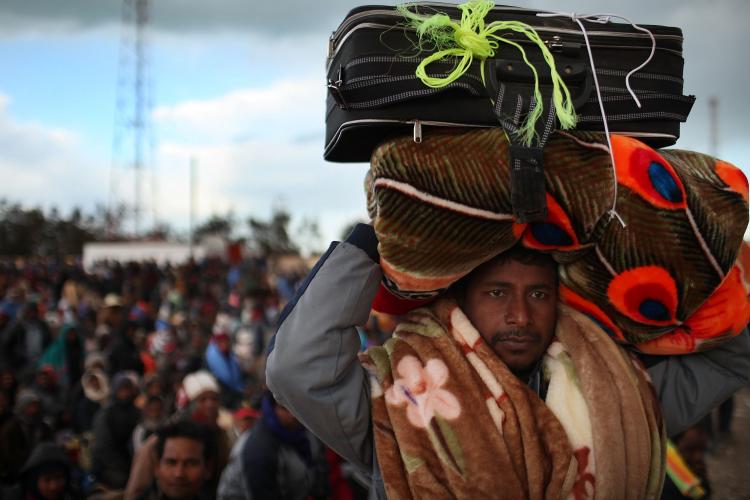
As fighting rages in Libya, the nation’s borders are bleeding refugees hoping to escape to neighboring Tunisia or Egypt—countries that are themselves still in the chaotic, post-revolt, transitional phase. Tunisia and Egypt, in cooperation with aid organizations, have established the joint Humanitarian Evacuation Program to enhance efforts focused on relieving the crisis at the Libyan-Tunisian border, specifically.
An estimated 40,000 people have collected at the Libyan side of the Tunisian border; 14,000–15,000 people per day are making it across putting incredible stress on Tunisia’s infrastructure. Since Feb. 14, about 140,000 people have crossed into Tunisia and Egypt
“Tunisian civilians, the Tunisian Red Crescent, and the Tunisian military have been offering what our staff have described as ‘unprecedented support,’ but are seriously overstretched,” a representative of the United Nations High Commissioner for Refugees (UNHCR) said by e-mail. “The overcrowding at the border worsens by the hour.”
Anna Nelson from the International Committee of the Red Cross (ICRC) is worried that the record number of refugees entering Tunisia will put too much pressure on the country. Nelson says coordinating the distribution of aid is even more crucial than the amount of aid itself.
Items like tents, blankets, and kitchen utensils are arriving at the border to offer some relief to the refugees waiting in the cold to escape. Last weekend, a plane with provisions for 10,000 people arrived in Tunisia with more to follow. Some items are being bought locally in Tunisia as well.
In an appeal to governments, the UNHCR and International Organization for Migration (IOM) are urgently asking for planes, boats, expert personnel, and money. Transportation is needed to help relieve pressure at the border, specifically. The refugee organizations want to mobilize “a massive humanitarian evacuation of tens of thousands of Egyptians and other third country nationals who have fled into Tunisia from Libya.”
About 66,000 people who have crossed into Egypt from Libya have already been transported onward from the border area.
On Sunday, UNHCR chief António Guterres said he “welcomed the efforts under way by countries of origin to facilitate the repatriation of these stranded migrants.”
Libya had about 1.5 million non-Libyans employed there, according to the IOM, many of which are now trying to flee the country. As of Sunday, out of the tens of thousands of people leaving Libya, only 4,600 were Libyan.
The situation in western Libya is still highly insecure. On Tuesday, rebel groups were bracing for renewed attacks from Libyan leader Moammar Gadhafi’s forces.
The Red Cross has a team in Tunisia ready to enter Libya, but is waiting for a guarantee that medical aid will be respected. Nelson said she is very concerned about reports of people being attacked in hospitals.
Some Libyans have been able to reach the UNHCR office in Tripoli. They report feeling “trapped, threatened and hunted,” says Nelson.
“We have heard several accounts from refugees who tell us their compatriots have been targeted and killed. Others tell us about forced evictions and attacks on their home,” she said.
An estimated 40,000 people have collected at the Libyan side of the Tunisian border; 14,000–15,000 people per day are making it across putting incredible stress on Tunisia’s infrastructure. Since Feb. 14, about 140,000 people have crossed into Tunisia and Egypt
“Tunisian civilians, the Tunisian Red Crescent, and the Tunisian military have been offering what our staff have described as ‘unprecedented support,’ but are seriously overstretched,” a representative of the United Nations High Commissioner for Refugees (UNHCR) said by e-mail. “The overcrowding at the border worsens by the hour.”
Anna Nelson from the International Committee of the Red Cross (ICRC) is worried that the record number of refugees entering Tunisia will put too much pressure on the country. Nelson says coordinating the distribution of aid is even more crucial than the amount of aid itself.
Items like tents, blankets, and kitchen utensils are arriving at the border to offer some relief to the refugees waiting in the cold to escape. Last weekend, a plane with provisions for 10,000 people arrived in Tunisia with more to follow. Some items are being bought locally in Tunisia as well.
In an appeal to governments, the UNHCR and International Organization for Migration (IOM) are urgently asking for planes, boats, expert personnel, and money. Transportation is needed to help relieve pressure at the border, specifically. The refugee organizations want to mobilize “a massive humanitarian evacuation of tens of thousands of Egyptians and other third country nationals who have fled into Tunisia from Libya.”
About 66,000 people who have crossed into Egypt from Libya have already been transported onward from the border area.
On Sunday, UNHCR chief António Guterres said he “welcomed the efforts under way by countries of origin to facilitate the repatriation of these stranded migrants.”
Libya had about 1.5 million non-Libyans employed there, according to the IOM, many of which are now trying to flee the country. As of Sunday, out of the tens of thousands of people leaving Libya, only 4,600 were Libyan.
The situation in western Libya is still highly insecure. On Tuesday, rebel groups were bracing for renewed attacks from Libyan leader Moammar Gadhafi’s forces.
The Red Cross has a team in Tunisia ready to enter Libya, but is waiting for a guarantee that medical aid will be respected. Nelson said she is very concerned about reports of people being attacked in hospitals.
Some Libyans have been able to reach the UNHCR office in Tripoli. They report feeling “trapped, threatened and hunted,” says Nelson.
“We have heard several accounts from refugees who tell us their compatriots have been targeted and killed. Others tell us about forced evictions and attacks on their home,” she said.