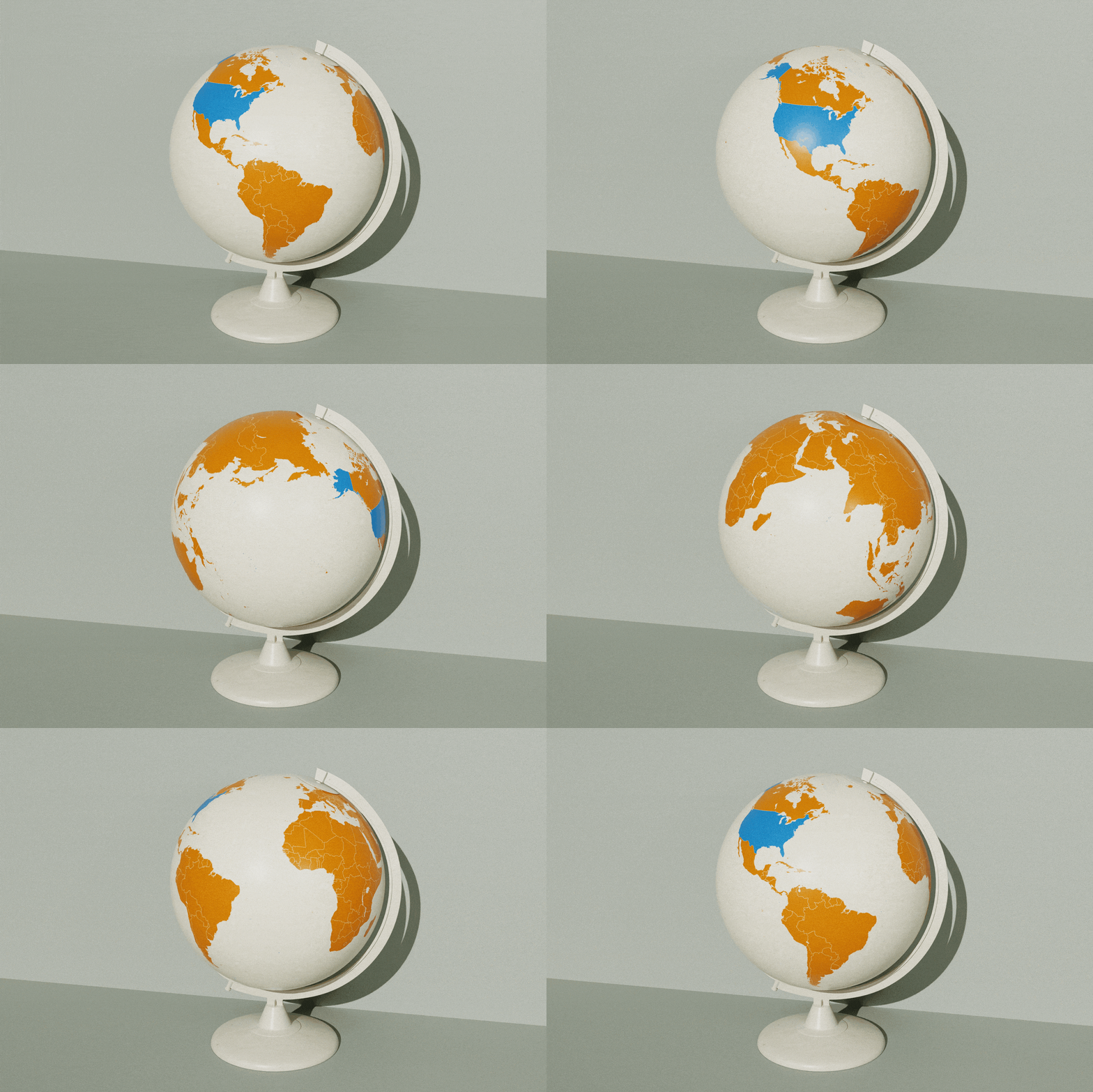
WASHINGTON—In his second term, President Donald Trump has reshaped U.S. foreign policy, using tariffs not just as economic leverage but as a central tool of diplomacy.
His administration has leveraged economic pressure to address global conflicts and secure concessions from other nations, marking one of the most significant shifts in U.S. foreign policy in decades.
Just months after taking office, Trump made his ambitions clear, stating that his second term would be very different from his first.
“The first time, I had two things to do—run the country and survive; I had all these crooked guys. And the second time, I run the country and the world,” he told The Atlantic in an April interview.
Trump has touted how his tariff strategy—resulting in trade concessions from allies such as the European Union and South Korea, along with breakthroughs in conflicts—is evidence that the new foreign policy approach is delivering results.
His trade threats have already helped end several conflicts, including the recent border skirmish between Thailand and Cambodia and the crisis between India and Pakistan.
On June 27, Trump hosted the foreign ministers of Congo and Rwanda at the White House as they signed a peace deal to end their 30-year war.
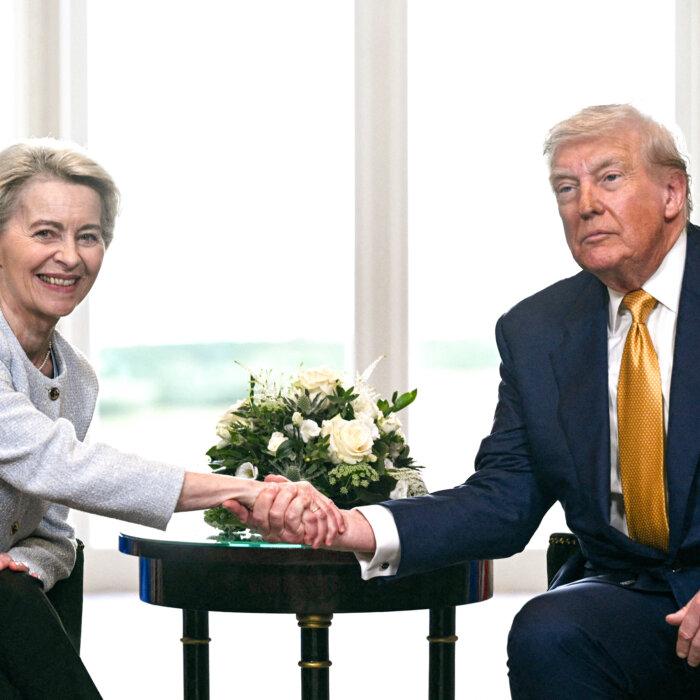
Michael Walsh, senior fellow in the Africa program at the Foreign Policy Research Institute, said the White House has demonstrated that it can promote regional stability through economic incentives.
“They believe very strongly that if you can show countries that they have an economic incentive to not fight with one another and to work with one another and work with the United States, that you can resolve a lot of conflicts in the world,” Walsh told The Epoch Times.
Walsh said Trump’s approach in Africa—prioritizing trade over aid—has been more effective than the strategy pursued by former administrations.
Although no breakthrough has been achieved so far, Walsh said, Sudan and other parts of Africa remain a priority for U.S. peace efforts.

Tariffs May Weaken Russia, BRICS
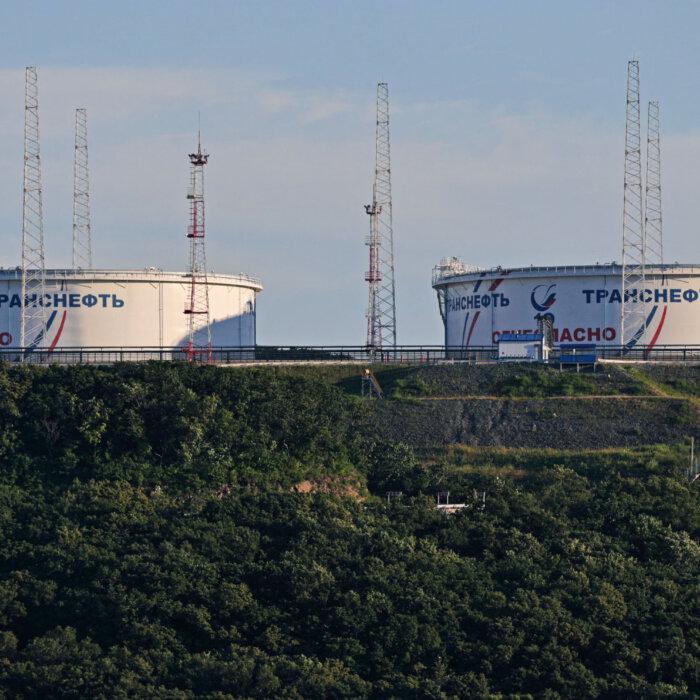
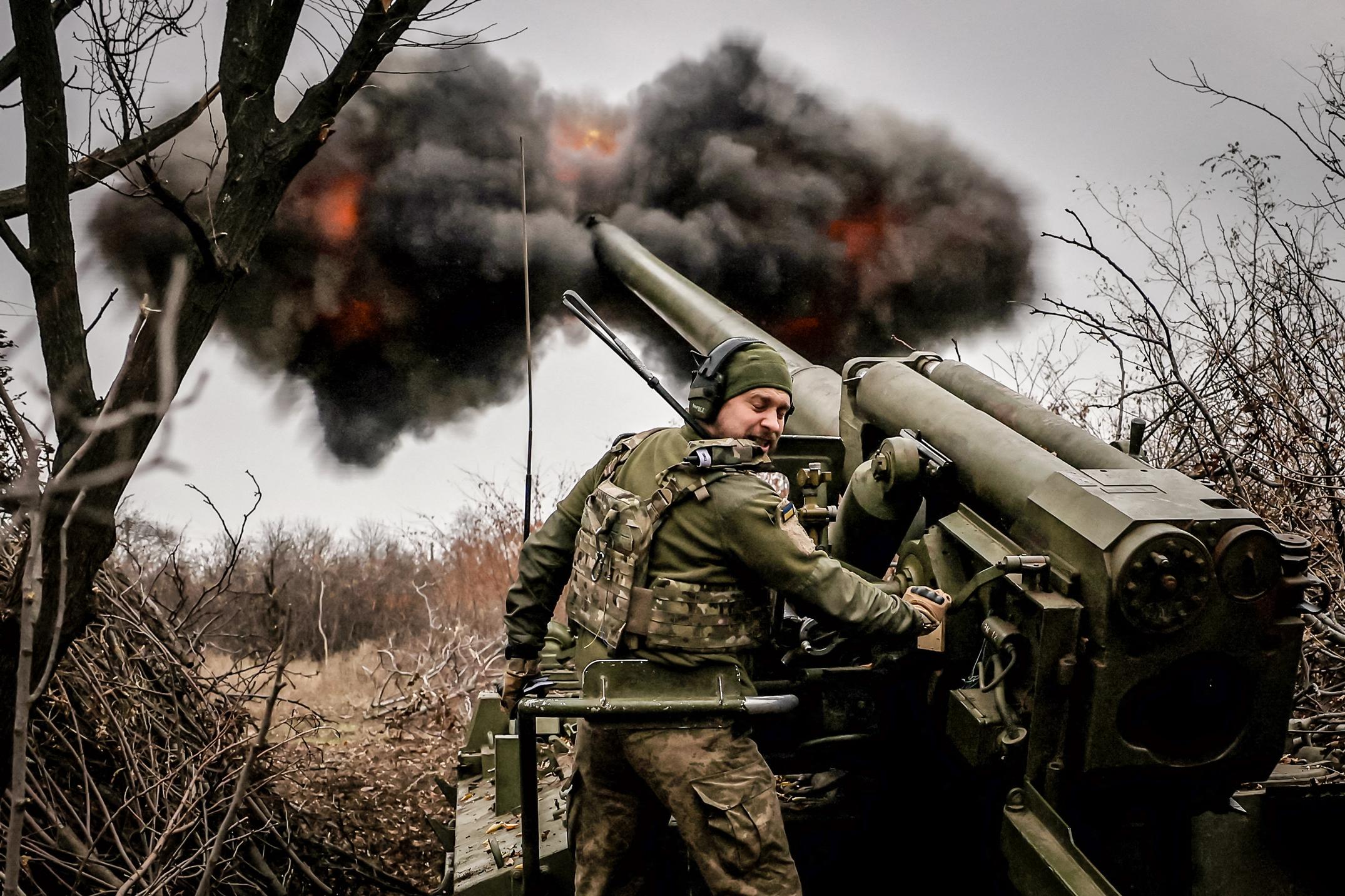
Most recently, Trump has been pressuring China and India to stop purchasing sanctioned Russian oil as part of his effort to weaken the Kremlin and end its war in Ukraine.On Aug. 1, Trump took to Truth Social to criticize Moscow over the rising death toll in both Russia and Ukraine.
The Trump administration is leveraging tariffs in negotiations with China and India to isolate Russia, according to Chris Tang, a professor at the University of California–Los Angeles Anderson School of Management, who described the development as “a very interesting dynamic.”
If the strategy succeeds, it could drive Russia into economic collapse, he told The Epoch Times.
In July, Trump also targeted the BRICS alliance—led by Brazil, Russia, India, China, and South Africa—warning members against their efforts to challenge the U.S. dollar’s global dominance.
In February, just weeks into his second term, Trump imposed 25 percent tariffs on goods from Canada and Mexico, and added a 10 percent levy on Chinese imports, to pressure those countries to address fentanyl trafficking.
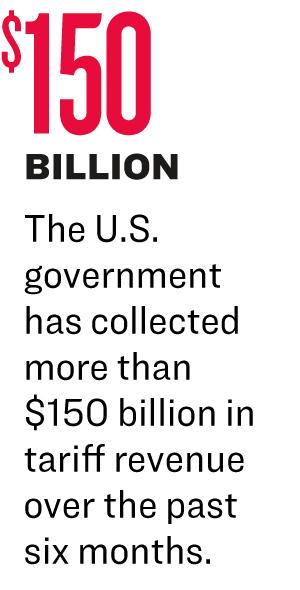
Trump’s tariff strategy is already showing results. In June, Canada backed off its plan to implement a 3 percent digital services tax on large tech firms after Trump halted trade talks and threatened to impose higher tariffs on Canadian imports.
Keith Krach, who served as under secretary of state for economic growth, energy, and the environment in the first Trump administration, said Trump is using tariffs as a broader strategy to rewire global trade and secure U.S. dominance on the world stage.
Key Concessions
Many analysts argue that the strength of Trump’s tariff strategy stems from U.S. economic and military power. As the world’s largest economy and consumer market, the United States can exert pressure in a way that others can’t.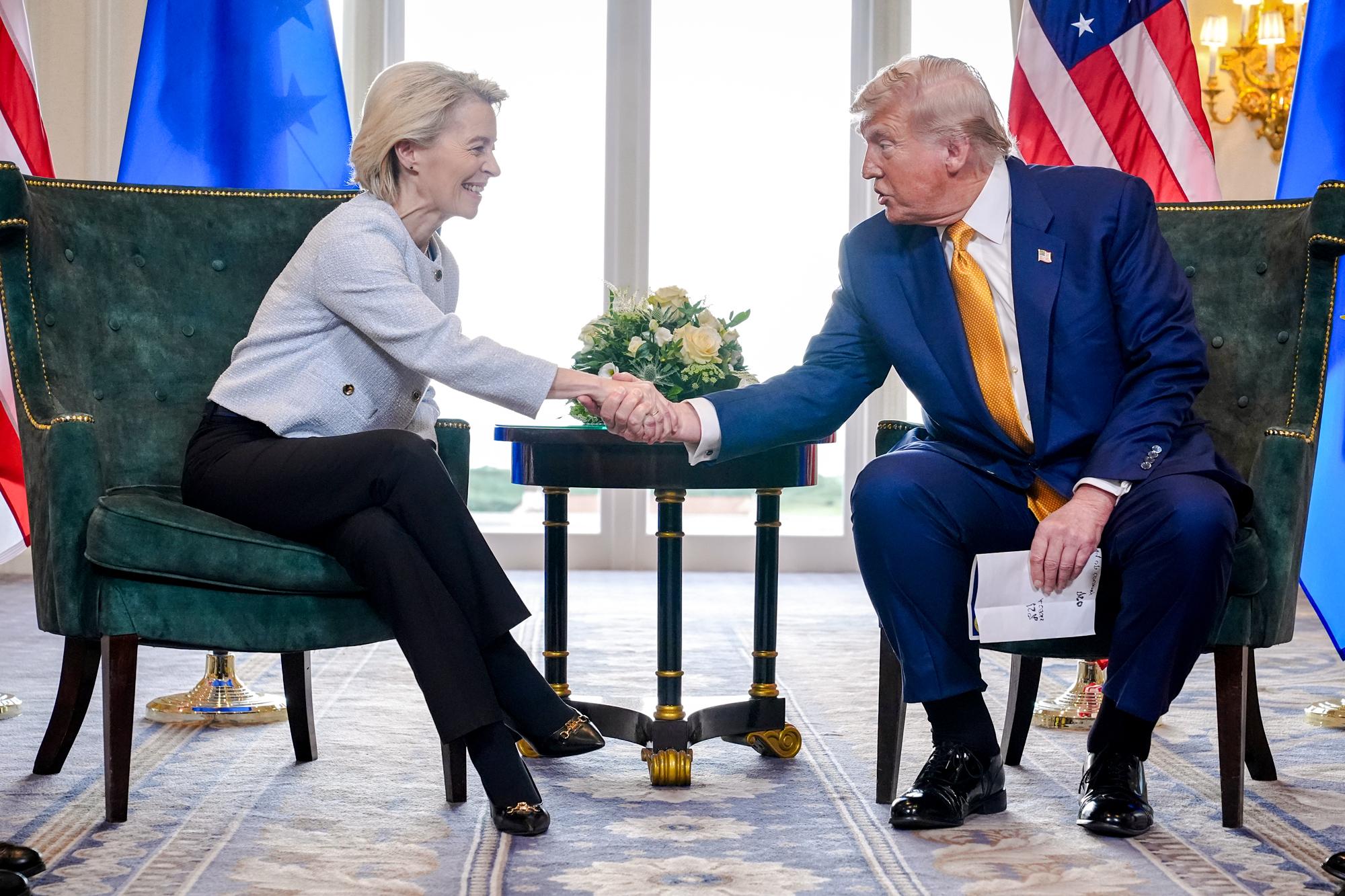
U.S. Treasury Secretary Scott Bessent called it “the deal of the century,” and European Commission President Ursula von der Leyen called it “a huge deal.”
“It will bring stability; it will bring predictability. That’s very important for businesses on both sides of the Atlantic,” von der Leyen said.
However, some other European leaders reacted strongly against the deal.
Marine Le Pen, leader of France’s National Rally party, condemned the agreement as a “political, economic, and moral fiasco.”
Under the latest deal with South Korea, exports to the United States will face a 15 percent tariff, while U.S. goods entering South Korea will be exempt from any tariffs.
In addition, Seoul committed to investing $350 billion in the United States and purchasing $100 billion worth of U.S. liquefied natural gas, crude oil, and coal.
On July 31, Trump signed an executive order establishing reciprocal tariff rates for dozens of countries. However, several nations, including Mexico, Canada, India, and China, have yet to finalize agreements with the Trump administration.
Kevin Hassett, director of the White House National Economic Council, said the administration has already secured trade deals with eight key trading partners, covering “about 55 percent of world GDP.”

Countries that don’t have finalized agreements will soon face “reciprocal rates,” with further negotiations expected to continue, he said.
So far, this overhaul of U.S. tariff policy has not triggered broad retaliation from major trading partners, although the United States and China are still negotiating after tit-for-tat tariffs were paused.
“President Trump is seizing the moment to reset the rules of the game. I give him high marks. His strategy is already producing impressive results,” Krach said. “No one has exploited our generosity more than China.”
Philip Luck, director of the economics program at the Center for Strategic and International Studies, said Trump has managed to roll out his strategy “without triggering widespread retaliation from trading partners.”
Tariffs Reshape Supply Chains
Trump has long championed tariffs to revive U.S. manufacturing and boost domestic jobs. But according to Tang, reshoring jobs to the country remains difficult after decades of industrial decline because of ongoing infrastructure and regulatory hurdles and a shortage of skilled labor.
Some companies are relocating production to the United States to avoid tariffs and serve the domestic market. However, many still depend on cheaper overseas labor for international sales, creating a split in global supply chains.
“For domestic consumption goods, a lot of companies will gradually produce more in the United States,” Tang said. “But for the international market, the United States still relies on emerging markets with lower labor costs.”
He cited Eli Lilly as an example, noting that the pharmaceutical giant plans to produce more of its weight-loss drugs in the United States because the domestic market is the largest.
“It makes sense for the company to produce here,” Tang said.
Industries such as pharmaceuticals and semiconductors are leading the reshoring trend because of their highly automated production processes, which reduce labor needs. Automakers such as Volkswagen are also ramping up their U.S. investment to avoid Trump’s tariffs. Still, bringing entire automotive supply chains to the United States remains a challenge.
Even with tariffs, high labor costs make countries such as Mexico and China more attractive for some parts of the supply chain, Tang said.
Despite several recent trade wins, Trump still faces unresolved battles, including a new trade agreement and an ongoing standoff with China over rare-earth minerals. Although Chinese rare-earth shipments have surged in recent weeks, Beijing is still falling short of its commitments, according to Hassett.
“In the last month, there’s been a big, big increase, but I think that we’re all still hoping for more,” he told The Epoch Times on July 30.
White House officials continue to push for reducing U.S. dependence on processed rare earths from China by supporting domestic investments, but “it will take a few years to get there,” Tang said.

Uncertainty Remains
While Trump has secured a series of trade victories, questions remain about their long-term durability.Many of the tariff measures are based on executive authority and could be reversed by future administrations. Additionally, enforcement of major investment commitments by trading partners is still unclear.
One example is Trump’s trade deal with the EU, which includes a pledge from Brussels to purchase $750 billion in U.S. energy over three years. However, analysts are skeptical. In 2024, U.S. energy exports to the EU totaled $78.5 billion—far below what would be needed to meet the commitment.
“The critical limitation facing U.S. exporters isn’t production capacity but rather export infrastructure,” Zadeh said. “Particularly for natural gas, the process of liquefaction and marine terminal loading creates bottlenecks that cannot be quickly overcome, regardless of how much gas is produced domestically.”
Von der Leyen backed the agreement, saying the EU would “replace Russian gas and oil with significant purchases of U.S. [liquified natural gas], oil, and nuclear fuels.”
Business leaders are also cautiously supportive of Trump’s trade deals. The Business Roundtable, an association of more than 200 CEOs of leading U.S. companies, praised Trump’s efforts to restore balance in trade and support U.S. manufacturing, but warned of risks.
Meanwhile, the market reaction to the 15 percent tariffs on key trading partners such as the EU and Japan has been largely muted. Investors have so far shrugged off concerns about the tariffs’ potential impact on the U.S. economy and inflation. The S&P 500 has rebounded by more than 25 percent since its April 8 low, suggesting that markets may have initially overreacted to the April 2 unveiling of the tariffs.