Some of the most popular internet services, like Facebook or Google Drive, are free—but they come at an environmental cost.
There’s no fee for users to store a practically infinite number of family photos, emails, documents, and cat videos in the cloud. But as ethereal as the “cloud” may sound, it is made of a staggering number of machines that require real energy to operate.
The internet is currently responsible for about 2 percent of the globe’s overall power consumption. But the internet’s share of power use is increasing much more quickly than other users’.
If it continues to grow at the current rate, “the internet will choke the planet in terms of power consumption,” said Kerry Hinton, director of the Centre for Energy-Efficient Telecommunications at the University of Melbourne in Australia.
“It’s just not sustainable,” he said.
Exponential Growth
Without a major change, Hinton estimates that in about 15 years the internet will be responsible for 20 percent of global power consumption.
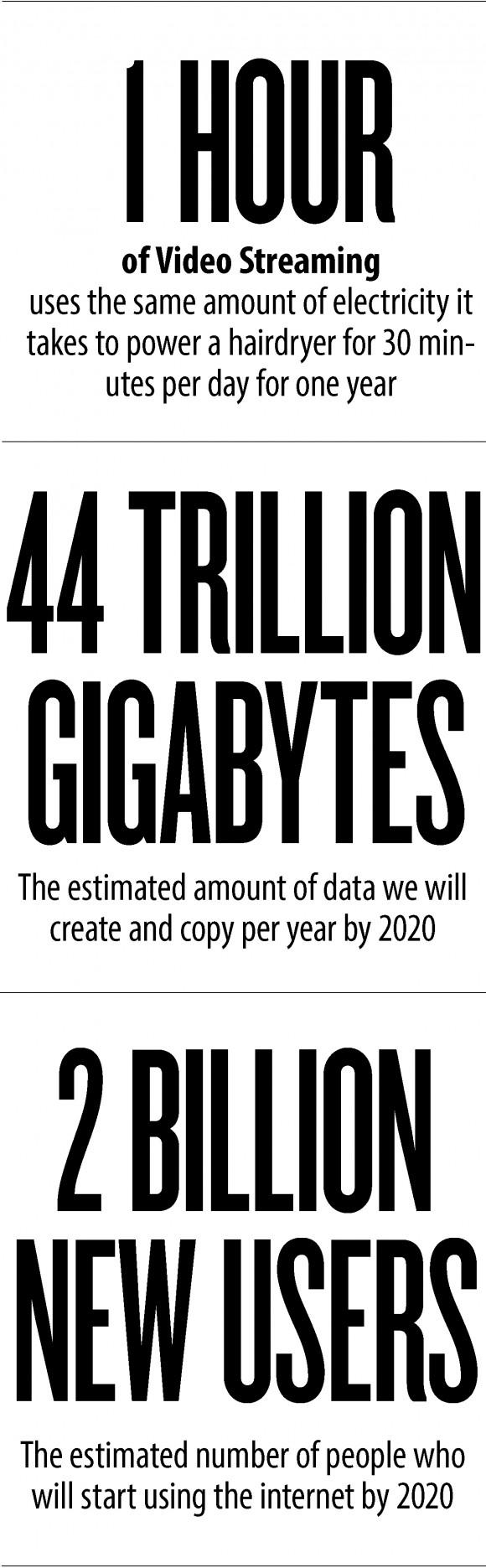
A 2014 report by Dell EMC on the growth of the “digital universe” expressed it well: “Like the physical universe, the digital universe is large—by 2020 [it will contain] nearly as many digital bits as there are stars in the universe. It is doubling in size every two years, and by 2020 the digital universe—the data we create and copy annually—will reach 44 zettabytes, or 44 trillion gigabytes.”
Global e-Sustainability Initiative (GeSI), an information technology industry group, estimates that an additional 2 billion people will hook up to the internet by 2020. It is seen as a major tool for developing countries, and GeSI describes internet technologies as connecting users with the “knowledge economy.”
While the internet can have many benefits, including ecological ones—from helping educate and mobilize people on environmental issues, to helping run a smart grid—it also has a big footprint.