Artificial intelligence (AI) has been marketed as everything from a productivity revolution to a near-autonomous decision-maker.
However, as AI tools integrate into daily operations, concerns have risen over what happens when promises fail to materialize after AI products are purchased.
Issues from exaggerated accuracy claims to opaque performance metrics have caused some to ask: What does recourse look like when AI systems underdeliver?
This disconnect has drawn the attention of consumer protection agencies, attorneys, and AI experts, who say that marketing claims need to be meaningfully enforced.
The phenomenon is called “AI washing.” Similar to the concept of “green washing,” referring to deceptive labeling of a product as environmentally friendly or sustainable, AI washing is the practice of making false claims or exaggerating an AI model’s abilities to make it appear more advanced, attract investment, or gain a competitive edge in the market.
The initiative sought to crack down on the use of AI tools to “trick, mislead, or defraud people.”
“The FTC is focused on ensuring that AI companies are able to rapidly innovate while preserving the safety, security, and objectivity of AI platforms, in keeping with the President’s AI Action Plan,” FTC Deputy Director of Public Affairs Christopher Bissex told The Epoch Times.
Bissex said some of the agency’s recent actions include orders against companies making false claims about the accuracy or efficacy of its AI products, suing businesses that have made false marketing claims, and conducting a study to gather information on how companies are approaching potential risks with AI chatbots, particularly when children are involved.
Legal Frameworks
Christopher Trocola, founder of cybersecurity company ARC Defense Systems, said the accountability gap isn’t caused by a lack of regulation.“It’s a lack of understanding that existing laws already apply to AI. Companies think, ‘There’s no AI-specific legislation, so we’re not liable,’” he told The Epoch Times.
Trocola said that he understands the pitfalls of emerging industries and is building AI compliance frameworks after watching the same “failure patterns” nearly collapse the solar industry in 2017. Back then, he led compliance consulting that protected millions of dollars in contracts while collaborating with the FTC.
Now, his objective is slightly different.
“I make sure AI doesn’t eat people,” he said.
He said many existing regulations can be applied to AI models.
The real problem, Trocola said, is that “companies don’t understand their AI is creating compliance violations in real time under statutes that have been enforceable for decades.”
“Courts aren’t waiting for ‘AI laws.’ They’re applying existing frameworks right now,” he said.
“Voluntary pledges offer little protection when existing statutes are being violated, and most companies have no audit trail to prove they weren’t negligent.”
Bob Gourley, chief technology officer of cybersecurity and AI consultancy OODA, said, “The enforcement related to deceptive claims, for example, consumer protection, is likely in the next few years, as there are already established mechanisms.”
“On the other hand, it would be difficult to enforce noncompliance related to safety guarantees, as there are no regulations relating to [AI] noncompliance,” Gourley told The Epoch Times.
Tax attorney Chad Silver, founder of Silver Tax Group, said he’s seen firsthand how regulations regarding AI company promises are problematic.
“Voluntary self-regulatory agreements between tech giants and the government now have no legal force in federal law,” Silver told The Epoch Times. “My team witnesses software developers assuring compliance with taxes and evading with truculent licensing agreements that absolve all corporate responsibility. These businesses assert that their algorithms are under the guidelines of the IRS, yet they cannot generate audit trails when the agency makes a formal summons.”
“We got out of a $167,000 debt, since we demonstrated that a client was acting under the advice of an automated system that gave him false information,” he said. “The best form of accountability thus far is litigation, since courts will order discovery and provide real damages to defrauded consumers.”
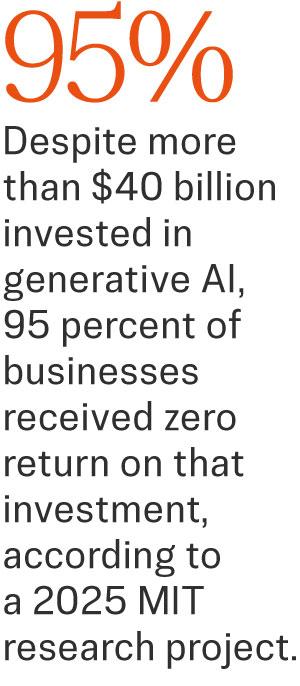
From a systematic review of more than 300 AI initiatives, interviews with 52 organizations, and survey responses from 153 industry leaders, the analysis offered a sobering glimpse into the reality of AI beyond the marketing campaigns.
Moreover, the G2 analysis noted that 83 percent of surveyed buyers indicated they were satisfied with their AI agent performance.
Some experts say greater transparency and auditing are key for companies to be able to discern whether they were misled on their AI investments.
“A trustworthy audit would involve model-level examination, safety checks, examination of provenance, as well as organizational governance,” Gourley said.
“An audit should also examine training data, performance, bias, misuse robustness, as well as mitigation strategies for risk. The audit should happen on a scheduled basis, for example, once per year, with some portion for public summary, while organizational-specific issues are not disclosed because they constitute trade secrets.”
Trocola said he believes that the method for auditing AI needs to change.
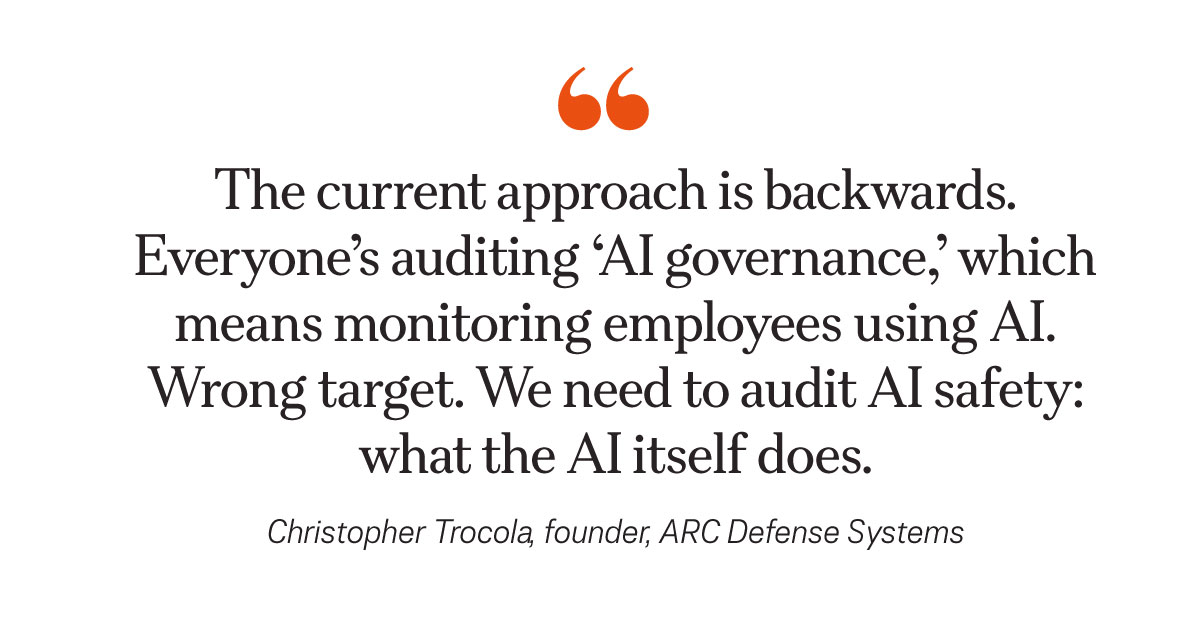
“The current approach is backwards. Everyone’s auditing ‘AI governance,’ which means monitoring employees using AI. Wrong target. We need to audit AI safety: what the AI itself does.”

He said this type of auditing should include things such as AI drift—the gradual degradation of an AI model’s performance and accuracy over time, including hallucinations, information leaks, and bias.
“This is why 70 to 80 percent of enterprise AI projects fail. They monitor the wrong thing,” Trocola said.



Silver said he believes that third-party performance audits are necessary.
“The regulatory environment of a frontier [AI] model provider is truculent as state laws require them to report on annual energy consumption and training sets,” he said. “The third party should audit weights and biases of a model every six months, and this should be credible.”
Gourley was adamant about the importance of AI transparency.
“Standards should be specific about the documentation of the design of the model, the data sources, the limitations, the risk analysis, and the mitigation plans, which are to be adapted for each of the high-impact domains,” he said.
He said he thinks certification should be facilitated by a hybrid body or a U.S. public agency, such as the National Institute of Standards and Technology, or AI regulators who collaborate with independent experts.
Researchers at Stanford University’s Institute for Human-Centered Artificial Intelligence predicted that after years of “billion-dollar bets,” 2026 could be a watershed moment for AI: when actual utility is put under a microscope.