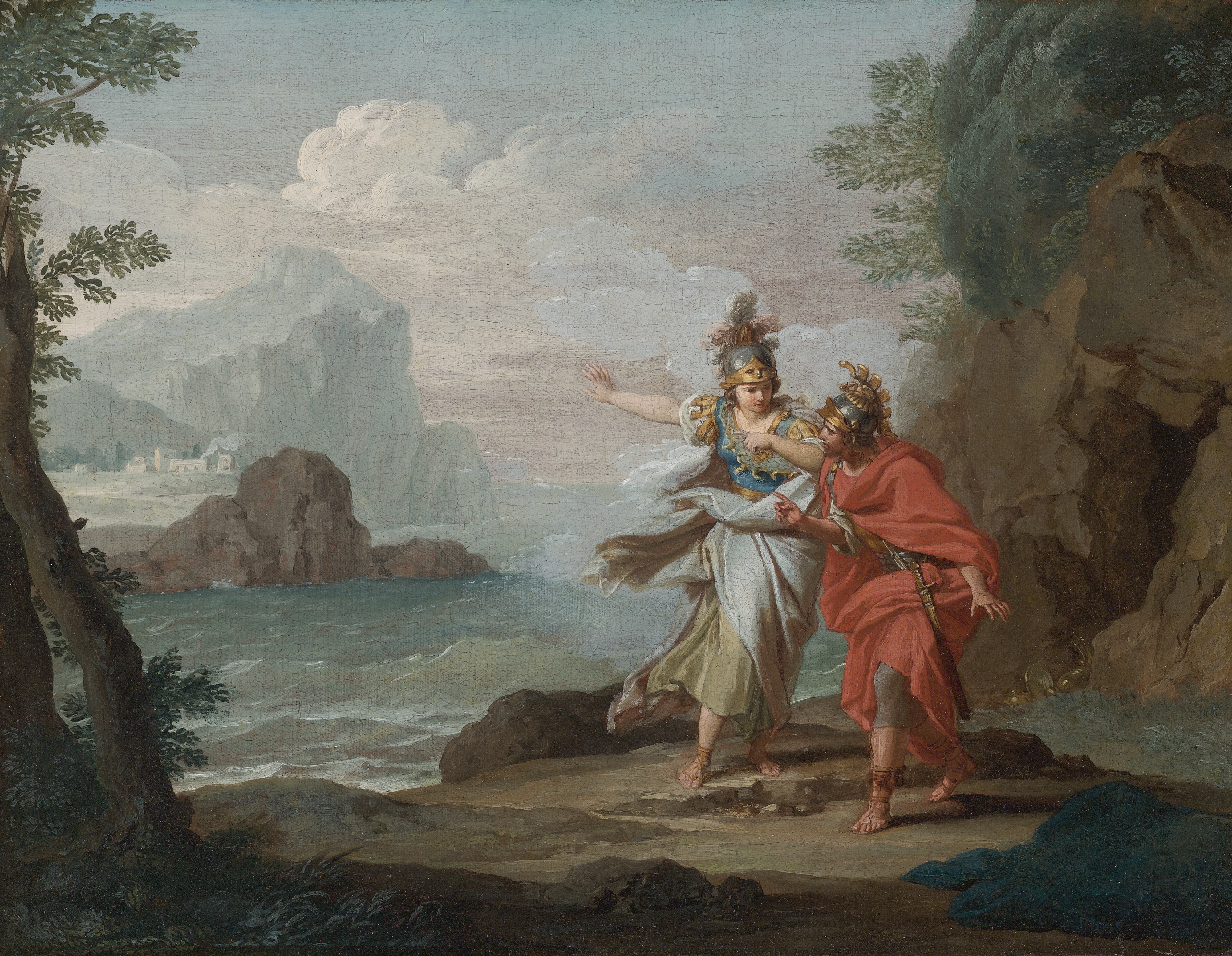
The Odyssey has been passed down for millennia, and the story is foundational for Western thought and storytelling. What drives the poetic journey and has kept it relevant for listeners and readers is the namesake character, Odysseus, and his five principal virtues: Perseverance, loyalty, wisdom, piety, and justice.
The poem describes Odysseus’s journey home from the Trojan war, wandering the Mediterranean for 10 years, fighting mythical beasts, and overcoming god-sent challenges. When the hero finally returns home, he still must face down the suitors draining his house’s wealth and pursuing his wife.
The 12,109-line epic poem is credited to the legendary poet Homer, and was composed some time short of 3,000 years ago.
The journey of Odysseus is being adapted to the big screen by popular director Christopher Nolan, and may refocus the eyes of the culture on the ancient tale. Here’s what can be learned from the heroic Greek warrior and king.
Perseverance
The clearest trait of Odysseus from a general overview of his tale is his sheer perseverance and will to go home. He hits challenge after insurmountable challenge and never gives up, even when he has lost everything.

Odysseus left his island kingdom of Ithaca to lead his men in the Trojan War for 10 years, and the journey home cost another 10 years and the death and loss of all his crew and possessions.
The most disheartening tribulation Odysseus faced was when he had been given a bag of winds by Aeolus, the god of winds. The bag blew his ships to Ithaca in just nine days and nights.
Odysseus stayed awake the entire trip from Aeolus’s island to Ithaca, and fell asleep when they were close enough to see people tending fires on the shore. His men were jealous of the riches their leader had gathered during the war, and opened the bag to see what treasures it held. The winds exploded out, creating a hurricane that tossed the fleet back to the wind god’s island.
Odysseus thought during the storm, “Should I just drop in the water and drown, or keep on and suffer, gritting my teeth?”
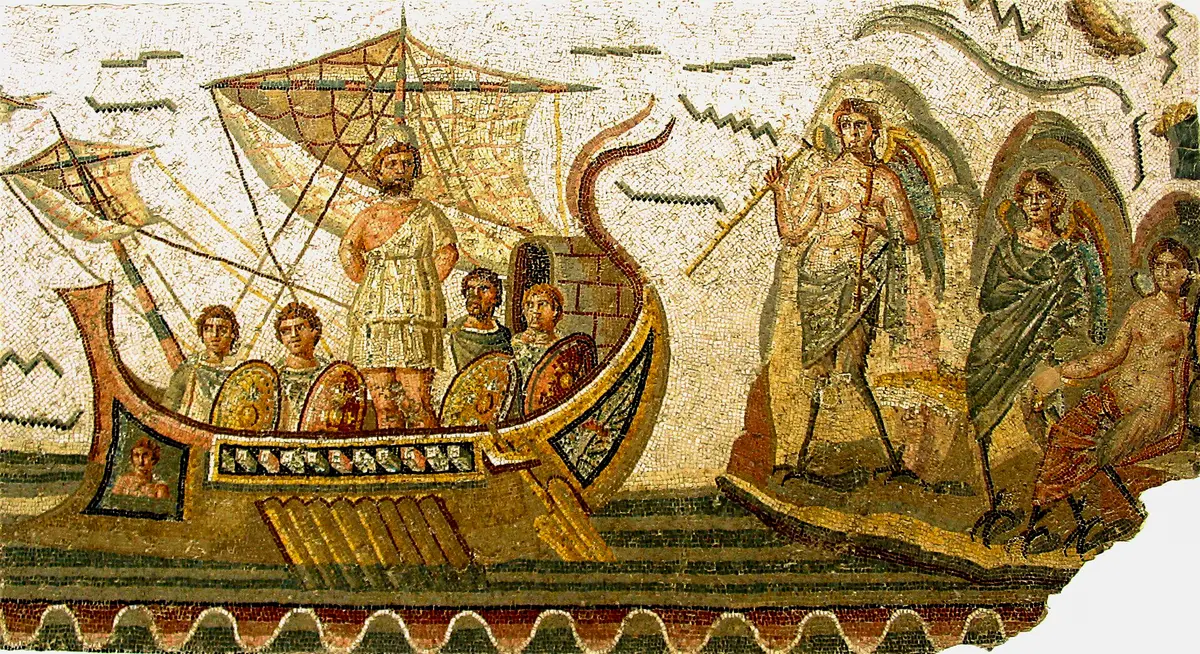
The king held on, weathering the winds and waves to return home another day.
After being expelled from the wind god’s island, Odysseus’s fleet wandered the waters until they arrived at the fortress of Lamus. Eleven of the twelve ships were destroyed by the violent giants that inhabited the land, throwing rocks and spears down on the harbored ships. Only Odysseus’s ship escaped the island.
Odysseus didn’t let the loss hold him back. He persevered; he kept on his journey home, and he never gave up. Not when he lost his fleet, not when he lost his last crew and ship, and not when he was imprisoned for seven years; he kept struggling forward.
Knowing what Odysseus endured to get home has inspired people across millennia and heroes after him.
Loyalty
What fueled the Odysseus’s perseverance was his loyalty to his family and home. For 20 years, he fought both the obstacles and the temptations that threw him off his path.
Odysseus showed where his priorities lay at the island of the lotus eaters, where people ate the bliss-inducing, honey-sweet fruit of the lotus.
The taste of the fruit was so fine that eating it wiped away all memories of home. Several of Odysseus’s men ate the fruit and had to be dragged back to the ships, wailing and crying. They were tied below deck because all they wanted was to return to eating the lotus fruit.
Odysseus rallied his ships off the island as soon as he found out about the dangerous temptation. He could have let his crew wallow in the blissful fruit for the rest of their lives and avoided the long journey ahead. Odysseus instead led his men out, commanding, “Don’t eat that lotus! It makes you forget about home! Weigh anchors! We sail!”

On the island of the goddess Calypso, years after the ships of Odysseus had been smashed by sea and stone, the lost king made an ultimate show of loyalty by rejecting the offer of immortality.
Calypso kept Odysseus on her island alone for seven years, wishing to make him her husband. Zeus pitied him and demanded that he be let free to make his way home.
The goddess offered Odysseus immortality if he stayed on the island as her lover. He rejected her, enshrining his will to go home. When Calypso points out that his wife, Penelope, is nothing compared to the beauty of a goddess, Odysseus acknowledges and accepts that truth.
Only too well!—and you’ll never die or grow old.
She’s far, far away from your beauty, your build—and yet,
Even so, I still want to go. I can’t stop this aching
To see my own house on that day when I’m finally home.”
The loyalty Odysseus shows to his family and home is beyond feelings; it’s his way of life. He stayed true to his goal through 20 grueling years of temptation and hardship. Anyone who can stay devoted to their family, promises, and goals for so long, and more so a lifetime, is worthy of heroic admiration.
Wisdom
It is telling that the first description of Odysseus in the epic is the “man who survived on his wits.”
He has long been an icon of the smart and savvy hero on a quest.
The forward planning and quick wittedness of Odysseus is shown spectacularly in how he saved himself and his men from the cyclops’s cave.
The leader and his band of men stumbled into the cave of the cyclops while exploring an island. The one-eyed giant owner of the cave, Polyphemus, caught them in the act of making off with his goat cheese, and closed the cave with a massive rock that Odysseus knew would be impossible for the men to move.
The cyclops asked Odysseus where his ship was, and Odysseus, suspecting a trap, lied that they were shipwrecked. The cyclops did not go looking to destroy their nearby anchored ship, and instead ate two of Odysseus’s men and fell asleep.
Odysseus’s first thought was to stab Polyphemus in the lung while he slept. The hero’s wisdom shone through when he realized it would be unwise to take out the monster at that moment, as they could not open the cave without the hulking brute. He had to come up with a way to both move the rock and defeat the cyclops.
Odysseus found a tree the cyclops had left to dry in the cave, and got to work cutting, sharpening, and hardening it in a fire. He hid the finished work before Polyphemus came back with all his sheep and goats.
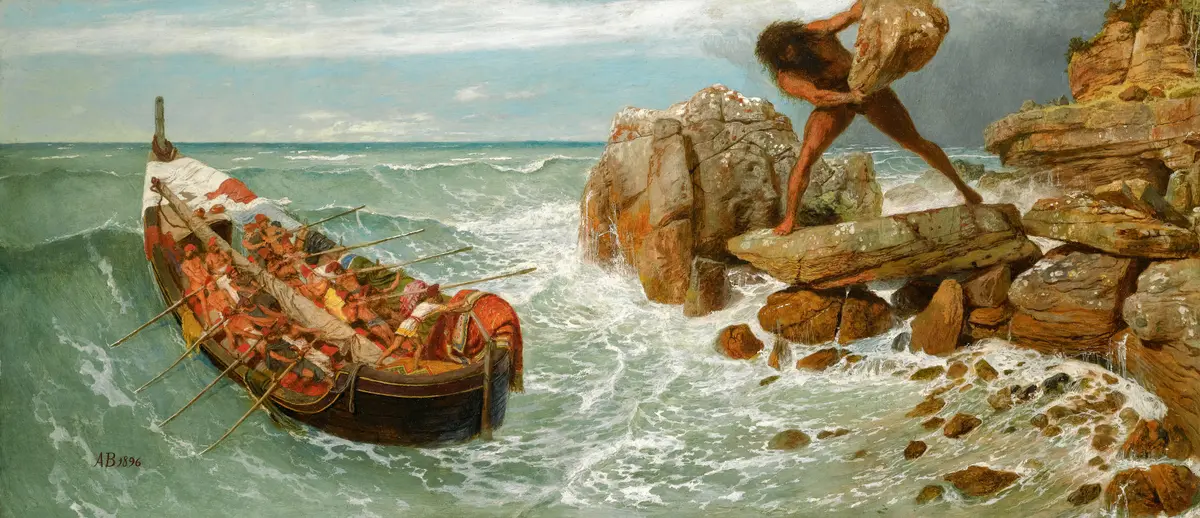
Now when the monster killed two more men to eat, Odysseus offered it a bowl of mythically strong wine he had brought from the ship. Polyphemus drank down three bowls of the delicious liquid, and became intoxicated. Odysseus told the cyclops that his name was Noman, and the cyclops thanked Noman for the wine, saying that he would be eaten last.
While the Polyphemus slept a drunk, deep sleep, Odysseus and his men used the great wooden spear to stab the giant’s eye out. Polyphemus woke up screaming, attracting its neighboring cyclops, who heard the screams, “Noman is in here! Noman is trying to kill me by using his tricks!’”
Because the rock still blocked the entrance, the other cyclops could not see in and were confused by the yells of Polyphemus. They assumed he was sick and went back to their caves.
Odysseus’s final act of genius was his plan to smuggle the men out unnoticed. Polyphemus moved the rock and sat at the mouth of the cave, waiting blindly with his hands out to catch any man that would pass.
Odysseus tied his men to the belly of the rams that the ogre kept in his cave, three rams per man.
Polyphemus dumbly felt the backs of the sheep as they trotted out of the cave, carrying their human cargo undetected.
This saga unfortunately ends with Odysseus’s greatest mistake, which was letting his ego overcome his judgment. As they sailed away from the cyclops’s island, Odysseus revealed his true name.
Such a terrible thing to your eye?’—you tell him ‘Odysseus,
Sacker of Cities! He blinded me! He is the one,
The son of Laertês! The hero whose home is in Ithaca!’”
This allowed Polyphemus to beg his father, Poseidon, to bring revenge on Odysseus, causing the tragic journey home.
Piety
Odysseus displayed constant piety and respect towards the gods, and received help because of it.
Fresh off a shipwreck and being tossed around the waves off some rocky and perilous shore, Odysseus turned to prayer to land safely.
Spotting a river that went inland, he prayed to the divinity of the river as he swam through the rough waves.
I’m only a refugee, cursed by the sea and Poseidon,
But even the gods everlasting will offer respect
To a mortal who comes as a wanderer, as I have now come
To your stream: I’m down at your knees—a suffering man!
I’m humbled, my Lord. Take pity. I pray for your mercy.”
The river and sea calmed for Odysseus, saving him from drowning or being smashed onto the stony shore, and allowing him to swim to the safety of the river banks.
Odysseus didn’t just ask the gods for assistance, he also looked to see if they approved of his plans. The dawn before he was to slaughter the suitors ruining his house, he asked Zeus in the heavens if this was what he was meant to do. He wished to have an omen to say that it was right.
Zeus heard him and instantly let loose thunder in the cloudless sky and sent an omen to Odysseus. A slave woman passing him prayed out loud that this would be the final day and meal of the suitors.
Odysseus knew at once, “They’ve wronged me, but vengeance is mine.”
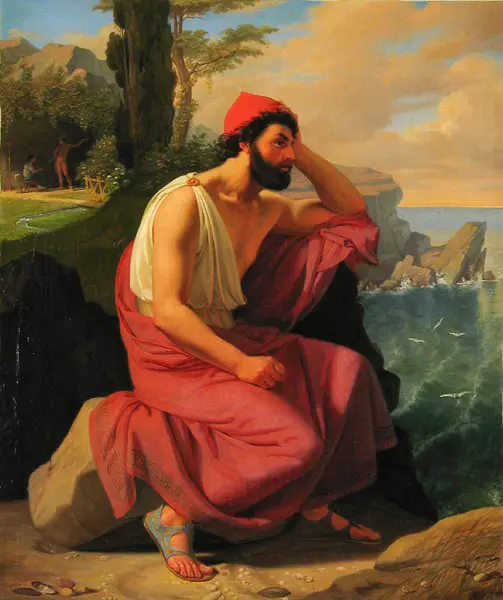
For people of faith, Odysseus is a shining example of remembering the divine in the darkest times and respecting its power.
Justice
The Odyssey is the tale of a man delivering justice to the people invading his home. More specifically, Odysseus, his son, and two loyal servants killed more than 100 suitors and a dozen disloyal maids.
This is justice according to the moral code “xenia,” which were the Greek sacred laws between host and guest. Property owners were supposed to welcome everyone, providing food and drink to wandering beggars or traveling kings. Guests were expected to honor their hosts, give gifts, and not impose for too long. Breakers of xenia were believed to be punished by Zeus.
The suitors pursuing Odysseus’s wife, Penelope, were horrid guests. They stayed in his house for years, feasting daily, sleeping with the maids, and plotting to kill his son. To the ancient Greeks, the suitors got what they deserved.
The various suitor characters who acted disrespectfully get deaths of poetic justice. The ringleader of the suitors, Antinoûs, is killed first, shot through the neck by Odysseus’s arrow. He died holding a cup of Odysseus’s wine, kicking up his table as he fell to the ground. His blood spoiled the food.
A particularly nasty suitor named Ctesippus had thrown a cow’s hoof at Odysseus when he was disguised as a beggar in his home. For his disrespect, he was killed by the spear of Odysseus’s loyal cowherd.
You gave to that wandering beggar—to godlike Odysseus!”
Odysseus spared some in the massacre. Phemius, the suitors’ minstrel, was let live by the returned king. Phemius pleaded to Odysseus that it would be terrible to rob the world of a minstrel who creates such joy, and that he had been forced into singing for the suitors.
I took nothing for it. ‘Sing for us, minstrel’—they warned me—
‘Or else!’ I had to!”
Odysseus’s son vouched that the performer had done nothing wrong or against the house of Odysseus. The same is not true for the suitor’s priest, Leiodês.
The priest swore he never mistreated the household women and had tried to sway the suitors from their wicked ways.
Who peered into smoke for the suitors—and I am to die here
And lie with them too? Is that what a good man deserves?”
Odysseus told Leiodês that if he had been the suitors’ priest, he had prayed many times that Odysseus would not come back to reclaim his house. Leiodês did not escape the brutal justice that he sowed.
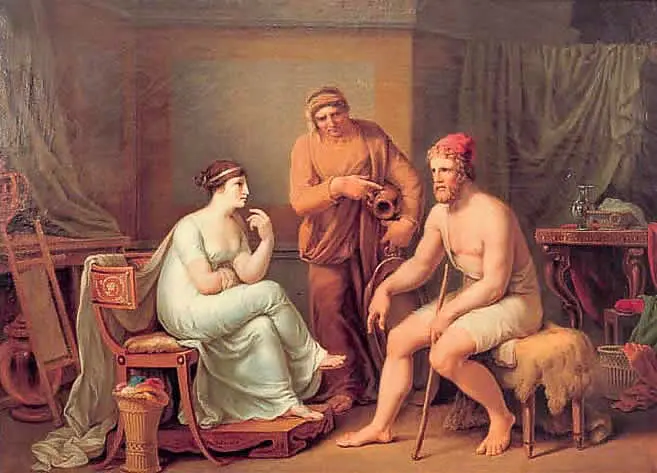
The Odyssey is a deep and foundational story that, thanks to both its captivating story and strong virtues, has outlived most civilizations. In Ancient Greece, it was honored with statues, in classical Europe, with brilliant paintings, and in the modern day, with film adaptations. Throughout it all are the virtues of Odysseus, the sailing soldier of Ithaca.