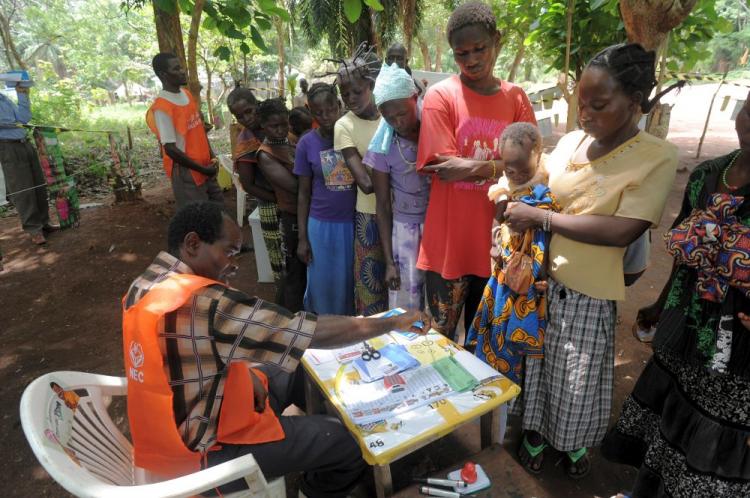
Sixteen million Sudanese people had registered to vote by April 8 in the country’s first multiparty election in 24 years. The outcome appears certain as current President Omar al-Bashir is likely to be elected after the main opposition parties pulled out, while calling for new polls during the run-up to the elections. The elected president will reign for four years.
The parties boycotted the election due to an alleged rigged voter registration system, bribed tribal leaders, and intimidation of opposition party leaders. By pulling out they have taken away much of the credibility of what was meant to be a historical transition to democracy.
The voting period was set to end April 8, but was extended for two days by the election commission due to a delay in ballot papers being delivered to polling stations. Names were also missing from the electoral roll and ballots had been mixed up, according to a BBC report.
Initially, the U.S.-based Carter Center, which monitors the election process in Sudan, had suggested a postponement of 10 days but the election is now taking place as planned.
“It’s not going to be a perfect election. There are no such things,” former U.S. President Jimmy Carter was reported as saying by Reuters. Carter is the founder and trustee of the Carter Center. “But if we feel that in the elections the will of the voters has been expressed adequately then that would be the primary judgment we will make.”
Voting in Sudan is complicated, as votes are not only cast to a national president but also a regional president, an assembly, and governors. Voters in the north have to fill in eight forms while those in south fill in a total of 12 forms. The names of opposition leaders that have withdrawn remain on the ballot papers.
“There are a lot of crowds and there should have been more information because there is a whole new generation that have never voted,” a voter was reported as saying by Reuters.
The outcome of the election will be announced on April 18.
The elections are part of a 2005 peace deal that marked the end of a 21-year civil war between north and south Sudan. It is also regarded as a stepping-stone toward a referendum that will decide on the division or reunification of the country. The referendum will be held in January 2011.
President Omar al-Bashir came into power in a coup in 1989 and has been indicted by the International Criminal Court for alleged war crimes in Darfur.
The parties boycotted the election due to an alleged rigged voter registration system, bribed tribal leaders, and intimidation of opposition party leaders. By pulling out they have taken away much of the credibility of what was meant to be a historical transition to democracy.
The voting period was set to end April 8, but was extended for two days by the election commission due to a delay in ballot papers being delivered to polling stations. Names were also missing from the electoral roll and ballots had been mixed up, according to a BBC report.
Initially, the U.S.-based Carter Center, which monitors the election process in Sudan, had suggested a postponement of 10 days but the election is now taking place as planned.
“It’s not going to be a perfect election. There are no such things,” former U.S. President Jimmy Carter was reported as saying by Reuters. Carter is the founder and trustee of the Carter Center. “But if we feel that in the elections the will of the voters has been expressed adequately then that would be the primary judgment we will make.”
Voting in Sudan is complicated, as votes are not only cast to a national president but also a regional president, an assembly, and governors. Voters in the north have to fill in eight forms while those in south fill in a total of 12 forms. The names of opposition leaders that have withdrawn remain on the ballot papers.
“There are a lot of crowds and there should have been more information because there is a whole new generation that have never voted,” a voter was reported as saying by Reuters.
The outcome of the election will be announced on April 18.
The elections are part of a 2005 peace deal that marked the end of a 21-year civil war between north and south Sudan. It is also regarded as a stepping-stone toward a referendum that will decide on the division or reunification of the country. The referendum will be held in January 2011.
President Omar al-Bashir came into power in a coup in 1989 and has been indicted by the International Criminal Court for alleged war crimes in Darfur.