WASHINGTON—While much progress has been made toward a recovery from the global financial crisis, which began two years ago, unemployment remains unacceptably high in many countries.
These countries more often than not are the developed countries, and it is these developed countries in this economic crisis that are slowing the global recovery—not the developing countries who have been blamed in the past.
This year, at the International Monetary Fund (IMF) and the World Bank Group (WBG) Annual Meetings of 187 countries earlier this month, the emerging markets criticized the developed countries for their policies that led to the crisis and for retarding progress in the recovery.
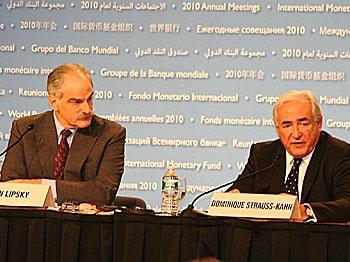
“The recovery is going on, but as everyone knows it is still very fragile,” said IMF Managing Director Dominique Strauss-Kahn in his opening statement at the press conference on Oct 7.
Strauss-Kahn observed that that fragility was due to the uneven progress countries were making in rebounding. Asia and Africa are displaying high rates of growth, and even the sub-Saharan Africa rate of growth is around 5 percent, he noted. But Europe is “sluggish,” and in the United States, unemployment has been hovering close to 10 percent for several months.
The developing countries are leading the way out of today’s economic crisis with their higher growth rates. In fact, in some developing countries, the economic slowdown has ended.
“Developing countries are expected to account for about one-half of global growth in the several years ahead. It is a very different world from the one even 10 years ago. Their growth provides an important source of demand for exports in developed countries,” said World Bank President Robert Zoellick.
The developing countries are, increasingly, the engine of global growth, and consequently are playing a crucial role in the recovery.
However, the global economy is still experiencing significant imbalances, which threaten the recovery’s sustainability. “A lack of growth accompanied by unemployment is having consequences,” said Zoellick.
There is a need for more balanced global growth, and this requires more coordination at the global level. “Multilateral institutions need to matter,” said Zoellick.
Developing countries want more representation in international bodies and changes in the financial policies of the developed countries. The consensus is that the global economic governance is suffering from serious weaknesses, and there is a need for more coordinated economic policies with more balanced representation of all the nations having a stake in the global economy.
Joseph Stiglitz, copresident, Initiative for Policy Dialogue at Columbia University, said at a Brookings Institution discussion that there were many areas in the economic and financial system now that are unfair to developing countries.
“The reserve system clearly is antiquated, where you have a global system which is so dependent on the currency of one country,” he said, which was one instance he cited on a long list. He also charged that the sources of finance for development are highly unstable.
These countries more often than not are the developed countries, and it is these developed countries in this economic crisis that are slowing the global recovery—not the developing countries who have been blamed in the past.
This year, at the International Monetary Fund (IMF) and the World Bank Group (WBG) Annual Meetings of 187 countries earlier this month, the emerging markets criticized the developed countries for their policies that led to the crisis and for retarding progress in the recovery.
“The recovery is going on, but as everyone knows it is still very fragile,” said IMF Managing Director Dominique Strauss-Kahn in his opening statement at the press conference on Oct 7.
Strauss-Kahn observed that that fragility was due to the uneven progress countries were making in rebounding. Asia and Africa are displaying high rates of growth, and even the sub-Saharan Africa rate of growth is around 5 percent, he noted. But Europe is “sluggish,” and in the United States, unemployment has been hovering close to 10 percent for several months.
The developing countries are leading the way out of today’s economic crisis with their higher growth rates. In fact, in some developing countries, the economic slowdown has ended.
“Developing countries are expected to account for about one-half of global growth in the several years ahead. It is a very different world from the one even 10 years ago. Their growth provides an important source of demand for exports in developed countries,” said World Bank President Robert Zoellick.
The developing countries are, increasingly, the engine of global growth, and consequently are playing a crucial role in the recovery.
However, the global economy is still experiencing significant imbalances, which threaten the recovery’s sustainability. “A lack of growth accompanied by unemployment is having consequences,” said Zoellick.
There is a need for more balanced global growth, and this requires more coordination at the global level. “Multilateral institutions need to matter,” said Zoellick.
Developing countries want more representation in international bodies and changes in the financial policies of the developed countries. The consensus is that the global economic governance is suffering from serious weaknesses, and there is a need for more coordinated economic policies with more balanced representation of all the nations having a stake in the global economy.
Joseph Stiglitz, copresident, Initiative for Policy Dialogue at Columbia University, said at a Brookings Institution discussion that there were many areas in the economic and financial system now that are unfair to developing countries.
“The reserve system clearly is antiquated, where you have a global system which is so dependent on the currency of one country,” he said, which was one instance he cited on a long list. He also charged that the sources of finance for development are highly unstable.