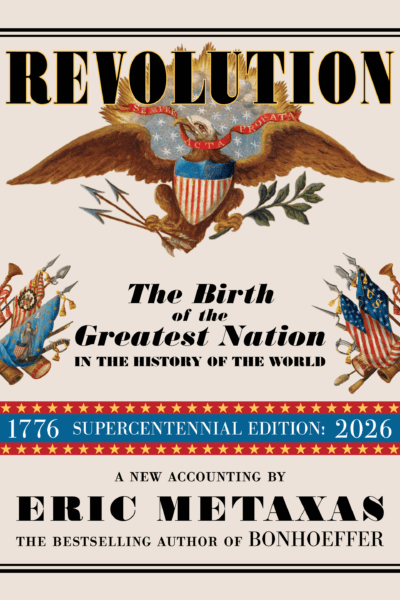
The story of the American Revolution has long been framed as a quest for political and economic liberty. But historian Eric Metaxas argues there is a profound undercurrent to this story that is frequently overlooked.
Matters of Principle
Metaxas begins his tale in a manner that feels closer in spirit to Mel Brooks than David McCullough. He flippantly recalls the abrupt death in 1760 of the aged King George II after relieving himself following the ingestion of a laxative. The monarch’s heir was his 22-year-old grandson, who took the name George III. He was ill-advised and ill-prepared to deal with the disaster that awaited him.Metaxas points out that there was always a degree of tension between the British establishment and its American subjects. After all, the colonies were settled by Britons seeking to escape religious and political intolerance.
But as the years passed, the culture of the colonies evolved dramatically. Metaxas highlights how Americans were extremely serious about their faith while the British elites were more interested in decadent distractions. As a result, the colonists placed great emphasis on principles, law, virtue, and morality; this did not sit well with the casual corruption of the 18th-century British leadership.
A typical response came from the British Gen. James Grant: “If a good bleeding can bring those Bible-faced Yankees to their senses, the fever of independency should soon abate.”
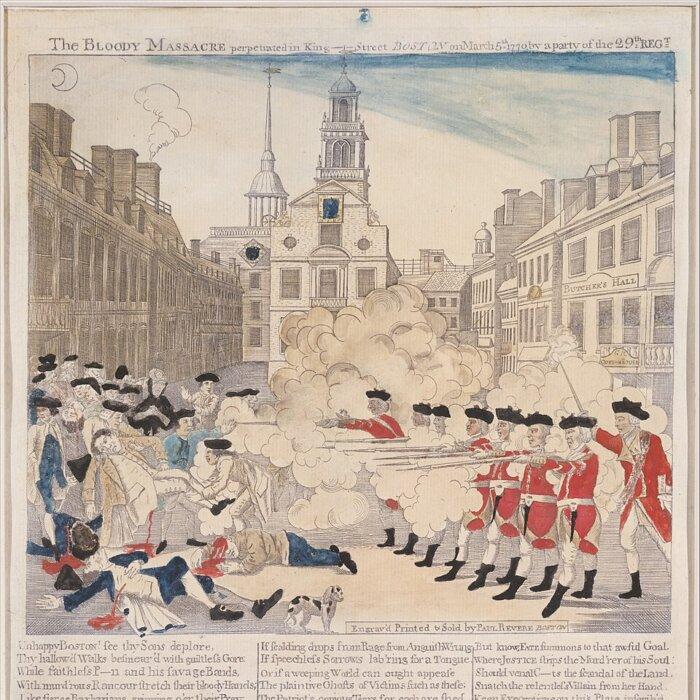
The “good bleeding” began with the fatal shooting of 11-year-old Christopher Seider in Boston on Feb. 22, 1770. He was killed by customs officer Ebenezer Richardson, who fired on a demonstration outside of a store owned by a British loyalist. Eleven days later, five Americans were killed in a confrontation with British soldiers in an event that became known as the Boston Massacre.
Trusting in God
From the American perspective, Metaxas details the often-overlooked impact of the evangelist George Whitefield (1717–1770) on calibrating the conflict in biblical terms. Whitefield’s highly influential sermons compared the Americans to the ancient Israelites who broke their captivity under Pharaoh. By insisting there was “no king but Jesus” and telling the colonists they were in a direct covenant with God, Whitefield advised the faith-focused colonists to fulfill their destiny.In describing the First Continental Congress, Metaxas observes: “The Christian atmosphere of Congress—and the frank belief among most of its members that their fate lay in God’s hands—would continue.”
The Congress would later make 15 different national calls to prayer throughout the war. The Declaration of Independence went further by boldly proclaiming how “the Laws of Nature and of Nature’s God” took precedence over the British Crown.
Metaxas also highlights an extraordinary act of religious tolerance in the instructions of Gen. George Washington to pre-traitorous Benedict Arnold’s campaign into Quebec. In dealing with the Catholic French-Canadian population, Washington warned Arnold to “avoid all disrespect or contempt of the religion of the country and its ceremonies.”
Washington would rely heavily on the military skills of Catholic foreign officers such as the Marquis de Lafayette, Comte de Rochambeau, and Thaddeus Kosciuszko to help achieve victory.
Recalling Colonial Heroes
“Revolution” isn’t just a consideration of religion’s role in the birth of the United States. It also provides a vigorous retelling of the personalities and events that shaped the conflict. To his credit, the author puts the historical spotlight back on several individuals whose contributions to the cause of liberty are often overlooked today. These include the lawyer James Otis Jr. and the military officers Henry Knox and Israel Putnam.The author’s eloquence is on great display in recalling the respective captures and executions of American spy Nathan Hale and Britain’s Maj. John André. However, this is the rare contemporary history book that de-emphasizes the role of women and the impact of slavery in the American Revolution. Several crucial figures in the conflict are also conspicuously absent from the book.
Missing from “Revolution” are the Boston Massacre martyr Crispus Attucks; Haym Salomon, the Polish-Jewish merchant whose funds enabled Washington to finance his army; and Dr. Bodo Otto, the German-born senior surgeon of the Continental Army.
The crucial military input provided by two foreign generals, Poland’s Casimir Pulaski and Spain’s Bernardo de Gálvez, is also omitted.
Despite its flaws, “Revolution” is a wonderful companion guide for those seeking a greater understanding of the nation’s birth. Timed for release during the America 250 observances, it’s a work of timeless value.