A U.S. appeals court on Aug. 29 ruled that most of President Donald Trump’s tariffs exceed his authority under the International Emergency Economic Powers Act (IEEPA).
Strong Support for Trump’s View
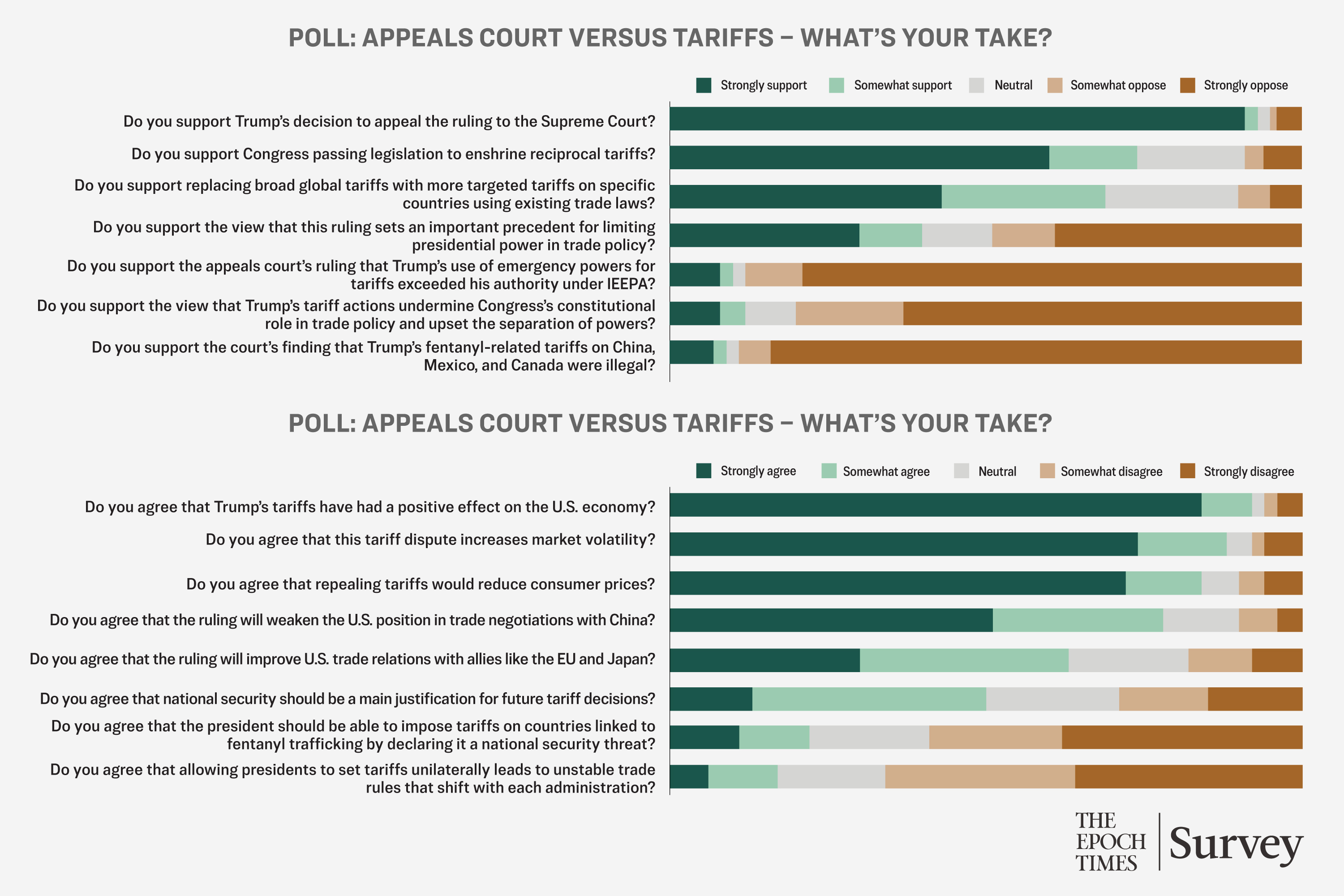
Respondents overwhelmingly supported the president’s view that his use of tariffs does not exceed his authority and his decision to appeal the appellate court’s ruling.
Of the 22,045 who participated in the survey, 88 percent opposed the appeals court’s finding that Trump’s use of emergency powers for tariffs exceeded his authority under IEEPA. Of those, 79 percent strongly opposed the finding. Ten percent of readers favored the court’s view.

The appeals court ruling stated that Congress did not “explicitly include the power to impose tariffs, duties, or the like, or the power to tax” in the law.
“If Congress will not move in this area, then Trump needs to move,” one reader wrote.
Another said, “All presidents being able to do this probably isn’t a good thing because I do not trust all presidents.”
An even higher number, 93 percent, supported Trump’s decision to appeal, with 91 percent strongly supporting it.
Only 5 percent of respondents opposed the decision to appeal the ruling.
One reader called the court’s judgment “a politically motivated decision not intended to benefit the general condition ... of the United States.”

Support for Reciprocal and Targeted Tariffs
One part of Trump’s tariff strategy has been to impose tariffs on other countries at the same rate they impose tariffs and other levies or restrictions on U.S. goods, broadly based on a trade deficit calculation. Readers appear to like the idea, with 74 percent supporting the idea that Congress should enshrine such reciprocal tariffs into law.
Just 9 percent of participants opposed the idea, but 17 percent were neutral on the idea.
One reader stated, “The world uses tariffs against the United States, and the president needs the ability to act quickly and unilaterally concerning trade tariffs.”
More than two-thirds (69 percent) of poll respondents supported the idea of using existing law to impose targeted tariffs.
Limits of Power
Article 1, Section 8 of the Constitution grants Congress the power to “collect taxes, duties, imposts and excises” and to “regulate Commerce with foreign Nations.”Some 12 percent of poll respondents supported the view that Trump’s tariffs undermine the constitutional role of Congress in setting trade policy. About 80 percent saw no threat to the separation of powers in Trump’s actions.
“I believe that if Congress objects to anything the President does, they should act,” a reader said.
However, opinions were divided on whether the appellate court’s ruling sets an important precedent for limiting presidential power. Some 30 percent of respondents felt strongly that the ruling does set an important precedent, and 30 percent said it does not.
Ten percent of respondents each somewhat supported and somewhat opposed that idea. Eleven percent were neutral.
Some readers suggested greater cooperation between the president and Congress on tariff matters.
“Allow the president 12–24 month tariff control, but force congress to take up measures within 90 days to either confirm, appeal, or reject these tariffs,” one reader said.
Another said, “The president should have the power to make these decisions, but Congress needs to codify them.”
The appeals court ruling does not take effect until Oct. 14, allowing some time for the appeal. As one reader put it, “We'll wait and see.”