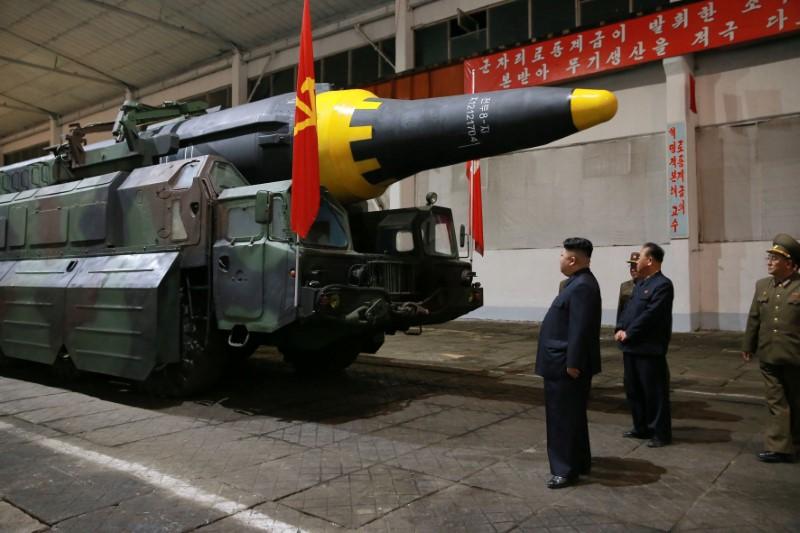
SEOUL—North Korea’s successful missile test-launch signals major advances in developing an intercontinental ballistic missile, such as mastery of re-entry technology and better engine performance key to targeting the United States, experts say.
The isolated country has been developing a long-range missile capable of striking the mainland United States mounted with a nuclear warhead. That would require a flight of 4,800 miles or more and technology to ensure a warhead’s stable re-entry into the atmosphere.
The North’s official KNCA news agency said the new strategic ballistic missile named Hwasong-12, fired on Sunday at the highest angle to avoid affecting neighboring countries’ security, flew 489 miles on a trajectory reaching an altitude of 1,312 miles.
The details reported by KCNA were largely consistent with South Korean and Japanese assessments that it flew further and higher than an intermediate-range missile (IRBM) tested in February from the same region, northwest of Pyongyang.
Such an altitude meant it was launched at a high trajectory, which would limit the lateral distance traveled. But if it was fired at a standard trajectory, it would have a range of at least 2,500 miles, experts said.
The test “represents a level of performance never before seen from a North Korean missile,” John Schilling, an aerospace expert, said in an analysis on the U.S.-based 38 North website.