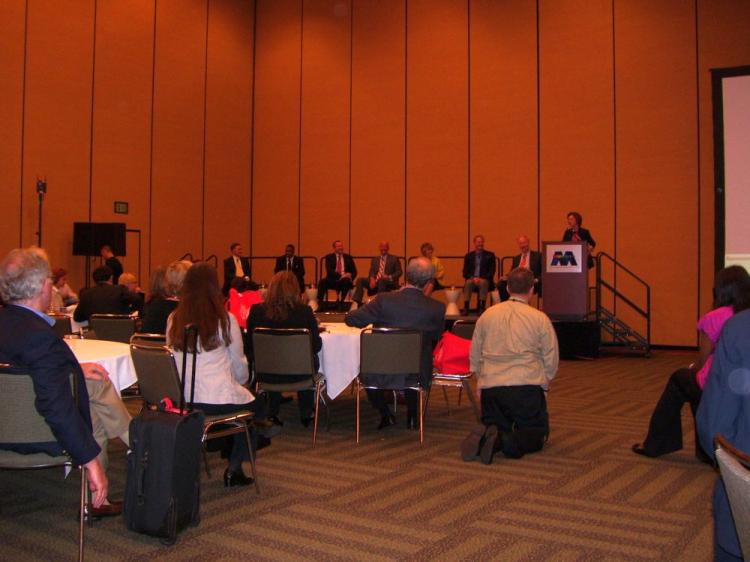
SAN FRANCISCO—The National Conference on Volunteering and Service brought leaders in volunteerism together during June 22 - 24 from all over North America for its annual meeting in San Francisco. Leaders of businesses and nonprofits attended to see what inspiration and cooperation they could garner from the meetings.
The message from the corporate world was that there are companies that are fully engaged in community volunteering, working with the systems and services that most closely match their products and abilities.
Some attendees acknowledged that their board of directors and top managers did want to see a gain in their bottom line from taking part in charity work, but many of the benefits were not easy to quantify. For instance, increased support of employees working in the community doing good deeds was credited with retaining good employees. Volunteerism also improved companies’ reputations.
The CEO of City Capital Corporation, Ephrem Taylor II, said that to him “sustainability is survivability.” It is a requirement that the work of the company be involved in some way in doing good works. His company was a holding and investment firm, so instead of investing in newly-built houses, they took abandoned houses and rehabilitated them so people could affordably live in them.
He said there was no vandalism or theft on projects when people from the community were employed in the home renovation projects.
Whatever a company produces, the leaders said that they find some way to use the skills and expertise of their employees to benefit others in their environment, sometimes directly, but often through a non-profit that was ready to do the work.
For instance, as a food company, Quaker Foods and Snacks helps feed hungry children, according to company president Mark Schiller. And they developed a way to use the sun’s power to process their Sun Chips product.
The president and CEO of eBay, Inc., John Donahoe said eBay is in the recycling business. Many items that would have been dumped into landfills are sold to others.
One of their customers sells “experienced” golf balls, which he scoops out of ponds, saving the resources needed to make new balls. The eBay founder has many times said, “I believe people are basically good.” And on that principle, the eBay system was built.
The principle of “Performance in Purpose” is the foundation for Quaker’s business, building into their products qualities people value. Schiller said three aspects are involved in this principle:
1. Human sustainability - making healthful food, as in the case of eliminating trans fats from their snacks in 2002, long before the public became aware of the potential problems with them.
2. Reducing Waste – they use the oat hulls for fuel to run the factory.
3. Maintaining and Sustaining talent - employees are happier at work.
Huge Change Has Taken Place
Schiller noted that there is a change in consumers’ attitudes. They have “moved from boycotting to buycotting.” If the company does the right thing, consumers reward it, and the money follows. Other leaders made similar statements.
John B. Veihmeyer, CEO of KPMG, said there is no conflict between corporate responsibility and profitability. When employees are inspired, committed to the community and fully engaged, the company’s profitability goes up. Lisa Mascolo of Accenture LTD said they are now using their skills, competencies and organization for charities their employees wish to support.
According to Jason McBriarty of Levi Strauss & Co., their founder always stressed giving back to the community, not because of outside pressure, but because it is the right thing to do.
It has been part of the jeans company culture and is currently expressed in supporting the free trade ideal. The company is working with their suppliers in Guatemala and also in another program recruiting retail employees to be involved in a denim recycling program. The program is a partnership with Goodwill industries.
Emily Tailey of Capital One found that bankers were ready to contribute long before it became popular. Intel’s Jeanne Forbis pointed out that as a math and science-based company, her top managers wanted to see numbers that showed the positive results of volunteerism. The information was hard to provide, but they did obtain data showing that when children exercised in programs they funded, the youngsters did better in school.
Her company is also one that chose to volunteer in the work they are supporting: they do more than just write a check.