A report examining the failed NASA launch of a Nuclear Compton Telescope from Australia earlier this year was recently released by the agency’s Mishap Investigation Board (MIB). The two volume report, totaling nearly 400 pages, investigates how a NASA mission resulted in the partial destruction of a University of California-owned gamma-ray telescope, a totaled car, and spectators narrowly escaping injury.
A NASA team planned to launch a 400-foot balloon carrying a $2 million telescope from the Alice Springs International Airport, located in Australia’s Northern Territory. The project was designed to help the agency look for distant galaxies from a vantage point high in Earth’s upper atmosphere, using a telescope developed to study astrophysical sources of nuclear line emission with high spectral and spatial resolution.
The launch team reported for duty at 2:00 a.m. on Apr. 29, 2010, determined that weather conditions were favorable, and began assembling the balloon and payload hardware at the launch site. The MIB concluded that there were no technical problems with either the launching vehicle or payload.
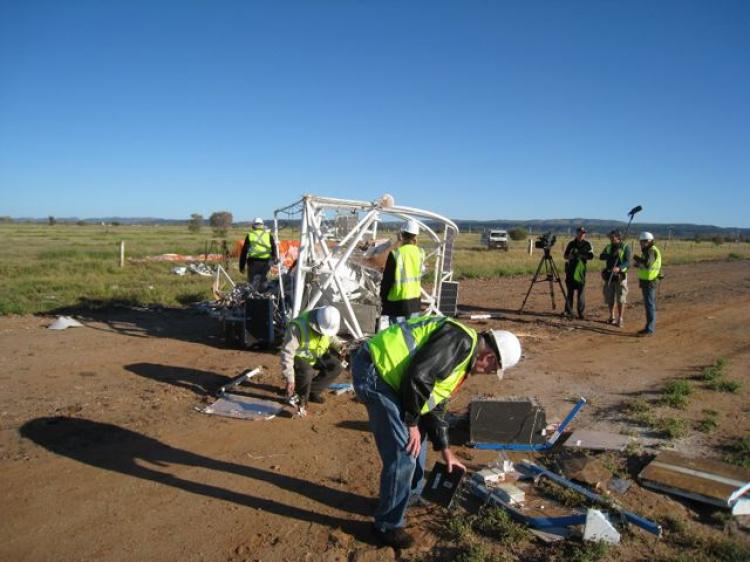
According to the report, however, after the balloon was released from its spool, the payload inadvertently separated from a mobile crane being used for the launch, and the two ton platform, including the telescope, was dragged for approximately 150 yards. Launch spectators were nearly hit by the runaway payload that struck an airport fence and destroyed an unoccupied parked car.
NASA commissioned an investigation in May 2010 to gather information and identify the causes related to the mishap. In an official memo for the mishap investigation, Goddard Space Flight Center director Robert Strain wrote, “Due to the severity of the proximity to the aborted launch to the spectators, the mishap investigation will place a high priority in addressing corrective actions needed to ensure public safety in future launch operations.”
The MIB report uncovered 25 causes related to accident, including insufficient risk analysis, contingency planning, personnel training, government oversight, and public safety accommodations. The board also listed 44 recommendations regarding the need for better communication; more robust range and ground safety plans and procedures; and better understanding of potentially unsafe conditions that can lead to accidents.
“There is no question in our minds that balloon launches are fragile processes,” said Michael L. Weiss of NASA’s Goddard Space Flight Center in a statement for the report release.
“The mishap board reviewed a large volume of information about the accident and conducted numerous interviews with eyewitnesses,” Weiss said. “But in the course of our investigation, we found surprisingly few documented procedures for balloon launches. No one considered the launch phase to be a potential hazard.”
Immediately following the accident in Australia, launch operations at all of NASA’s balloon sites were suspended. NASA says its Balloon Program Office will resume launches once it has implemented and verified new procedures to safeguard launch crews and the public.
“We have learned a lot from this incident, and we’ll have a better balloon program because of it,” Strain said in a statement.
A NASA team planned to launch a 400-foot balloon carrying a $2 million telescope from the Alice Springs International Airport, located in Australia’s Northern Territory. The project was designed to help the agency look for distant galaxies from a vantage point high in Earth’s upper atmosphere, using a telescope developed to study astrophysical sources of nuclear line emission with high spectral and spatial resolution.
The launch team reported for duty at 2:00 a.m. on Apr. 29, 2010, determined that weather conditions were favorable, and began assembling the balloon and payload hardware at the launch site. The MIB concluded that there were no technical problems with either the launching vehicle or payload.
According to the report, however, after the balloon was released from its spool, the payload inadvertently separated from a mobile crane being used for the launch, and the two ton platform, including the telescope, was dragged for approximately 150 yards. Launch spectators were nearly hit by the runaway payload that struck an airport fence and destroyed an unoccupied parked car.
NASA commissioned an investigation in May 2010 to gather information and identify the causes related to the mishap. In an official memo for the mishap investigation, Goddard Space Flight Center director Robert Strain wrote, “Due to the severity of the proximity to the aborted launch to the spectators, the mishap investigation will place a high priority in addressing corrective actions needed to ensure public safety in future launch operations.”
The MIB report uncovered 25 causes related to accident, including insufficient risk analysis, contingency planning, personnel training, government oversight, and public safety accommodations. The board also listed 44 recommendations regarding the need for better communication; more robust range and ground safety plans and procedures; and better understanding of potentially unsafe conditions that can lead to accidents.
“There is no question in our minds that balloon launches are fragile processes,” said Michael L. Weiss of NASA’s Goddard Space Flight Center in a statement for the report release.
“The mishap board reviewed a large volume of information about the accident and conducted numerous interviews with eyewitnesses,” Weiss said. “But in the course of our investigation, we found surprisingly few documented procedures for balloon launches. No one considered the launch phase to be a potential hazard.”
Immediately following the accident in Australia, launch operations at all of NASA’s balloon sites were suspended. NASA says its Balloon Program Office will resume launches once it has implemented and verified new procedures to safeguard launch crews and the public.
“We have learned a lot from this incident, and we’ll have a better balloon program because of it,” Strain said in a statement.