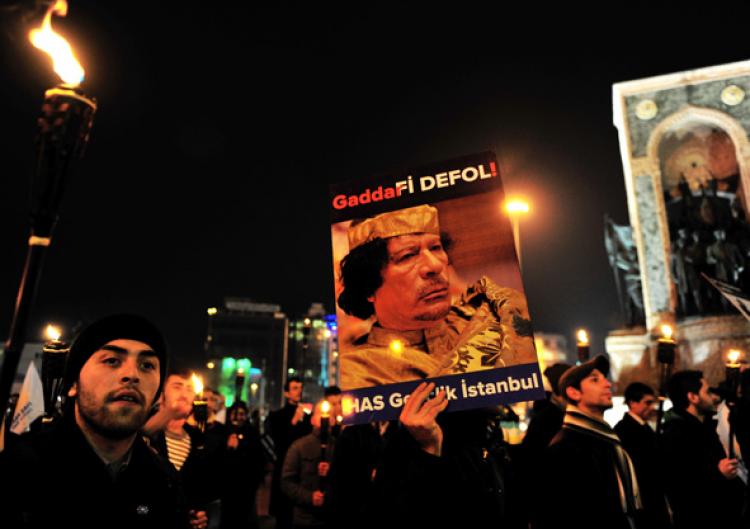
Muammar Gaddafi couldn’t have made it clearer, he has no intention of stepping down. The eccentric Libyan leader argued on national television on Tuesday that he is not the “president” of Libya but its “revolutionary leader,” and therefore cannot be disposed. Talking furiously he said he will fight until his last drop of blood and hopes to become a “martyr.”
In Gaddafi’s first appearance since the start of nationwide protests, he repeatedly called for all protesters, who he referred to as “drug-taking rats,” to be executed. The Libyan leader also called on those supporting him to attack the protesters, effectively pushing the country toward civil war.
Libyan people took to the streets last week inspired by the overthrows of long-standing leaders in Tunisia and Egypt. In Libya, people are revolting against Gaddafi’s 42-year dictatorship. Libya’s strongman denied reports he had ordered the army to crackdown on protesters, saying that, if he did, everything would burn.
In the eastern side of Libya, parts of the country are now completely controlled by opposition leaders. According to the BBC, there have been delirious celebrations in eastern Libya.
The United Nations Security Council (UNSC) held a closed discussion on Libya’s violent crack down on Tuesday after an urgent letter was sent by Libya’s envoy in New York calling on the council for action.
Libyan deputy ambassador to the U.N. Ibrahim Dabbashi and other Libyan diplomats renounced their connections to Col. Gaddafi’s regime and called for his overthrow.
Human Rights Watch (HRW), citing witnesses who were among protesters in the capital of Tripoli, reported that Libyan forces had randomly started firing at protesters in the city on Feb. 21 and 22.
One man told HRW through Skype that he saw unidentified men drive around shooting people passing by in the Ben Ashour neighborhood of Tripoli.
“We saw loads of Land Cruisers full of masked men in military uniforms and heavy machine guns heading to where the huge protests are downtown. Men wearing civilian clothing in the square were shooting at us,” the witness told HRW.
The organization said that it was unable to verify the information. It also has some accounts from two hospitals in Tripoli saying that their medical facilities had received at least 62 bodies since Feb. 20. Last Sunday, HRW reported the last known death toll of 233, citing firsthand accounts from witnesses. The true number of dead is suspected to be much higher.
Compared with the demonstrations in Tunisia and Egypt, it is much harder to get information out of Libya, especially since the regime shut down the Internet last Friday.
U.N. refugee agency (UNHCR) reported that it is having trouble getting to refugees or asylum seekers in Libya. It received some information from a third-party source, which is “very worrying.”
“A journalist has passed information to us from Somalis in Tripoli who say they are being hunted on suspicion of being mercenaries. He says they feel trapped and are frightened to go out, even though there is little or no food at home,” Melissa Fleming, UNHCR’s chief spokesperson, told journalists in Geneva on Tuesday.
The agency reported that inside Libya there are more than 8,000 registered refugees and 3,000 pending cases of asylum seekers originally from Chad, Palestine, Somalia, Sudan and Eritrea.
Additional reporting by Jasper Fakkert
In Gaddafi’s first appearance since the start of nationwide protests, he repeatedly called for all protesters, who he referred to as “drug-taking rats,” to be executed. The Libyan leader also called on those supporting him to attack the protesters, effectively pushing the country toward civil war.
Libyan people took to the streets last week inspired by the overthrows of long-standing leaders in Tunisia and Egypt. In Libya, people are revolting against Gaddafi’s 42-year dictatorship. Libya’s strongman denied reports he had ordered the army to crackdown on protesters, saying that, if he did, everything would burn.
In the eastern side of Libya, parts of the country are now completely controlled by opposition leaders. According to the BBC, there have been delirious celebrations in eastern Libya.
The United Nations Security Council (UNSC) held a closed discussion on Libya’s violent crack down on Tuesday after an urgent letter was sent by Libya’s envoy in New York calling on the council for action.
Libyan deputy ambassador to the U.N. Ibrahim Dabbashi and other Libyan diplomats renounced their connections to Col. Gaddafi’s regime and called for his overthrow.
Human Rights Watch (HRW), citing witnesses who were among protesters in the capital of Tripoli, reported that Libyan forces had randomly started firing at protesters in the city on Feb. 21 and 22.
One man told HRW through Skype that he saw unidentified men drive around shooting people passing by in the Ben Ashour neighborhood of Tripoli.
“We saw loads of Land Cruisers full of masked men in military uniforms and heavy machine guns heading to where the huge protests are downtown. Men wearing civilian clothing in the square were shooting at us,” the witness told HRW.
The organization said that it was unable to verify the information. It also has some accounts from two hospitals in Tripoli saying that their medical facilities had received at least 62 bodies since Feb. 20. Last Sunday, HRW reported the last known death toll of 233, citing firsthand accounts from witnesses. The true number of dead is suspected to be much higher.
Compared with the demonstrations in Tunisia and Egypt, it is much harder to get information out of Libya, especially since the regime shut down the Internet last Friday.
Refugees Trapped and Frightened
U.N. refugee agency (UNHCR) reported that it is having trouble getting to refugees or asylum seekers in Libya. It received some information from a third-party source, which is “very worrying.”
“A journalist has passed information to us from Somalis in Tripoli who say they are being hunted on suspicion of being mercenaries. He says they feel trapped and are frightened to go out, even though there is little or no food at home,” Melissa Fleming, UNHCR’s chief spokesperson, told journalists in Geneva on Tuesday.
The agency reported that inside Libya there are more than 8,000 registered refugees and 3,000 pending cases of asylum seekers originally from Chad, Palestine, Somalia, Sudan and Eritrea.
Additional reporting by Jasper Fakkert