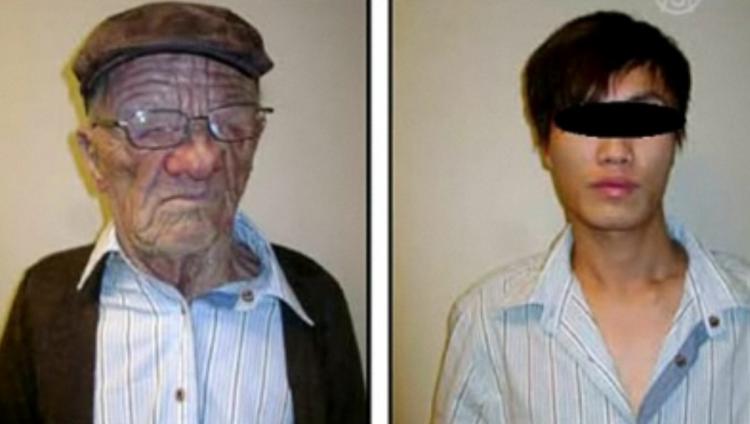
The man’s remarkable ruse got global media attention after someone at Canada Border Services Agency (CBSA) leaked images of the man with and without his mask, showing the dramatic difference.
The case stayed in the news after the man’s lawyer asked that several Chinese-language newspapers be banned from covering his immigration refugee board hearing in Vancouver, alleging these newspapers are under the control of the Chinese regime.
During a Monday hearing, the man’s lawyer, Dan McLeod, cited several stories from The Epoch Times and other media about the influence of the Chinese regime over Chinese-language media in Canada, including one that quoted a study by the Jamestown Foundation, a Washington-based think tank.
That study documented the financial and political ties between Chinese newspapers in North America and the Chinese Communist Party.
McLeod told The Epoch Times he wanted all media banned from the hearing but if that request was denied, he wanted at least the three pro-Beijing papers banned. He said he was worried that if they were allowed in, his client’s identity could become known by the Chinese regime.
“It could result in reprisals against his relatives in China,” he said.
The request surprised reporters from Sing Tao, Ming Pao and World Journal, the three papers the lawyer singled out.
While individual reporters may not be compromised, said McLeod, he noted a number of Chinese-language publications have run into controversy in the past for their apparent ties to Beijing.
In October 1995, Ming Pao was bought by Datuk Tiong Hiew King, a wealthy Malaysian merchant who has close business ties with Beijing. According to a report by the Jamestown Foundation, Ming Pao has since been “heavily influenced” by the Chinese regime, as have World Journal and Sing Tao Daily.
“Employees at Ming Pao’s New York office have told sources that their ‘true boss’ is none other than the Chinese Consulate [in New York], and that they are obligated to do whatever the consulate asks,” said the Jamestown report.
In April 2008, The Epoch Times reported an incident involving Sing Tao, whose Toronto edition is majority owned by the Toronto Star, but whose editorial department maintains close ties with the Sing Tao headquarters in Hong Kong.
The story showed that a Star article translated into Chinese by Sing Tao was given controversial edits that significantly changed the angle of the Chinese story from its original English version, and portrayed a pointedly pro-Beijing slant on Chinese-Canadians’ attitudes toward the turmoil in Tibet in 2008.
Wilson Chan, then the managing editor at the Chinese-language Sing Tao, was let go that fall over the controversy, according to sources that include two staff members at Sing Tao.
“Unfortunately, whether the individual journalists are influenced was not the question, it was whether the newspaper and the owners are influenced, they are the ones that decide the content of the newspaper and not the individual journalists,” said McLeod.
Sing Tao notes on its website that a senior company director also sits on the Chinese political consultative committee, an arm of the Chinese Communist Party, the ruling regime in China, he said.
“That is pretty straightforward—there is no dispute about what that organization is and there doesn’t seem to be any dispute that Sing Tao executives, at least one and possibly two … sit on the consultative conference,” he said.
While McLeod showed evidence that Beijing may influence Chinese media in Canada, Immigration and Refugee Board adjudicator Daphne Shaw-Dyck ruled on Wednesday that he had not presented a persuasive argument that those media would collect information to send back to Beijing. Media can attend the hearings but cannot report any information that would identify the man, his family or his associates.
She also ruled that the man would remain detained until CBSA had determined his identity.