

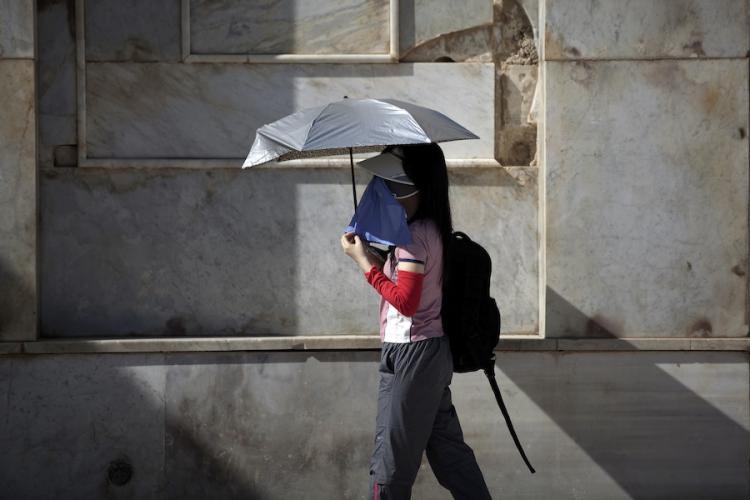
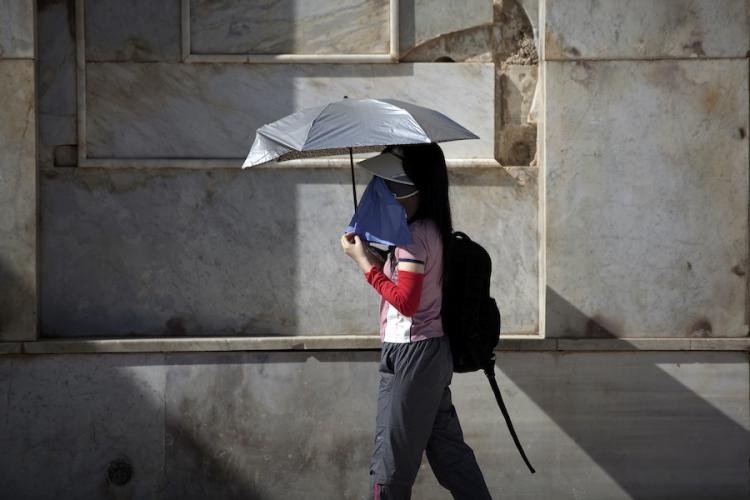
JERUSALEM—If you live in the Middle East, sooner or later you need to understand the awesome power that the sun wields here. No, scratch that. You need to have a healthy fear of the sun here.
This is just one of those places in the world where if you’re not using your head, the sun can take you down with one case of sunstroke. The funny part is, it’s so simple. If you don’t drink water and pace yourself, you could be gambling with your life.
If you’re thinking this is a bit melodramatic, you’ve probably never experienced sunstroke. The wrong combination of factors could spell days of tormented, feverish, searing pain, punctuated by vomiting. A worst case scenario could spell death. Even in the United States and other countries, when there are massive heat waves that wipe out air conditioners and damage power grids, people sometimes die.
Take those same people—unaccustomed on the whole to horribly hot temperatures—and put them in the Middle East. In Israel, they call it the “sharav.” It loosely translates as the “burden of heat.” The idea that heat can be a burden means staying inside the house where there is air conditioning, shade, and a cocoon of safety from the sun.
Last week, there were record-breaking temperatures in Israel, and it got up to 98 degrees Fahrenheit in Jerusalem alone—a city that is typically quite temperate. On the worst day, the morning started out hot, and I woke up with the strange, dry headache that usually comes after not drinking enough water. It was only 8:00 a.m. and I knew there was a heat outside waiting for me that was like no other I had experienced. I never once ventured outside that day, forcing myself to drink glass after glass of water.
When it comes to avoiding heat here, simply dodging the sunlight is one of the best strategies possible. On days that the heat seems to hunt you down, there’s nothing like the shade of a tree. When I am near buildings, I like to move from the shade of one facade to the next.
Yes, there’s nothing like the warm sun on your back on a clear day without a cloud in the sky. But when the weather is like that basically every single day, the effects of the sun on the environment become more noticeable. Everything looks like it has been baked and browned and weathered away, until it is all a small variance of shades of brown. The stones, the trees, the dirt, even the people are toned and cured by the sun to be brown. Even I am several shades darker than when I arrived a few months ago.
The best part of the burden of heat, or the heat wave, is when the burden is finally lifted and the heat breaks. It comes on as an annoying day of very windy weather, as though the heat is being blown away. It’s both a relief and incredibly annoying. But as with so many things I’ve gone through in the Middle East, it’s a moment that marks survival. You’ve borne the burden of heat and come out the other side, so a little wind whipping you in the face seems like a lighthearted gesture of playfulness from the weather.
This is just one of those places in the world where if you’re not using your head, the sun can take you down with one case of sunstroke. The funny part is, it’s so simple. If you don’t drink water and pace yourself, you could be gambling with your life.
If you’re thinking this is a bit melodramatic, you’ve probably never experienced sunstroke. The wrong combination of factors could spell days of tormented, feverish, searing pain, punctuated by vomiting. A worst case scenario could spell death. Even in the United States and other countries, when there are massive heat waves that wipe out air conditioners and damage power grids, people sometimes die.
Take those same people—unaccustomed on the whole to horribly hot temperatures—and put them in the Middle East. In Israel, they call it the “sharav.” It loosely translates as the “burden of heat.” The idea that heat can be a burden means staying inside the house where there is air conditioning, shade, and a cocoon of safety from the sun.
Last week, there were record-breaking temperatures in Israel, and it got up to 98 degrees Fahrenheit in Jerusalem alone—a city that is typically quite temperate. On the worst day, the morning started out hot, and I woke up with the strange, dry headache that usually comes after not drinking enough water. It was only 8:00 a.m. and I knew there was a heat outside waiting for me that was like no other I had experienced. I never once ventured outside that day, forcing myself to drink glass after glass of water.
When it comes to avoiding heat here, simply dodging the sunlight is one of the best strategies possible. On days that the heat seems to hunt you down, there’s nothing like the shade of a tree. When I am near buildings, I like to move from the shade of one facade to the next.
Yes, there’s nothing like the warm sun on your back on a clear day without a cloud in the sky. But when the weather is like that basically every single day, the effects of the sun on the environment become more noticeable. Everything looks like it has been baked and browned and weathered away, until it is all a small variance of shades of brown. The stones, the trees, the dirt, even the people are toned and cured by the sun to be brown. Even I am several shades darker than when I arrived a few months ago.
The best part of the burden of heat, or the heat wave, is when the burden is finally lifted and the heat breaks. It comes on as an annoying day of very windy weather, as though the heat is being blown away. It’s both a relief and incredibly annoying. But as with so many things I’ve gone through in the Middle East, it’s a moment that marks survival. You’ve borne the burden of heat and come out the other side, so a little wind whipping you in the face seems like a lighthearted gesture of playfulness from the weather.


