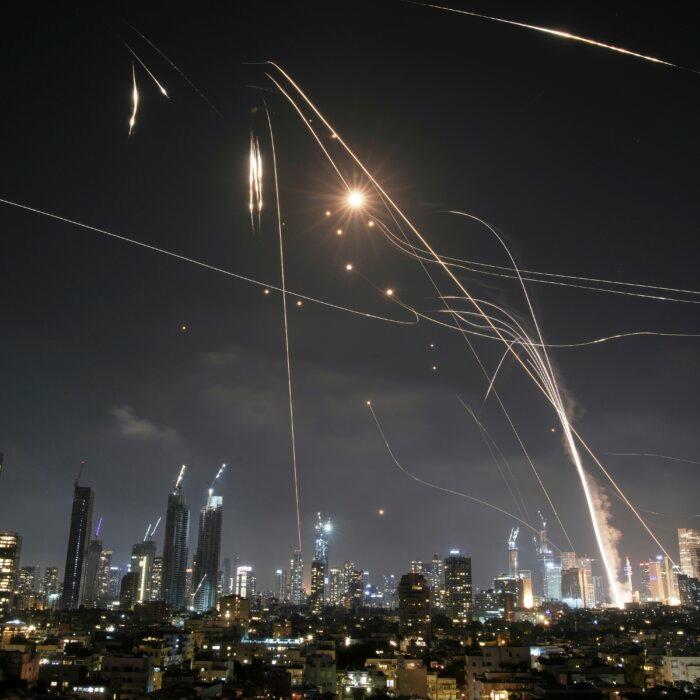
Israel and Iran continued to exchange missile strikes on June 14 and into June 15.
The Israel Defense Forces (IDF) announced on Telegram at 2:40 a.m. local time, “A short while ago, the IAF completed an extensive series of intelligence-based strikes on a number of targets in Tehran related to the Iranian regime’s nuclear weapons project.
“The targets included the Iranian Ministry of Defense headquarters, the headquarters of the SPND nuclear project, and additional targets, which advanced the Iranian regime’s efforts to obtain a nuclear weapon and where the Iranian regime hid its nuclear archive.”
Israeli Defense Minister Israel Katz wrote on social media earlier on June 14, “Tehran is burning,” after the Islamic regime launched its initial retaliatory attack in the waning hours of June 13.
Since Iran’s initial response, the two nations have volleyed strikes. The IDF said just after midnight Israel time on Telegram, “While the IDF is operating to intercept missiles launched from Iran, the IAF is currently striking military targets in Tehran.”
Saturday night marked the second consecutive night when sirens and calls for people to shelter in place continuously rang out across Israel, and at least three people were killed and dozens injured.

Despite Iran’s continued onslaught, Israel touts the advantage. Israel’s army spokesman, Brig. Gen. Effie Defrin, said earlier on June 14 that his nation had attacked more than 400 “missile-related” targets and others in Iran, including 40 in the capital, Tehran. He said dozens of fighter jets were “operating freely” in the skies above the capital.
Israel has said its key objective is to cripple Iran’s nuclear progress.
The International Atomic Energy Agency (IAEA) Director General Rafael Grossi confirmed that Israel dealt significant blows to at least Iran’s nuclear facility in Natanz.
“The level of radioactivity outside the Natanz site has remained unchanged and at normal levels, indicating no external radiological impact to the population or the environment from this event,” Grossi said. “However, due to the impacts, there is radiological and chemical contamination inside the facilities in Natanz.”
Israel’s attack was launched just before Iran and the United States were supposed to meet in Oman for the latest round of talks involving its nuclear program.
After Israel’s attack, and the United States’s confirmation that it was assisting Israel in shooting down Iranian missiles, those talks are unlikely to continue.
“The other side acted in a way that makes dialogue meaningless. You cannot claim to negotiate and at the same time divide work by allowing the Zionist regime to target Iran’s territory,” Iran’s foreign ministry spokesperson Esmaeil Baghaei told the state-affiliated Tasnim news agency on June 14.
Trump said he also expressed his view that the Russia–Ukraine war should also come to an end.