America’s founding principles, the moral character of its citizens, and the idea that rights are derived from God—not government—are essential to the country’s greatness, according to a poll conducted by The Epoch Times of nearly 1,900 readers.
Each generation of Americans has a personal responsibility to uphold and strengthen the nation’s ideals, readers overwhelmingly reported in the survey, but they also said that young Americans today are not learning enough about the sacrifices required to preserve them.
Essentials to American Freedom
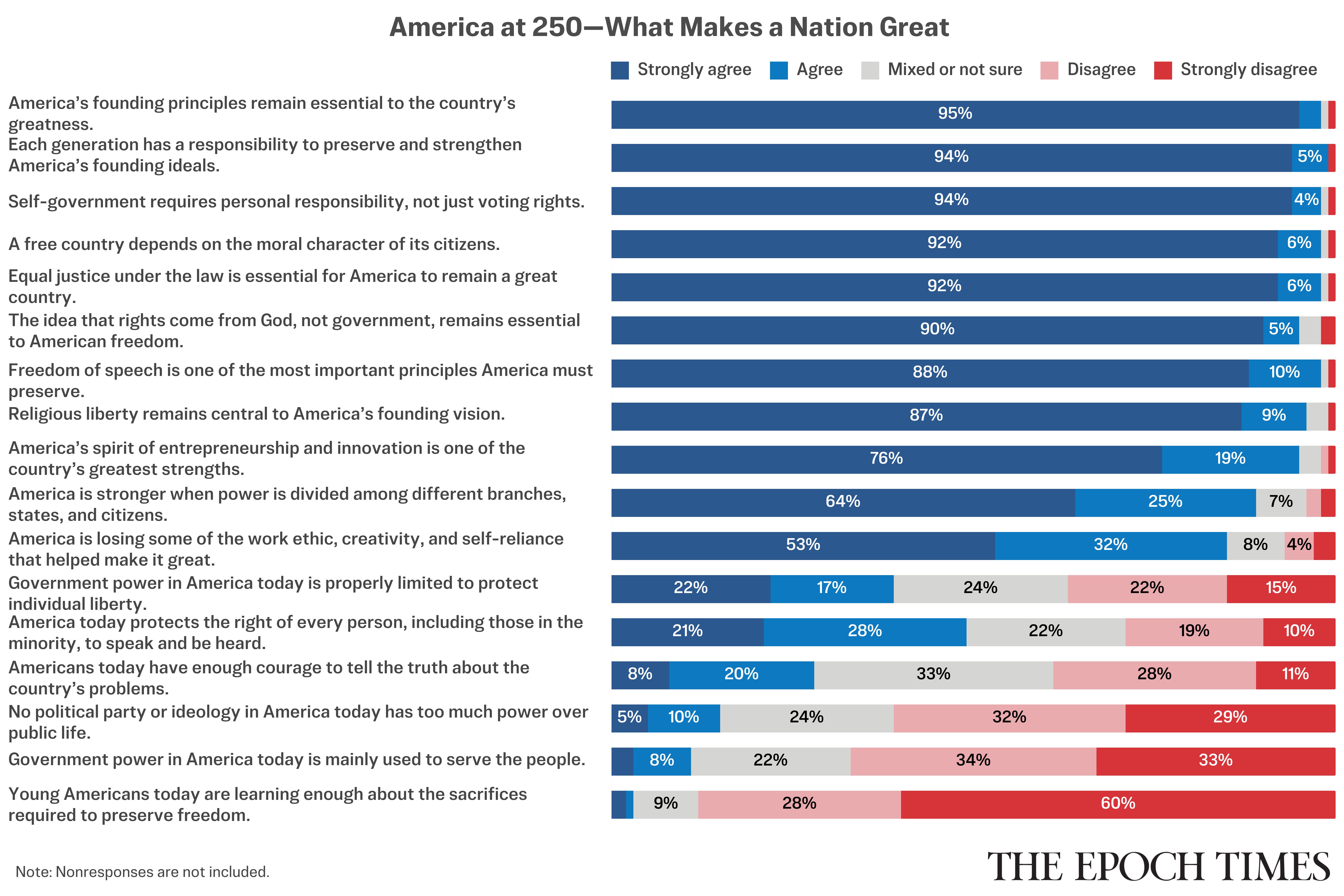
Readers who participated in the poll overwhelmingly reported that America’s founding principles are crucial to the country’s greatness, with 98 percent reporting they “strongly agree” or “agree.”
These founding principles include, but are not limited to, equal justice, inalienable rights, freedom of speech, religious freedom, individual liberty, limited government, and the rule of law.
Respondents were asked about these principles and how important they are to American freedom.

On equal justice under the law, 98 percent of respondents marked “strongly agree” or “agree” that this is essential to remaining a great country.
The survey also asked participants whether the idea that rights come from God—not government—is essential, and 95 percent of respondents said they “strongly agree” or “agree.”
Freedom of religion and speech remain among the core founding principles of America that must be preserved, the majority of respondents said.
On speech, 98 percent “strongly agree” or “agree” that it’s one of the most important aspects of America to be upheld. For religion, 96 percent “strongly agree” or “agree” that it’s central to the country’s founding vision.
But when asked whether America today upholds the right of every person to speak or be heard, the results were more mixed.
Twenty-one percent said they “strongly agree,” 28 percent said “agree,” 10 percent said “strongly disagree,” 19 percent said “disagree,” and 22 percent said “mixed or not sure.”
Personal Responsibility
America’s self-governance requires personal responsibility of its citizens, and not just voting rights. Ninety-eight percent of respondents said they “strongly agree” or “agree” with this statement.
Furthermore, 99 percent “strongly agree” or “agree” that each generation has a responsibility to preserve and strengthen America’s founding ideals. Ninety-eight percent of respondents reported they “strongly agree” or “agree” that a free country depends on the moral character of its citizens.
This ties into America’s spirit of entrepreneurship and innovation, which 95 percent of survey participants said they “strongly agree” or “agree” is among the United States’ greatest strengths.
Eighty-five percent, however, reported they “strongly agree” or “agree” that America is losing its work ethic, creativity, and self-reliance that helped make it great in the first place.
Respondents gave similar marks to younger generations of Americans.
When asked to rank whether they are learning enough about the sacrifices required to preserve freedom, 88 percent of participants in the poll said they “strongly disagree” or “disagree.”
Mixed results were recorded on whether Americans have the courage to tell the truth about the country’s problems. Eight percent said they “strongly agree,” 20 percent said “agree,” 11 percent said “strongly disagree,” 28 percent said “disagree,” and 33 percent said “mixed or not sure.”
Government Power
Respondents were also questioned about the role of government in America and its impact on citizens.
Eighty-nine percent “strongly agree” or “agree” that America is stronger when power is divided among different branches of the federal government, states, and citizens.
But respondents were mixed on government limitations.
Twenty-two percent “strongly agree,” 17 percent “agree,” 15 percent “strongly disagree,” 22 percent “disagree,” and 24 percent were “mixed or not sure” when asked if government power is being properly limited today to protect individual liberty.
A majority of respondents, 62 percent, said they “strongly disagree” or “disagree” that no political party or ideology in the country has too much power over public life. Twenty-four reported they were “mixed or not sure,” leaving 15 percent saying they “strongly agree” or “agree.”
Similar rankings were observed when respondents were asked whether government power in America today is mainly used to serve the people.
Only 11 percent said they “strongly agree” or “agree,” and 67 percent reported they “strongly disagree” or “disagree.” The remaining 22 percent said they were “mixed or not sure.”