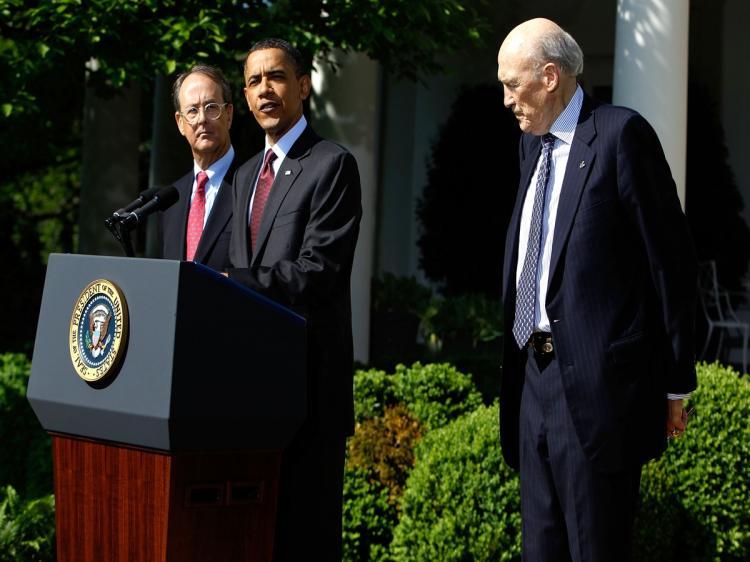
WASHINGTON—The 18 members of the executive-appointed bipartisan debt commission have been in secret meetings this week finalizing a debt reduction plan that was originally scheduled for release Wednesday, but has now been delayed until Friday.
The commission, headed by former White House Chief of Staff Erskine Bowles and former Republican Senate Whip Alan Simpson, requires 14 members to agree to recommendations.
A draft plan released by Bowles/Simpson on Nov. 11 got the ball rolling on a serious debate about the debt, shortly after the midterm elections.
A number of other plans, such as one released by the Bipartisan Policy Center on Nov. 17, have added to the discussion.
According to design, these plans put everything on the table, including across the board spending cuts, and tax and fee increases. These may be needed to meet the president’s stated goal of at least a balanced budget (not including debt payments) by 2015.
But one aspect of the Bowles/Simpson plan that could be overlooked, having received less media attention, is one to watch for on Friday when the final report is made public.
The issue is government oversight and accountability, and it touches on the culture in Washington that so often draws public ire and frustration.
During the commission’s fifth public meeting, available for online viewing on the commission’s website, members delved into government failures of accountability in an unusually frank way.
What follows is some of the detail from that meeting:
A presentation of the Government Accountability Office (GAO), a well respected research arm of the government that regularly reports on government waste and inefficiencies, elicited the candid discussions.
GAO reports, as well as their recommendations are often ignored in the business of the government, said Sen. Tom Coburn (R-Okla.).
GAO’s presentation to the commission focused on identifying areas of potential fragmentation, overlap, and duplication within the federal government.
“You will find programs supporting a particular goal in many different places and also using many different tools—tax credits, as well as grant programs, grant spending, loan guarantees—housing is one, research is another, energy programs is another one that you will find across the government,” said Patricia Dalton, managing director, Natural Resources and Environment with GAO.
In just one example cited by GAO, there are 20 federal agencies administering 200 programs providing assistance to individuals with disabilities. The programs developed independently, and they are not coordinated, making it impossible to assess overall results, and/or the success or failure of the programs.
Bowles said that with a $1.6 trillion dollar deficit, we have to operate more effectively, or the nation will go broke, and that we now have every incentive to “follow up to make sure that the money that we are spending at least is being spent wisely.”
“I do not think that the issue is runaway spending. It is that we have particular interests, each and every one of us. It is the same thing with the health care bill. We had every kind of interest group come in and tell us that they were too important to cut,” said Rep. Xavier Becerra (D-Calif. 31).
“Our problem is that we put parochial concerns ahead of the best long-term interests of the country,” said Sen. Tom Coburn (R-Okla.).
“That is really what’s happened and how we have gotten out of control. And the American people smell that. And that is why it is really important what we do in this commission. We could actually start a trend that would stop that. So we would all be dedicated, even with our own political bosses and our own philosophical differences to try to be doing the best right thing in the long-term for the country as a whole,” added Coburn.
The kind of problems pointed out by GAO occur because all of the discussion about whether to do a program or not happens at the time of appropriations. Without data available to measure the effectiveness of current programs, lawmakers are ill-equipped to make decisions.
“It is a cultural focus on the metrics of input,” said Rep. Paul Ryan (R-Wis. 1).
Lack of accountability due to frequent changes of agency leadership after elections is another problem committee members discussed. After leaders agree to make reforms, a new leader arrives and the process must begin again.
Further, Rep. Paul Ryan (R-Wis. 1) suggested that If he were to accept a GAO report and follow some of its recommendations, he might actually become liable for cutting an organization’s funding.
“The culture does not reward efficiency. The culture rewards inefficiency,” he said.
“There is an interest behind every dime that is in the federal budget,” Sen. Kent Conrad (D-N.D.).
Every two years GAO provides Congress with a list of areas at risk for potential waste, fraud, abuse, and mismanagement. As of Nov. 2009, there were 31 areas on the list, including DOD’s contract management, Medicare, Medicaid, and restructuring the U.S. Postal Service to achieve sustainable financial viability.
GAO also identified billions of dollars in potential savings in programs that have become bloated or may have outlived their effectiveness, even cases of money still being claimed after the intended purpose for it has clearly expired.
The Bowles/Simpson draft document says, “Demand Productivity and Effectiveness,” is one of 10 guiding principles for their report.
Under this bullet point, they list “fiscal restraints to promote savings through reforms and efficiencies that force government to produce better results.”
When the cochairmen release their report, Americans will be looking to see what kind of enhanced oversight and accountability requirements are included.
The commission, headed by former White House Chief of Staff Erskine Bowles and former Republican Senate Whip Alan Simpson, requires 14 members to agree to recommendations.
A draft plan released by Bowles/Simpson on Nov. 11 got the ball rolling on a serious debate about the debt, shortly after the midterm elections.
A number of other plans, such as one released by the Bipartisan Policy Center on Nov. 17, have added to the discussion.
According to design, these plans put everything on the table, including across the board spending cuts, and tax and fee increases. These may be needed to meet the president’s stated goal of at least a balanced budget (not including debt payments) by 2015.
But one aspect of the Bowles/Simpson plan that could be overlooked, having received less media attention, is one to watch for on Friday when the final report is made public.
The issue is government oversight and accountability, and it touches on the culture in Washington that so often draws public ire and frustration.
During the commission’s fifth public meeting, available for online viewing on the commission’s website, members delved into government failures of accountability in an unusually frank way.
What follows is some of the detail from that meeting:
A presentation of the Government Accountability Office (GAO), a well respected research arm of the government that regularly reports on government waste and inefficiencies, elicited the candid discussions.
GAO reports, as well as their recommendations are often ignored in the business of the government, said Sen. Tom Coburn (R-Okla.).
GAO’s presentation to the commission focused on identifying areas of potential fragmentation, overlap, and duplication within the federal government.
“You will find programs supporting a particular goal in many different places and also using many different tools—tax credits, as well as grant programs, grant spending, loan guarantees—housing is one, research is another, energy programs is another one that you will find across the government,” said Patricia Dalton, managing director, Natural Resources and Environment with GAO.
In just one example cited by GAO, there are 20 federal agencies administering 200 programs providing assistance to individuals with disabilities. The programs developed independently, and they are not coordinated, making it impossible to assess overall results, and/or the success or failure of the programs.
Bowles said that with a $1.6 trillion dollar deficit, we have to operate more effectively, or the nation will go broke, and that we now have every incentive to “follow up to make sure that the money that we are spending at least is being spent wisely.”
“I do not think that the issue is runaway spending. It is that we have particular interests, each and every one of us. It is the same thing with the health care bill. We had every kind of interest group come in and tell us that they were too important to cut,” said Rep. Xavier Becerra (D-Calif. 31).
“Our problem is that we put parochial concerns ahead of the best long-term interests of the country,” said Sen. Tom Coburn (R-Okla.).
“That is really what’s happened and how we have gotten out of control. And the American people smell that. And that is why it is really important what we do in this commission. We could actually start a trend that would stop that. So we would all be dedicated, even with our own political bosses and our own philosophical differences to try to be doing the best right thing in the long-term for the country as a whole,” added Coburn.
The kind of problems pointed out by GAO occur because all of the discussion about whether to do a program or not happens at the time of appropriations. Without data available to measure the effectiveness of current programs, lawmakers are ill-equipped to make decisions.
“It is a cultural focus on the metrics of input,” said Rep. Paul Ryan (R-Wis. 1).
Lack of accountability due to frequent changes of agency leadership after elections is another problem committee members discussed. After leaders agree to make reforms, a new leader arrives and the process must begin again.
Further, Rep. Paul Ryan (R-Wis. 1) suggested that If he were to accept a GAO report and follow some of its recommendations, he might actually become liable for cutting an organization’s funding.
“The culture does not reward efficiency. The culture rewards inefficiency,” he said.
“There is an interest behind every dime that is in the federal budget,” Sen. Kent Conrad (D-N.D.).
Every two years GAO provides Congress with a list of areas at risk for potential waste, fraud, abuse, and mismanagement. As of Nov. 2009, there were 31 areas on the list, including DOD’s contract management, Medicare, Medicaid, and restructuring the U.S. Postal Service to achieve sustainable financial viability.
GAO also identified billions of dollars in potential savings in programs that have become bloated or may have outlived their effectiveness, even cases of money still being claimed after the intended purpose for it has clearly expired.
The Bowles/Simpson draft document says, “Demand Productivity and Effectiveness,” is one of 10 guiding principles for their report.
Under this bullet point, they list “fiscal restraints to promote savings through reforms and efficiencies that force government to produce better results.”
When the cochairmen release their report, Americans will be looking to see what kind of enhanced oversight and accountability requirements are included.