TORONTO—The Colorado Rapids used a rugged approach that personified determination and the will to win in securing their first MLS Cup 2–1 in extra time over FC Dallas last Sunday at BMO Field in Toronto.
FC Dallas central defender George John deflected a weak shot by Colorado substitute forward Macoumba Kandji into his own net in the 108th minute for the winning tally.
It was an ugly winner in a scrappy game in which the referee Baldomero Toledo failed to settle down the physical aspect of the game, not unlike what took place in the World Cup final in July.
The first MLS Cup final to be played outside of the United States took place on a clear but cold night. Game time temperature was 45 degrees. There were many empty seats at BMO Field on the cold night, although attendance was reported as a sell-out at 21,700.
It would be the first title for either team and both teams were absolutely leaving nothing off the table as the game got underway.
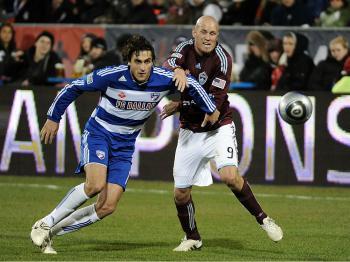
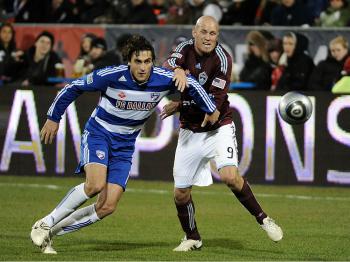
Rapids striker Conor Casey was in his element, with some hard challenges on several FC Dallas players. The two teams quickly developed distaste for one another.
“The ref basically let the game be played by the players,” FC Dallas head coach Schellas Hyndman said in his post-match press conference.
Colorado’s tactics were to gain control of the midfield with their tandem of Jeff Larentowicz and Pablo Mastroeni. For long stretches of the game, the tandem was successful.
Head coach Gary Smith knew he had to shut down FC Dallas’s midfield dynamo David Ferreira, who was named MLS MVP, and devise a strategy to counter a team that was generally favored to win.
“Sport is about adapting. Our team adapted very well. Not sure it was the greatest viewing for fans. It was such a cut-and-thrust game,” Smith said.
“This group is capable of mixing it with some of the more physical and bigger sides, and they kept the ball playing when necessary. For me that’s a good balance in a group,” Smith added.
Hyndman surmised that Colorado had come up with a plan to take advantage of the conditions and the situation to give themselves the best chance to win.
“Physical play is disruptive. If that was their game plan, it was perfect,” said Hyndman.
The soccer spectacle won’t be remembered for terrific technical skill but, much like the World Cup final, it was all about a team—the Colorado Rapids—doing what they felt gave them the best chance to win.
In the World Cup final, Netherlands was overmatched by Spain’s silky smooth midfield and they adopted an aggressive physicality to try and shut it down.
World Cup referee Howard Webb was criticized for missing Nigel de Jong’s karate kick to the chest of Xabi Alonso. (It should have been a red card). Instead, scrappy play went on, and the yellow cards rained down, turning the match into a disaster for soccer purists.
In Toronto, referee Toledo could have shown red to Rapids defender Anthony Wallace for a slide tackle from behind as well dishing out a handful of yellow cards. But instead, Wallace received the only yellow card of the first half.
FC Dallas central defender George John deflected a weak shot by Colorado substitute forward Macoumba Kandji into his own net in the 108th minute for the winning tally.
It was an ugly winner in a scrappy game in which the referee Baldomero Toledo failed to settle down the physical aspect of the game, not unlike what took place in the World Cup final in July.
Tough Conditions
The first MLS Cup final to be played outside of the United States took place on a clear but cold night. Game time temperature was 45 degrees. There were many empty seats at BMO Field on the cold night, although attendance was reported as a sell-out at 21,700.
It would be the first title for either team and both teams were absolutely leaving nothing off the table as the game got underway.
Rapids striker Conor Casey was in his element, with some hard challenges on several FC Dallas players. The two teams quickly developed distaste for one another.
“The ref basically let the game be played by the players,” FC Dallas head coach Schellas Hyndman said in his post-match press conference.
Colorado’s tactics were to gain control of the midfield with their tandem of Jeff Larentowicz and Pablo Mastroeni. For long stretches of the game, the tandem was successful.
Head coach Gary Smith knew he had to shut down FC Dallas’s midfield dynamo David Ferreira, who was named MLS MVP, and devise a strategy to counter a team that was generally favored to win.
“Sport is about adapting. Our team adapted very well. Not sure it was the greatest viewing for fans. It was such a cut-and-thrust game,” Smith said.
“This group is capable of mixing it with some of the more physical and bigger sides, and they kept the ball playing when necessary. For me that’s a good balance in a group,” Smith added.
Hyndman surmised that Colorado had come up with a plan to take advantage of the conditions and the situation to give themselves the best chance to win.
“Physical play is disruptive. If that was their game plan, it was perfect,” said Hyndman.
The soccer spectacle won’t be remembered for terrific technical skill but, much like the World Cup final, it was all about a team—the Colorado Rapids—doing what they felt gave them the best chance to win.
In the World Cup final, Netherlands was overmatched by Spain’s silky smooth midfield and they adopted an aggressive physicality to try and shut it down.
World Cup referee Howard Webb was criticized for missing Nigel de Jong’s karate kick to the chest of Xabi Alonso. (It should have been a red card). Instead, scrappy play went on, and the yellow cards rained down, turning the match into a disaster for soccer purists.
In Toronto, referee Toledo could have shown red to Rapids defender Anthony Wallace for a slide tackle from behind as well dishing out a handful of yellow cards. But instead, Wallace received the only yellow card of the first half.