From California to Virginia, youth gender clinics are pausing or halting medicalized treatments, and the nation’s largest one has closed, in the wake of Trump administration policies.
Facilities that provide chemical and surgical treatments to gender-confused children now face increasing pressure under new state laws, federal policy changes, investigations into their practices, and litigation. At least two disputes over gender-related treatment reached the U.S. Supreme Court this year.
The number of youths who identify as transgender has ballooned, along with concerns over the long-term health risks of gender-related hormones and surgeries.
In the United States, about half of the states banned such treatments for minors in recent years. Court challenges followed.
Fourteen other states, mostly Democrat-dominant, enacted “shield” or “refuge” laws intended to ensure access to these types of interventions, according to The Williams Institute, a think tank based at the University of California–Los Angeles School of Law that focuses on LGBT-related issues.
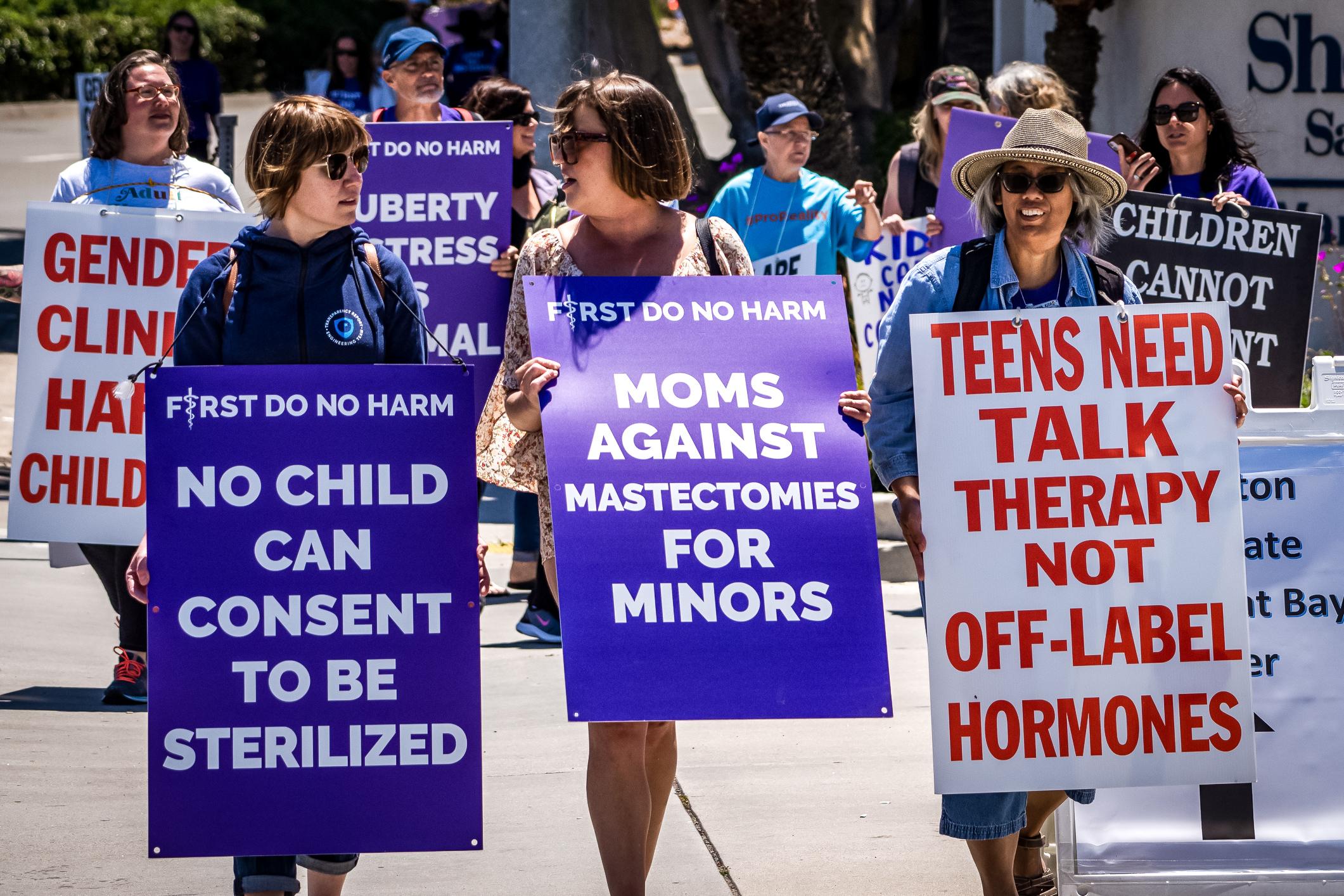
Still, clinics in some of those states, including California, recently stopped some or all of the medical procedures under political and legal pressures. In several cities, protesters decried the impact on young patients; demonstrators in Seattle hoisted placards urging, “Protect Trans Kids.”
Transgender activists nationwide continue to funnel children into a “pipeline” for gender-related medical procedures, Idaho counselor Peggy McFarland, who specializes in treating girls, women, and relationships, told The Epoch Times.
“It’s great that [certain clinics] are not medically harming children’s bodies anymore,” she said. “But the ideological war and movement behind medical transitioning, that is still very much alive.”
The debate around gender ideology and care for gender-confused youths continues to divide researchers, parents, and policymakers in the United States.
McFarland said controversy over caring for these youths stems from a pair of contradictory, incompatible belief systems.
The Trump Factor
Under President Donald Trump’s policies, opponents of gender-related treatments are freer to speak out, McFarland said, creating an opportunity to show people “what the war actually is.”The president denounced “the radical and false claim that adults can change a child’s sex through a series of irreversible medical interventions.”
“This dangerous trend will be a stain on our Nation’s history, and it must end,” he wrote.
Trump said that the U.S. government will not fund or assist “the so-called ‘transition’ of a child from one sex to another, and it will rigorously enforce all laws that prohibit or limit these destructive and life-altering procedures.”
That order, which applies to people younger than age 19—coupled with other federal actions and state restrictions—sparked an outcry from the transgender community.
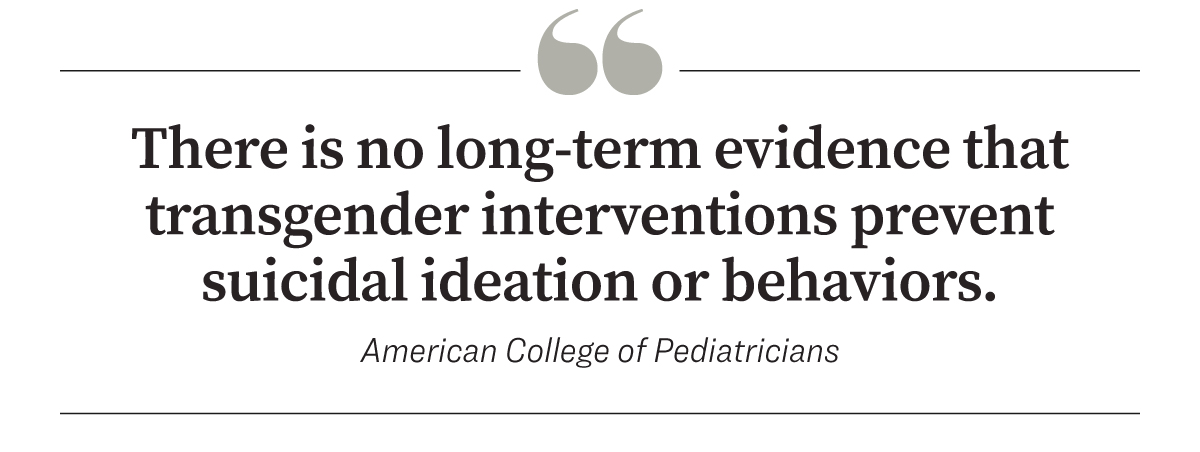
However, according to the American College of Pediatricians, “There is no long-term evidence that transgender interventions prevent suicidal ideation or behaviors.”
Instead, these procedures are likely to cause long-term harm to mental and physical health, along with sterility, according to the organization.
“There are no good, long-term studies showing any benefits,“ the organization stated. ”Nor can informed consent by pediatric patients be legitimate given the immaturity of their brains.”

“Affirming a transgender child’s identity is one of the best things a parent, teacher, or doctor can do to help keep children from harm, and parents who love and affirm their children should be applauded and supported, not threatened, investigated, or stigmatized,” the Biden White House said in a 2022 statement.
Shift in Political Tide

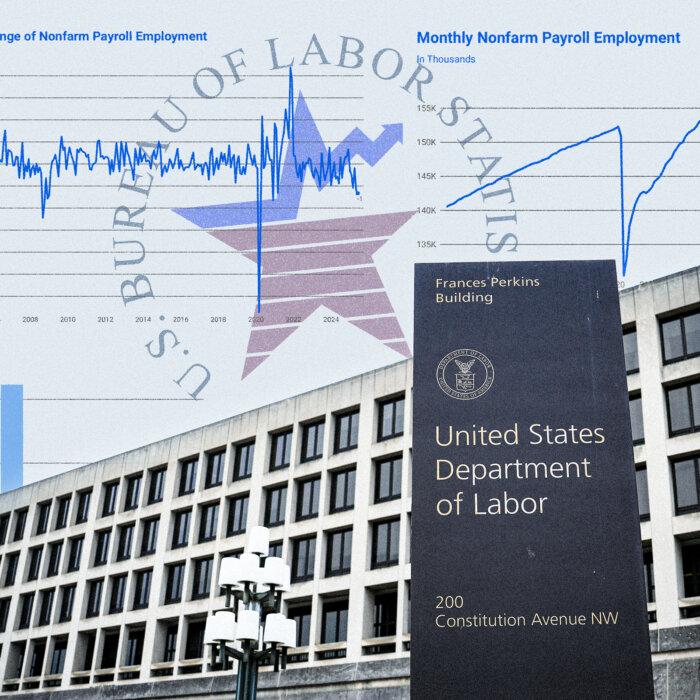
In the wake of Trump’s executive order and related actions, multiple health providers announced that they were putting the brakes on some transgender-related interventions for young patients.
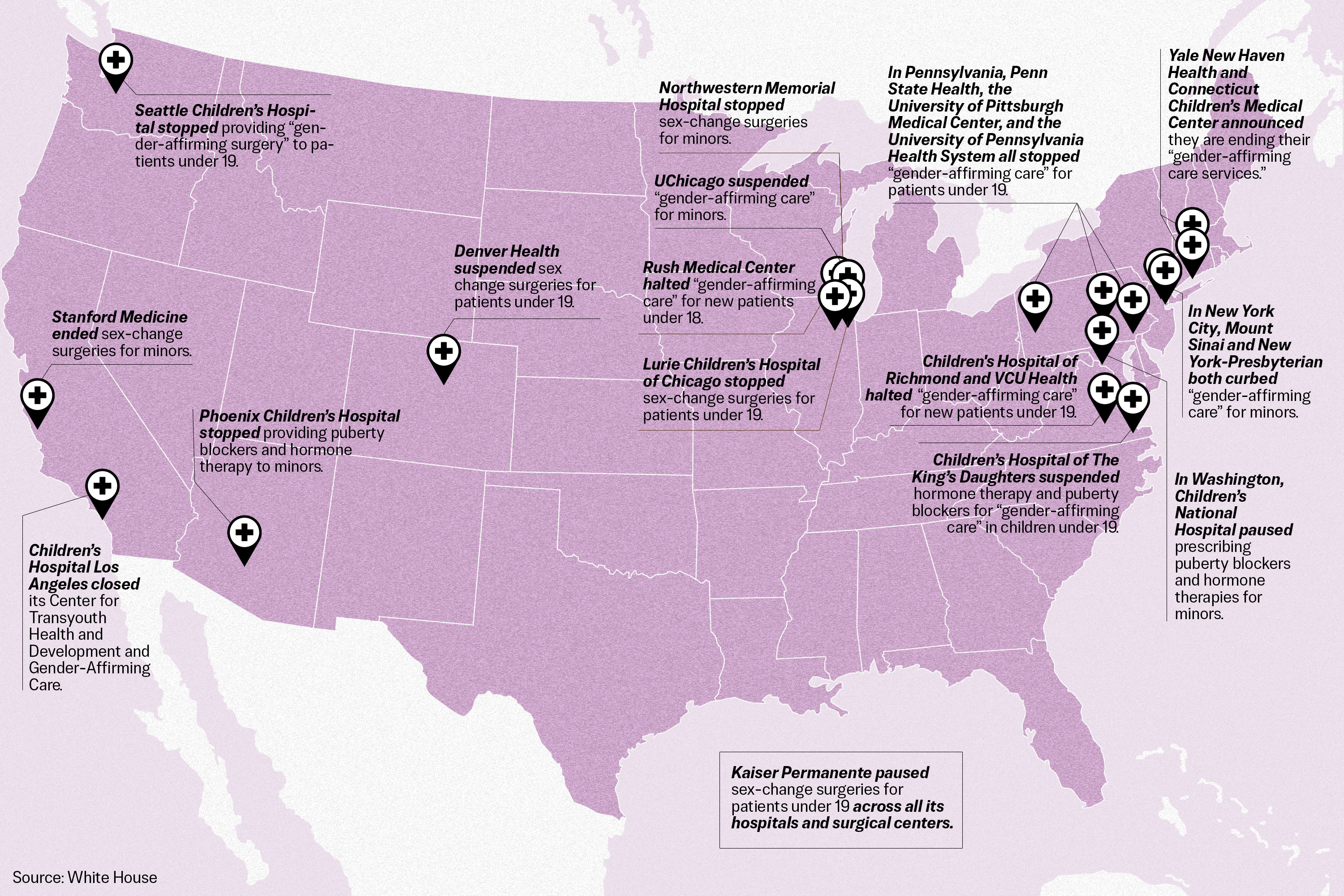
Denver Health in Colorado, Virginia’s VCU Health and Children’s Hospital of Richmond at VCU, and Children’s National Hospital in Washington were among the first sites to announce that they were ceasing or curtailing transgender-related treatments for minors. Their decisions were released shortly after Trump’s order.
Clinics in California, considered a haven for transgender-related treatments, have also announced changes.
Children’s Hospital Los Angeles called its pediatric transgender clinic, the Center for Transyouth Health and Development, “the largest transgender youth clinic in the United States.”
The clinic closed on July 22.
Effective on Aug. 29, Kaiser Permanente, a health system headquartered in Oakland, California, said it will pause the surgeries for patients younger than age 19 but will continue “all other gender-affirming care treatment.”
The changes affect all of the health care giant’s locations in multiple states, according to a statement emailed to The Epoch Times on July 29.
Many other health care providers have made similar changes, Kaiser Permanente noted, citing several factors: executive orders, federal funding restrictions, and inquiries from federal agencies.

Because of the evolving policies and regulations, Kaiser Permanente said that it “must carefully consider the significant risks being created for health systems, clinicians, and patients” who seek gender-related treatments.
Federal Inquiries
At least three federal agencies are scrutinizing providers, Kaiser Permanente said in its statement.Each surgery “related to gender dysphoria ranges from $53,645–$133,911,” the agency stated, noting that a typical pediatrician makes less than $250,000 per year.
The FTC also wants to determine whether practitioners may have violated federal laws by failing to disclose risks or by making false or unsubstantiated claims about benefits or effectiveness of treatments.

Conflicting Approaches
Despite concerns about the safety and effectiveness of “gender-affirming” protocols for transgender-identifying youngsters, major U.S. medical organizations—including the American Medical Association and the American Academy of Pediatrics—remain stalwart defenders.Under that approach, adults are encouraged to “affirm” rather than dispute a child’s assertion that he or she is transgender. After such “affirmation,” adults may help the child adopt a new name, different pronouns, and a cross-sex appearance. That “social transition” can cement a child’s identity. Surgical and hormone treatments often follow.
Rather than immediately affirming—or encouraging—a child to present as transgender, counselors such as McFarland advocate “change-exploring talk therapy.”
“It’s simply acknowledging the possibility of change. We strictly honor free will,” she said.
McFarland said some critics wrongfully label this approach as “conversion therapy,” which aims to change a person’s stated sexual orientation or gender identity.
She is a member of the Alliance for Therapeutic Choice and Scientific Integrity, which asserts that “the vast majority of gender dysphoric children come to embrace their innate sex if allowed to.” That’s one reason the alliance and other groups oppose the treatment-related model.
“Rather than focusing on who a child will become, valuing them for who they are ... fosters secure attachment and resilience, not only for the child but also for the whole family,” the group stated.
Consensus Is Disputed
Transgender activists often point out that the nation’s most prominent medical societies, such as the American Academy of Pediatrics and the American Medical Association, are backing the “gender-affirming” approach.They have ignored or discounted dissent from professionals, whistleblowers, and those who regret transitioning who went public with their concerns, according to the report.
“A small number of specialized committees” in the medical associations drove the appearance of consensus, the report states.
Those committees adopted the stance of the World Professional Association for Transgender Health (WPATH). That association emphasizes the affirmative model and “casts suspicion on psychotherapeutic approaches for management of gender dysphoria,” the government report states.
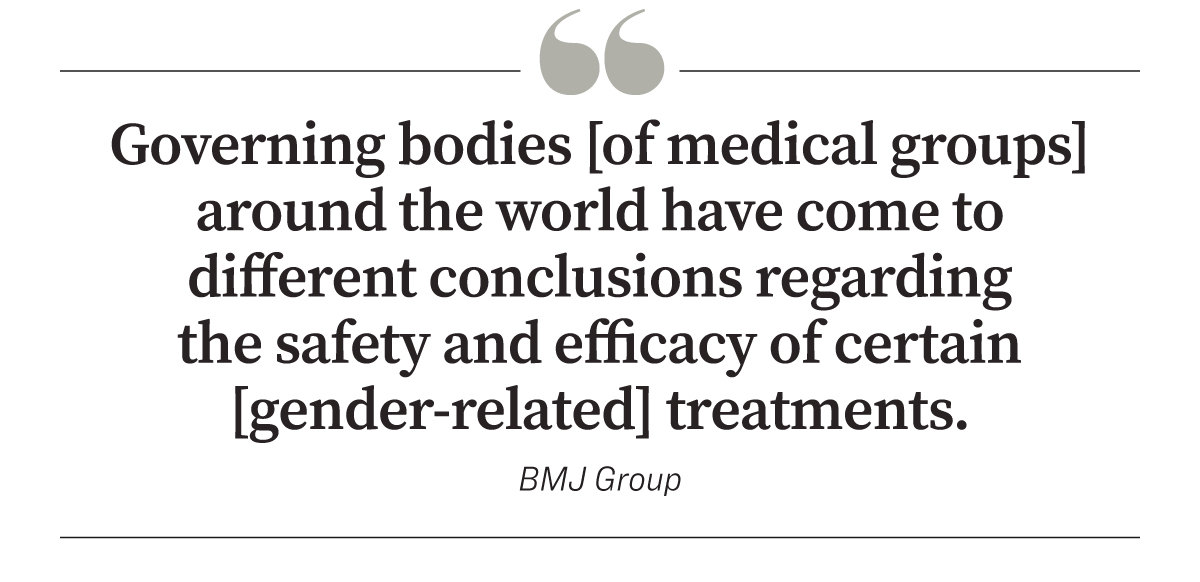
Addressing the question of consensus, the BMJ Group, a global medical-research organization in existence since 1840, stated in 2023 that “governing bodies [of medical groups] around the world have come to different conclusions regarding the safety and efficacy of certain [gender-related] treatments.” Experts also question the validity of evidence that those organizations cited to support their treatment guidelines.
What’s Next?
On July 25, the White House released a statement listing more than 20 health care providers that were curtailing or eliminating gender-related procedures for minors.This shows that Trump “delivered” on his campaign promise “to end the irreversible chemical and surgical mutilation of our children,” the White House stated.
“No federal law prohibits” gender-related procedures for minors, the suit argues, alleging that the president’s orders and agency enforcement actions are trampling on states’ “traditional police power” to regulate medicine.
In response to the lawsuit, a Justice Department spokesman told The Epoch Times, “As Attorney General [Pam] Bondi has made clear, this Department of Justice will use every legal and law enforcement tool available to protect innocent children from being mutilated under the guise of ‘care.’”
White House spokesman Taylor Rogers told The Epoch Times via email: “On Day One, President Trump took decisive action to stop the despicable mutilation and chemical castration of children—which everyday Americans resoundingly support.”

While the latest case makes its way through the court system, the Supreme Court has agreed to consider a case centering on counseling services for people struggling with gender-related issues.
In Chiles v. Salazar, licensed counselor Kaley Chiles opposes a Colorado law that she says infringes upon her free-speech rights as a practicing Christian.
Many counselors refuse to take gender-dysphoric clients “because any topic but ‘affirming’ can be said to violate” laws such as Colorado’s, subjecting the counselor to discipline, the petition states.
The Colorado law restricting counselors took effect in 2019 and “prohibited certain conversations between a counselor and her clients under age 18, condemning (and mislabeling) these conversations as ‘conversion therapy,’” Chiles’s lawyer wrote.
The law forbids any effort “to change behaviors or gender expressions or to eliminate or reduce sexual or romantic attraction or feelings toward individuals of the same sex,” even when the client wants that “change,” the attorney wrote.