But their limited success has brought about retaliation. Some rights lawyers have been arrested, beaten, and tortured for practicing normal legal defense work. The most recent method of intimidation is the denial of a license to practice.
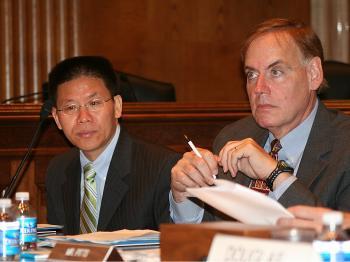
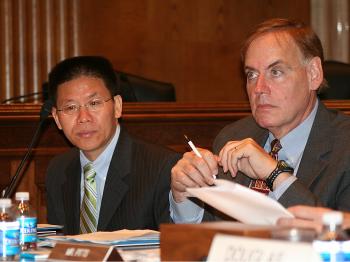
“Just these past few months, the Chinese government has been forcing human rights law firms to shut down,” said Professor James V. Feinerman, Georgetown University Law Center. Feinerman was speaking July 10 at the Congressional-Executive Commission on China (CECC) on Capitol Hill. At the CECC roundtable, a panel of experts on China’s legal system discussed China’s human rights lawyers and their role in advancing the rule of law in China.
“This has not involved a formal crackdown,“ said Mr. Feinerman. ”Authorities have not seized files or sent attorneys to labor camps. Instead, the justice authorities are simply using administrative procedures for licensing lawyers and law firms, declining to renew the annual registrations, which expired May 31, of those it deems troublemakers.”
What in the past was a perfunctory matter has become an instrument to pressure lawyers, law firms, and the profession in general.
“As far as we can confirm, 19 attorneys at this time are unable to practice law,” said Xiqiu “Bob” Fu, founder and president of China Aid, a Christian organization in the United States that focuses on religious freedom in China. However, these attorneys are just a handful, according to Professor Feinerman, whose information was that “dozens of China’s best defense attorneys have effectively been disbarred under political pressure.”
The CECC is composed of members from both the House and the Senate, with Senator Byron Dorgan (D-N.D.) and Representative Sander Levin (D-Mich.) Co-Chairmen. Congressman Joseph Pitts (R-Pa.), a legislature commissioner of CECC, attended the briefing.
China’s Lawyers Told What Cases They Can Represent
China’s Ministry of Justice and local lawyer associations are known for interfering in “sensitive” cases.
“Such cases include not only criminal prosecutions of alleged Tibetan or Uyghur ‘separatists,’ democracy organizers, and Falun Gong or ‘house church’ worshippers, but also claims against the government for many kinds of misconduct and corruption, birth control, and forced eviction and relocation,” said Jerome A. Cohen, a professor at New York University School of Law.