In 1670, the elder Penn died and the younger Penn inherited the family’s estates in England and Ireland. Additionally, his relationship with the king flourished. Like his father, Penn maintained good relations with the monarchy despite his complicated choices; his complicated choice was not political but religious.
Penn was a Quaker, a Christian sect that suffered persecution in Protestant England. Luckily, the king owed his late father a debt, which would be paid to young Penn.

‘Charter of Libertie’
Having been persecuted in the Old World for his religious beliefs, Penn desired to establish a colony where people could be free to follow the dictates of their conscience, especially in the right to worship freely. In 1682, he issued his “frame of the government,” known as his “Charter of Libertie,” itemizing 40 governmental parameters.The framework, steeped in Christian theology, did not address the freedom of worship until the 35th item, stating “[t]hat all persons living in this province, who confess and acknowledge the one Almighty and eternal God … and that hold themselves obliged in conscience to live peaceably and justly in civil society, shall, in no ways, be molested or prejudiced for their religious persuasion.”
The Quaker desired a Christian-centric society, noting that anyone who wished to be elected to governmental office, indeed, anyone voting in the election, should “possess faith in Jesus Christ, and that are not convicted of ill fame, or unsober and dishonest conversation.”

Twenty years after Penn received his charter from the king, he was in “Pensylvania” for his second and final visit to issue his second “Charter of Libertie.” This time, freedom of religion was the first thing on his list.
Possibly referencing his personal history, Penn stated that people could not be happy if their freedom of conscience and worship was “abridged.” He thus reiterated that ”no Person or Persons, inhabiting in this Province or Territories, who shall confess and acknowledge One almighty God … and profess him or themselves obliged to live quietly under the Civil Government, shall be in any Case molested or prejudiced.”
The Nixons
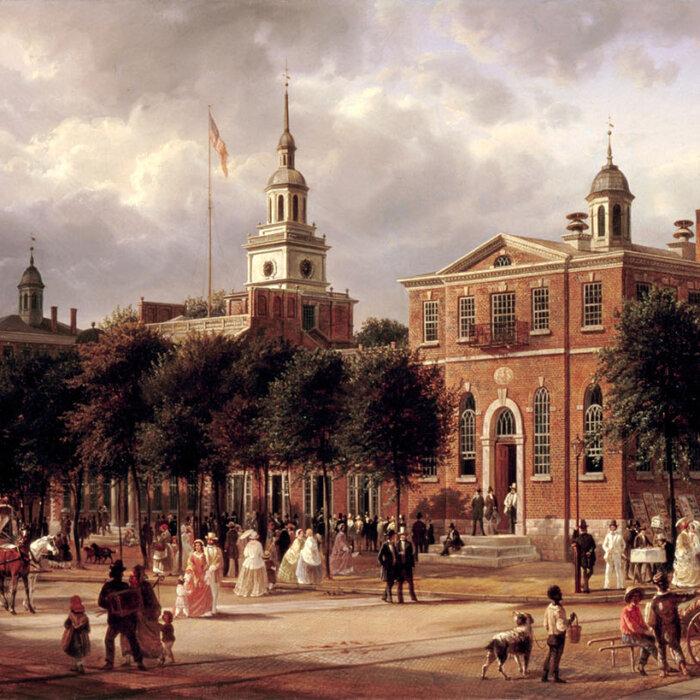
In 1729, about a decade after Penn’s death, the Pennsylvania Assembly, located in Philadelphia, authorized the construction of “a House for the Assembly of this Province to meet in.” Construction for the Georgian style State House began in 1732. The assembly house, located on Chestnut Street, was ready for use by 1736. Its most famous addition, however, was another 15 years away.Shortly after construction began on the Pennsylvania State House, Richard and Sarah Nixon gave birth to a son, John. The two Irish immigrants and Philadelphia colonists, had four children in all, though three died in infancy.
Richard Nixon was a prominent member of Philadelphia—economically, religiously, politically, and militarily. A wealthy and successful merchantman, he established a large business along Philadelphia’s famous Front Street, ultimately expanding to reach the Delaware River. He was also a member of Christ Protestant Episcopal Church and a vestryman for several years.
In 1742, he became a member of Philadelphia’s Common Council, a position he held until his death at the end of 1749. During King George’s War, which lasted from 1744 to 1748 in America (part of the European War of Austrian Succession), residents were encouraged to form militia regiments known as “Associators” to better protect the city and county. Richard Nixon was chosen as a company captain for Dock Ward.
On Jan. 27, 1749, nearly a year before Nixon died, the Pennsylvania Assembly met in the State House to authorize the construction of “a Building on the South-side of the said House to contain the Staircase, with a suitable Place thereon for hanging a Bell.” Though not part of the Assembly, Nixon may have been in attendance.
Nixon would not see the bell tower completed, much less the bell. His son, however, would, and Pennsylvania legend suggests he played a pivotal role during one of its most famous uses.
John Nixon stepped into his father’s shoes after his burial on Dec. 6, 1749. He took over his father’s business along Front Street, which was unofficially called Nixon’s Wharf. Additionally, his business property was connected to arguably the most successful business in the colonies, Willing & Morris.

A Bell for the Tower
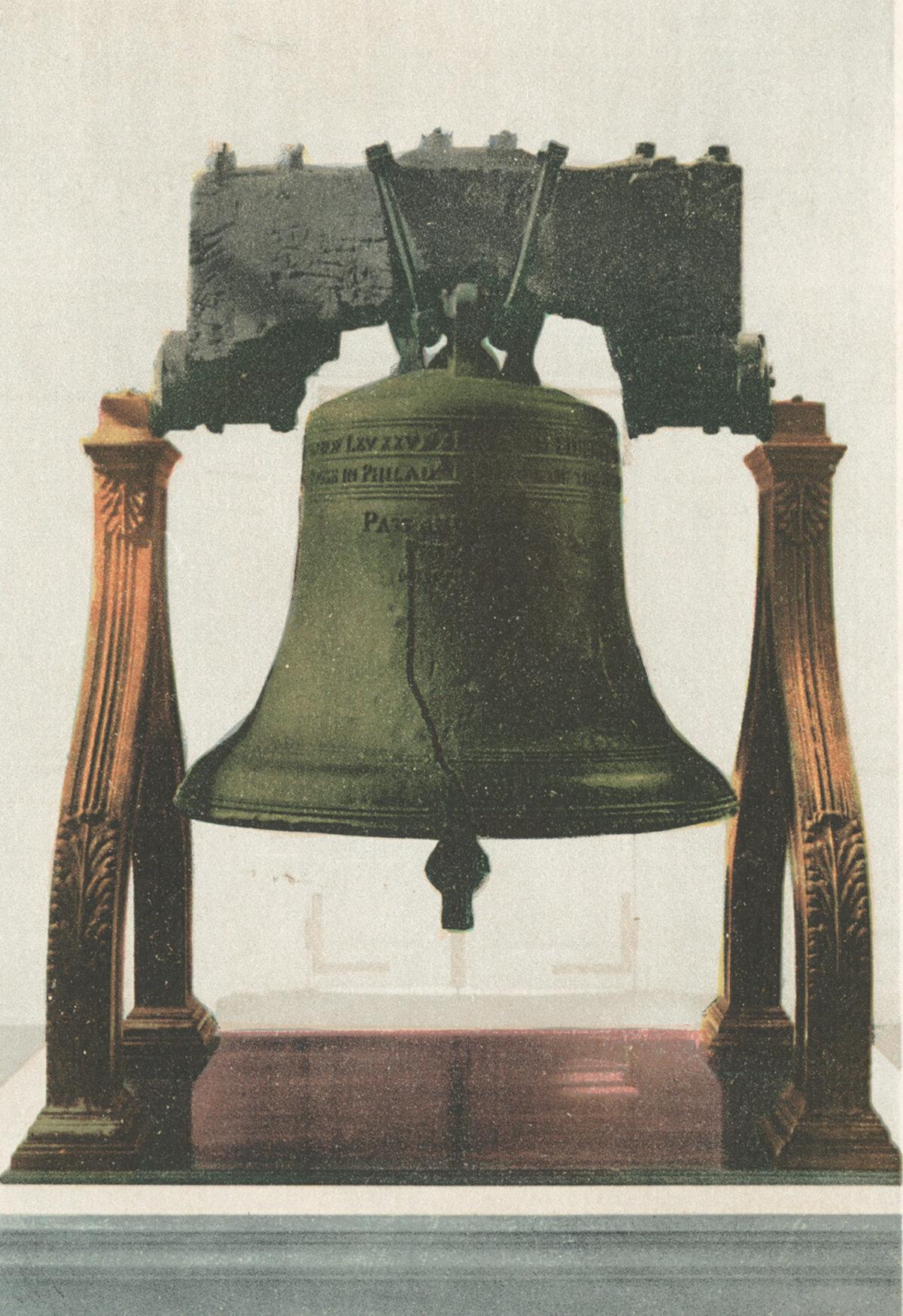
Before the Revolution and before the French and Indian War, Pennsylvania celebrated the 50th anniversary of Penn’s second Charter of Libertie. Perhaps in commemoration of the anniversary, the Pennsylvania Assembly ordered a bell to be built and housed in the newly constructed bell tower.Assembly Speaker Isaac Norris, wrote to Robert Charles, the Assembly’s agent in London, directing him to purchase a bell made by London’s best. Additionally the bell should have an inscription that read, “Proclaim Liberty thro' all the Land to all the Inhabitants thereof.” The quote, from the Bible’s book of Leviticus, references Israel’s Year of Jubilee.
The massive bell had cracked on its first sound test. The Assembly had two local artisans, John Pass and John Stow, recast it. The massive bell was placed in the State House’s bell tower and became the primary method of calling locals to the State House Yard to announce important news. As tensions began to increase between the American colonists and the British government, the bell was used frequently.

Ring the Bell
In 1761, the bell rang to announce the ascension of King George III to the throne. Little did the Philadelphians know that that moment signaled the eventual death knell of their rights as English subjects. In 1764, the bell pealed to signal the repeal of the Sugar Act, the first of the many acts passed against the American colonists. The following year, the Stamp Act was passed, and when a British ship neared Philadelphia along the Delaware River, the bell rang to warn of its approach. It rang in 1768 to gather the townspeople to protest the Townshend Act.The Rise of Nixon
John Nixon was intimately involved in these issues as they directly affected his business. He, like his father, was concerned about local affairs. He was a signer of one of the first non-importation agreements against British goods.According to Charles Henry Hart, Nixon’s 19th-century biographer, throughout the tenuous years of 1765 to 1774, “in all the measures of these trying times John Nixon took an active part.” When the Boston Committee of Correspondence issued a circular letter about the Intolerable Acts in May 1774 requesting they “be united in opposition to this violation of the liberties of all,” Nixon was part of the Philadelphia Committee that responded.
Defending Philadelphia

A few months later on the evening of April 24, the State House bell rang out in response to the battles of Lexington and Concord, which took place on the 19th and started the Revolutionary War in earnest. In response, the “Associators” were again assembled and formed three battalions, the third of which, comprising about 500 men, Nixon was made lieutenant colonel.
In May, delegates from the colonies began to assemble in Philadelphia, and on May 10, inside the Pennsylvania State House, the Second Continental Congress began. Over the coming months, Nixon was made a member and often chaired the meetings of the Committee of Safety for the Province of Pennsylvania. He was also made deputy to Philadelphia’s high sheriff.
In May 1776, he was sent to Mud Fort Island (now known as Fort Mifflin) to manage its defenses, but he was soon called back to Philadelphia to maintain the defense of the city. The city certainly needed protecting, as the Second Continental Congress was preparing to declare independence from Great Britain. On July 4, 1776, the Second Continental Congress made its declaration. The bell of the State House, however, remained silent.
The First Public Reading
The day after independence was declared, the Continental Congress ordered that the sheriff of the Counsel of Safety of Philadelphia have the Declaration read aloud at the State House at noon on July 8.On the morning of July 8, 1776, the bells of Philadelphia began ringing, signaling locals to the State House Yard. Philadelphia legend has it that the bell at the State House rang out as well (there is uncertainty if this is the case, as the bell tower was in desperate need of repair). In the Yard was a crudely built platform, which had been built by the American Philosophical Society in 1769 to follow the transit of Venus. William Dewees, high sheriff of Philadelphia, walked up the steps of the platform, followed by his deputy, Nixon. Dewees looked over the crowd and yelled, “Under the authority of the Continental Congress and by order of the Committee of Safety, I proclaim a declaration of independence.” He then gave way to his deputy.
It was during this week in history, on July 8, 1776, that Nixon gave the first public reading of the Declaration of Independence.

The following year, Philadelphia was occupied by the British. Fearing the State House bell would be melted down into bullets for the British, it was sent to Allentown for safekeeping. It returned once the British left in June 1778.
Although the bell of the Pennsylvania State House may not have rung on July 8, it did ring out on one of the most important dates in American history, which practically spelled the end of the Revolutionary War. On Oct. 24, 1781, the bell rang, signaling the victory at the Battle of Yorktown. Interestingly, the victory against the British came a century after William Penn received his 1681 Charter for the Province of Pennsylvania.
This week, on July 8, as part of America’s ongoing 250th celebrations, states across the country, covering nine time zones, are scheduled to conduct a simultaneous reading of the Declaration of Independence. The collaborative effort will center on the noon public reading at Philadelphia’s State House Yard, now known as Independence Square, in front of the Pennsylvania State House, now known as Independence Hall. Across Chestnut Street, behind Independence Hall, America’s most famous bell—now known as the Liberty Bell—will be watching.