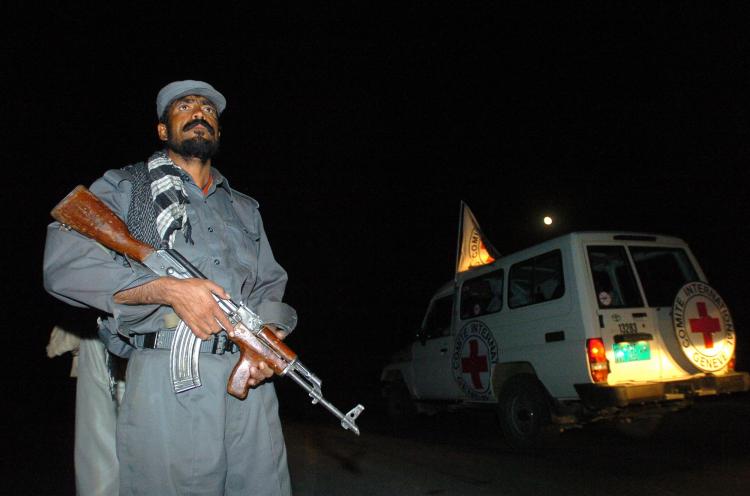
Civilian casualties, internal displacement, and lack of medical care will continue to challenge the country in 2011 as the number of armed groups increases, the International Committee of the Red Cross (ICRC), reported Wednesday.
The rapid increase in the number of armed groups in some areas is making living conditions difficult for residents and humanitarian organizations in many areas of the country.
Head of the ICRC delegation in Afghanistan, Reto Stocker, said, “In a growing number of areas in the country, we are entering a new, rather murky phase in the conflict in which the proliferation of armed groups threatens the ability of humanitarian organizations to reach the people who need their help,” in a news release.
“One armed group may demand food and shelter [from civilians] in the evening, then, the next morning, another may demand to know why its enemy was given sanctuary,’ Stocker said.
The new, armed groups, whose members include criminals, are difficult to identify, according to the report.
However, as of last July, attacks on aid workers in Afghanistan appear to be decreasing, according to a report by the Integrated Regional Information Networks of the United Nations, (IRIN). It reported that the Afghanistan’s NGO Safety Office (ANSO) noted a decrease in the attacks on NGO workers in the first half of 2010, compared with the 2008 and 2009, saying this was in part due to increased security measures adopted by the NGOs.
While number of attacks might have been decreasing, intimidation and threat of attack still inhibit the 1,200 humanitarian organizations in Afghanistan from providing relief to all parts of the country. IRIN reported that two-thirds of Afghanistan is “either inaccessible or considered high-risk by most international aid organizations, as well as U.N. agencies.”
The country now has an estimated 500,000 internally displaced persons (IDPs), according to a report by the United Nations Refugee Agency in November. The estimation comes from records of the Afghan Ministry of Refugees and Returnees Affairs (MoRR).
Stoker said, “Many people see fleeing as their only solution, and many end up in camps for the displaced or with relatives in neighboring districts.”
Many Afghans have difficulty reaching medical care, and even simple diseases become major problems. “The number of mothers coming in with children dying from easily preventable diseases such as measles or chronic diarrhea is staggering,” said Dr. Bart de Poorter, an ICRC health coordinator working in Afghanistan.
“But what doctor or vaccinator is brave enough to venture into rural areas given the appalling lack of security and the lack of respect for medical staff?” he said in the release.
President Barrack Obama is scheduled to give an update on the Afghan war Thursday.
The rapid increase in the number of armed groups in some areas is making living conditions difficult for residents and humanitarian organizations in many areas of the country.
Head of the ICRC delegation in Afghanistan, Reto Stocker, said, “In a growing number of areas in the country, we are entering a new, rather murky phase in the conflict in which the proliferation of armed groups threatens the ability of humanitarian organizations to reach the people who need their help,” in a news release.
“One armed group may demand food and shelter [from civilians] in the evening, then, the next morning, another may demand to know why its enemy was given sanctuary,’ Stocker said.
The new, armed groups, whose members include criminals, are difficult to identify, according to the report.
However, as of last July, attacks on aid workers in Afghanistan appear to be decreasing, according to a report by the Integrated Regional Information Networks of the United Nations, (IRIN). It reported that the Afghanistan’s NGO Safety Office (ANSO) noted a decrease in the attacks on NGO workers in the first half of 2010, compared with the 2008 and 2009, saying this was in part due to increased security measures adopted by the NGOs.
While number of attacks might have been decreasing, intimidation and threat of attack still inhibit the 1,200 humanitarian organizations in Afghanistan from providing relief to all parts of the country. IRIN reported that two-thirds of Afghanistan is “either inaccessible or considered high-risk by most international aid organizations, as well as U.N. agencies.”
Displacement and Medical Aid
The country now has an estimated 500,000 internally displaced persons (IDPs), according to a report by the United Nations Refugee Agency in November. The estimation comes from records of the Afghan Ministry of Refugees and Returnees Affairs (MoRR).
Stoker said, “Many people see fleeing as their only solution, and many end up in camps for the displaced or with relatives in neighboring districts.”
Many Afghans have difficulty reaching medical care, and even simple diseases become major problems. “The number of mothers coming in with children dying from easily preventable diseases such as measles or chronic diarrhea is staggering,” said Dr. Bart de Poorter, an ICRC health coordinator working in Afghanistan.
“But what doctor or vaccinator is brave enough to venture into rural areas given the appalling lack of security and the lack of respect for medical staff?” he said in the release.
President Barrack Obama is scheduled to give an update on the Afghan war Thursday.