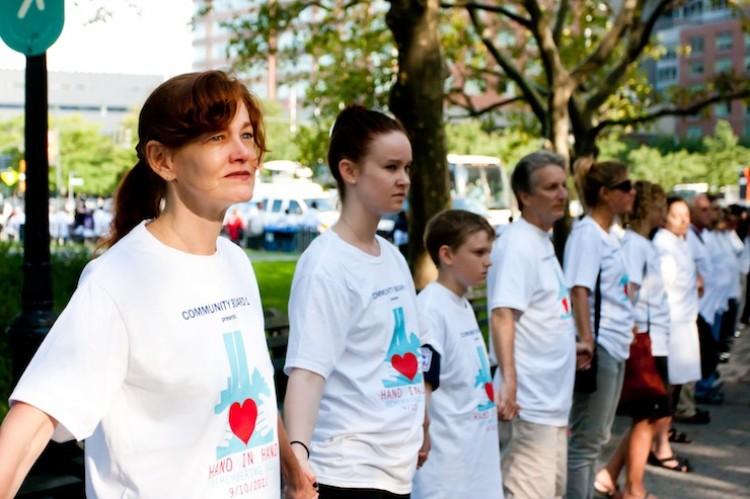
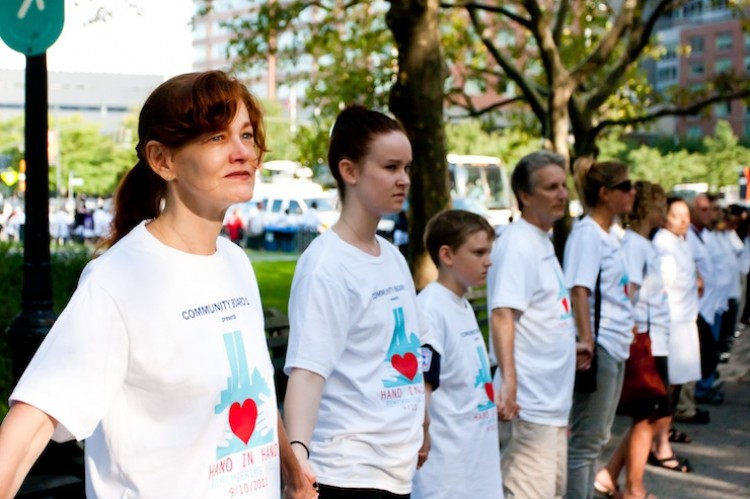
A first responder, who wished not to be named, stood facing the rising 1 World Trade Center from the perimeter of Battery Park on Saturday. She came to hold hands with strangers-turned-friends in a sense of community and togetherness reminiscent of the days and months following the Sept. 11, 2001, terrorist attacks.
The human chain stretched from Castle Clinton in Battery Park to Chambers Street, along the Hudson River Esplanade—covering about 1.5 miles and including more than 5,000 people.
“There are no coincidences,” said the first responder. She had joined the line early in the morning, but got inched down as volunteers from Community Board 1 rearranged people. When the line finally settled, she found herself at the exact spot she had entered ground zero 10 years ago.
The bells tolled at 8:46 a.m. on Saturday—the time the first plane had hit—and silence fell. On tear-streaked faces, eyes closed tightly against the pain. Yet, some smiling faces also shone in the rays of sun peaking through the tree leaves above.
“It was a moment,” said Vernon Samuel afterward. “It’s always good when people come together and leave the violence behind.”
He held hands with two co-workers from a health insurance company who survived the attacks.
Jerry Darvin came out with his son, daughter-in-law, and grandson. He has two cousins who were at the World Trade Center site on 9/11 and survived. Those cousins now live in different parts of the country and did not return for the 10th anniversary.
“A lot of people who were there are not here today,” said Darvin. “The memories are too vivid.”
Jeffrey Menkes, president and CEO of New York Downtown Hospital, stood near the beginning of the chain in front of Castle Clinton. In the first two days following the attacks, the hospital treated 1,500 people, he recalled.
Hospital staff who helped in the monumental effort wrote remembrances to post on a Wall of Remembrance, which was erected as part of the Hand-in-Hand event.
Menkes said his hospital is a great example of the successful rebuilding of Lower Manhattan. The financial community helped fund a new 28,000-square-foot emergency center and a decontamination station.
“If someone set off a dirty bomb in Lower Manhattan, we can tend it,” said Menkes.
On the 10th anniversary, New Yorkers should “show the terrorists that they in no way won” and “recognize that we are rebuilding,” said Community Board 1 chairwoman and Hand-in-Hand organizer Julie Menin.
She wanted to revive the unity that was the silver lining of a tragic time, when people “literally reached out and lent a hand to a stranger.”