
Lithium-ion battery fires are a growing cause for concern around the world, with fears about how electric vehicles, e-bikes, laptop chargers, and power banks pose a risk to people at home, at work, and on the move.
Fires involving lithium batteries—which are rechargeable—are notoriously difficult to extinguish using conventional firefighting methods.
Meanwhile, global demand for lithium-ion batteries is expected to increase significantly between 2025 and 2030.
“While awareness is growing, regulatory action still lags behind the pace of incidents we’ve had with lithium-ion battery fires,” Humby said. “Many trade bodies ... are reactive rather than proactive, and there’s still a lack of global consistency in standards and enforcement.”

He said bodies such as the International Electrotechnical Commission and the International Organization for Standardization are revising and expanding requirements for the testing, transport, and end-of-life management of lithium batteries, with the aim of ensuring “global alignment on safety and sustainability.”
“If these devices are packed in checked baggage, they should be turned completely off, protected from accidental activation, and packed so they are protected from damage.”
In-Flight Fire Risk
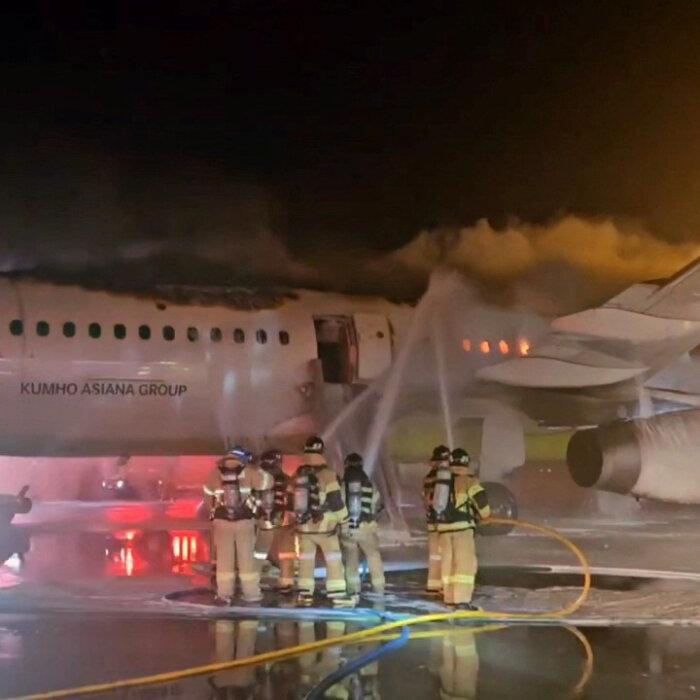
On Jan. 28, 2025, an Air Busan plane was destroyed by fire on the runway in Busan, South Korea. Preliminary findings indicated that a power bank stored in an overhead cabin likely went up in flames shortly before take-off.All 170 passengers and six crew members were evacuated, with three seriously injured and 24 having sustained minor injuries.
“The Air Busan incident shows how quickly things can escalate. Without stricter controls and better passenger education, an in-flight fire remains a real risk,” Humby said. “Many airlines have placed bans on power banks, but I really think this sector really needs to look deeper into this fire risk.
“It’s taken an aircraft fire to make them really sit up and see what the situation is.”
“They managed to get it under control, because they’re small batteries, so you can probably put them in water or an ice bucket. But planes should be carrying fire-resistant containment bags,” Humby said.
A number of airlines responded in the wake of the Busan incident.
Battery Fires ‘Systemic Issue’
However, he said that lithium battery fires are a “systemic issue” that could not be eliminated by airline restrictions alone.“They are influenced by product quality, user behavior, regulatory oversight, and aircraft systems themselves,” Gibbs said.
“While ICAO initially envisaged a new ‘fire-resistant packaging’ standard, a fully validated, globally adopted solution has yet to materialize,” Gibbs said.
He said current regulations focus on mitigating risk through stringent transport conditions.
Humby said fire-resistant packaging is “extremely difficult to achieve due to the intensity of thermal runaway events.”
He said small containment boxes had been created, but he said that “relying solely on packaging is only part of the tool kit, and a broader risk-management approach is needed.”
Without a doubt, there are benefits to rechargeable batteries, and in 2019, the Nobel Prize for chemistry was awarded to scientists John B. Goodenough, M. Stanley Whittingham, and Akira Yoshino for their work on the development of lithium-ion batteries.
However, the fire risk from lithium batteries remains.
“We have known for many years [that] lithium-ion batteries are a risk and must be part of a fire risk assessment,” Humby said. “The good news is awareness is growing and we are in a much better place than three years ago with this, but plenty still needs to happen. Education is key.”