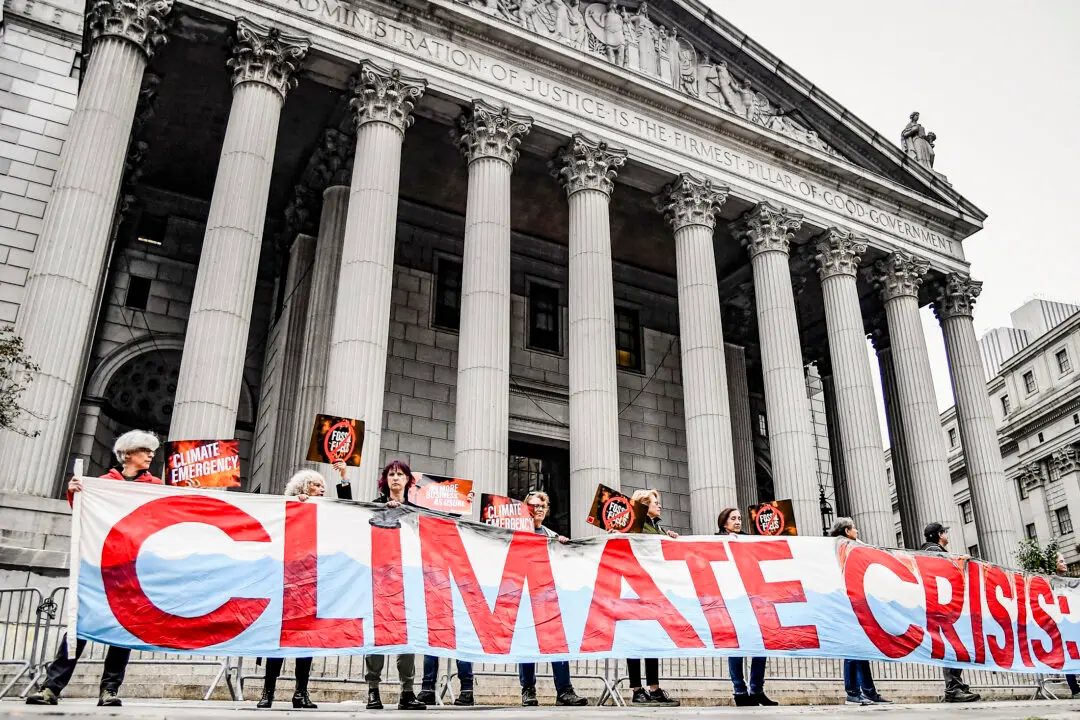
Under pressure from the Trump administration, the World Bank is stepping back from its commitment to fund climate-related projects in the developing world.
An international organization dedicated to financing global development, the World Bank announced on June 29 that it was dropping its goal of committing 45 percent of its funding to projects intended to fight global warming.
The Bank stated that it would extend its Climate Change Action Plan (CCAP), which was due to expire, although an independent evaluation group will provide an evaluation of it. However, as part of a “shift from inputs to outcomes,” the Bank stated that it would “retire” the target of requiring 45 percent of the Bank’s financing to have “climate co-benefits.”
In dropping this target, the Bank said it will now let borrowing countries determine their priorities instead of directing a fixed percentage of lending toward climate projects. It will, however, continue tracking the climate impacts of its lending decisions.
The move comes shortly after U.S. Treasury Secretary Scott Bessent disparaged the World Bank’s climate targets as “distortionary” and “nonsensical.”
It also follows an announcement by the United Nations Intergovernmental Panel on Climate Change (IPCC) that its worst-case scenario for rising temperatures, known as RCP8.5, was “implausible,” despite the fact that many climate activists and media organizations considered it a base-case scenario.


Originally founded in 1944 to help fund the reconstruction of Europe and Japan after World War II, the World Bank, based in Washington, D.C., has expanded its role to become a global development organization with 189 member countries. The United States is the Bank’s largest contributor, controlling about 16 percent of the voting shares, and is the sole member with veto power among the 25-member board of directors.
Environmental groups sharply criticized the Bank’s move to eliminate climate targets.
A May 29 letter signed by more than 90 organizations, including Amnesty International, the World Wildlife Fund, the Natural Resources Defense Council, the MenaFem Movement, Greenpeace, Islamic Relief, and Surfrider Argentina, stated: “With the internationally agreed 1.5°C global warming limit increasingly likely to be overshot by the early 2030s, the Bank’s efforts to eradicate extreme poverty and promote shared prosperity on a ‘liveable planet’ are increasingly in peril, as climate disasters erase development gains, increase climate vulnerable countries’ debt burdens, and exacerbate cost of capital issues that limit investments in development.”
The letter further states that the war in Iran has “cast doubt on the viability of liquefied natural gas as a ‘transition fuel’ and risks triggering severe food price inflation,” urging the World Bank to keep its focus on funding wind, solar and other renewable energy projects.
Climate skeptics, however, applauded the move.
“The World Bank’s core mission is poverty reduction and economic growth, and for years climate mandates diverted lending away from the affordable, reliable energy infrastructure that actually helps developing nations grow,” Jason Isaac, CEO of the American Energy Institute, told The Epoch Times. “A country with dependable electricity and a growing economy is far better positioned to adapt to any environmental challenge than one kept in energy poverty by ideologically driven lending restrictions.”
Isaac called the Bank’s move “a win for rational economic development and a sign that the era of climate finance virtue signaling at multilateral institutions may finally be coming to an end.”
Others, however, questioned whether the World Bank’s statement on goals will change much in practice, particularly when other member nations strongly support the Bank’s commitment to fighting global warming.
Eleonore Caroit, France’s development minister, stated, “We don’t find it acceptable that there is the expiry of this current action plan, and we want to find a solution so that we can find a way to continue acting in this field.”
Europe is experiencing a heat wave that health officials claim has led to 1,300 excess deaths. As temperatures in France hit 104 degrees Fahrenheit this week, Paris Deputy Mayor Audrey Pulvar wrote on social media that Americans bear “a significant amount of responsibility for global warming” due to the widespread use of air conditioning in the United States, according to Fox News and other outlets.
Critics of the World Bank’s climate financing say the ultimate solution is for the United States to withdraw from the World Bank, similar to Trump’s exit from the Paris Climate Agreement and U.N.-sponsored climate organizations in January.
“It’s great that Trump was able to force the World Bank to drop its climate target, but the reality is that the corrupt and wasteful bank will simply reclassify climate spending as something else,” Steve Milloy, senior fellow at the Energy & Environment Legal Institute and former adviser to Trump’s EPA Transition Team, told The Epoch Times in an emailed statement.
“What President Trump should do is pull the US out of corrupt, wasteful and failed global institutions like the World Bank.”