The swift escalation of wildfires in multiple provinces has driven thousands from their homes and has triggered air-quality alerts nationwide, as hot and dry conditions in Nova Scotia prompted the province to restrict summer activities in forested areas.
The worsening conditions have contributed to a wildfire season that is poised to become one of the most severe in Canada’s recorded history with 6.8 million hectares burned so far.
There were 754 active wildfires across the country as of Aug. 5, with 194 classified as out of control.
Thousands of people are currently under evacuation orders in two provinces, the majority in Manitoba’s north where 15,000 people have had to leave their homes. Meanwhile, fires on the Avalon Peninsula of Newfoundland and Labrador have resulted in the evacuation of 600 individuals.
Air quality warnings have been triggered over consecutive days in several regions that are well beyond active zones, as smoke from wildfires continues to cause poor air quality and reduced visibility.
That trend continued Aug. 6 with Environment Canada issuing 72 air quality warnings and statements issued across six provinces and one territory.
Newfoundland
Dry, hot temperatures with no rain in the forecast has left Newfoundland battling three wildfires in the province that has forced the evacuations of several communities on the Avalon Peninsula, both from the Kingston fire in Conception Bay North as well as a fire near Holyrood. A third fire was noted on Aug. 5 in central Newfoundland, situated south of Bishop’s Falls.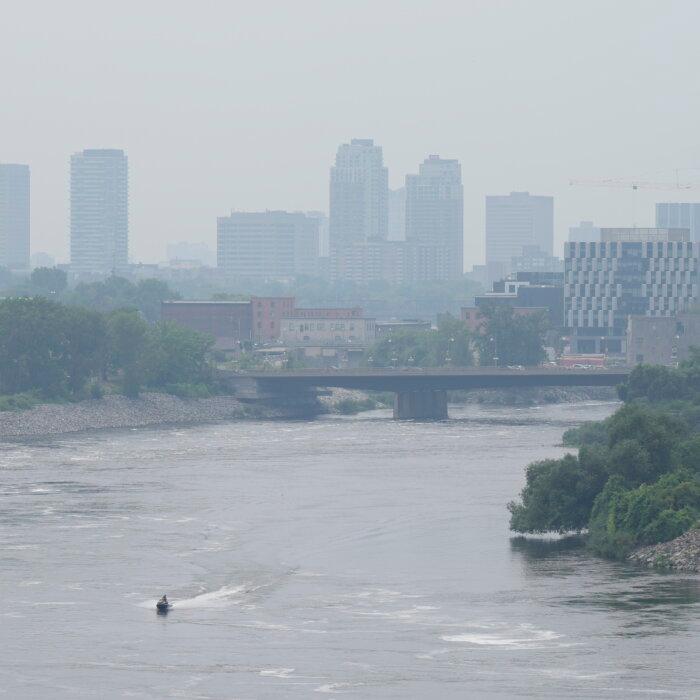

Most of Newfoundland is currently classified as being at a high to extreme risk of fire, according to the provincial fire hazard map, and remains under a fire ban until at least Sept. 7.
Newfoundland and Labrador Premier John Hogan told reporters in St. John’s on Aug. 5 that “all hands are on deck” to battle the blazes threatening communities.
Hogan said the province has extended evacuation efforts to include the towns of Salmon Cove, Conception Bay South, Holyrood, and Western Bay, noting that one of the fires had increased threefold in size overnight to cover at least 735 hectares. Power has been cut off in the entire region as a result.
He said that while residents are upset to leave their homes, all have complied with the orders to evacuate. Some structures have been lost since then.
“The most important thing is always for people to be safe,” Hogan said during the press conference. “The most important thing is people’s lives. We can repair homes, we can replace homes, we can repair buildings but we can’t replace loss of life.”
Hogan said officials had not yet assessed the full extent of the damage, but described it as “very serious.”
The province has had 192 significant wildfires in 2025 due to the “unbelievably historic dry season on the island,” Hogan said, adding that the province had requested help from the Canadian Interagency Forest Fire Centre and New Brunswick.
The request led to the province receiving three more aircraft known as Air Tractor 802s from New Brunswick to aid in wildfire suppression efforts on Aug. 6, the province said in a press release.
Nova Scotia
Like Newfoundland, Nova Scotia is dealing with extremely dry conditions. As a result, Premier Tim Houston has announced major restrictions on outdoor activities across the province.Hiking, camping, fishing, mining, forestry, and other outdoor activities are prohibited in forested regions until at least October and anyone who violates these restrictions will face a $25,000 fine, he said during an Aug. 5 press conference.
“As tinder-dry conditions continue to persist from one end of the province to the other, the risk of wildfires increases, and the risk is very, very high right now,” he said at the Halifax briefing. “I’m asking everyone to do the right thing. Don’t light that campfire, stay out of the woods and protect our people and communities.”
Access to beaches and parks is permitted, but trail systems are not open, and private landowners are restricted from hosting guests on wooded properties.
Houston noted that most wildfires are caused by human activity, so keeping people out of the woods until conditions improve will reduce the risk of a fire igniting.
A province-wide ban on open fires was implemented on July 30 and is to remain in place until Oct. 15 or until conditions improve.
All of the current restrictions were put in place through a proclamation under the Forests Act, the province noted in a press release.
Manitoba
Manitoba has been the hardest hit by wildfires this year and is presently under its second 30-day province-wide state of emergency. The province said in an Aug. 5 press release that the state of emergency could be extended beyond its Aug. 8 end date if active fire rates continue.The Manitoba Wildfire Service is currently responding to 165 active wildfires across the province and has dealt with a total of 401 wildfires to date, well above the average of 299 fires.
This year has been the worst wildfire season on record in the last three decades, with more than 1.55 million hectares of area burned in Manitoba thus far, the province said.
Roughly 15,000 people remain displaced from their homes, primarily from communities located in the northern region of the province where more than 1.55 million hectares has been burned.
A number of communities have chosen to evacuate due to the threat posed by wildfires, loss of road access resulting from wildfires, or smoke, the province said in a press release. This includes the 2,800 residents from Nisichawayasihk Cree Nation as well as people with health conditions from Little Grand Rapids First Nation and O-Pipon-Na-Piwin Cree Nation.
Premier Wab Kinew declared the second province-wide state of emergency on July 10. He said at the time that the main reason was due to a need for more facilities to shelter the “large number of Manitobans who are being forced to flee their homes.”
Many of the new evacuees are being housed in Winnipeg, some 600 kilometres south of their homes.
Saskatchewan, Alberta, BC
In the adjacent province of Saskatchewan, teams were confronted with 80 active wildfires as of Aug. 5—15 of which remained uncontrolled.Thirteen communities located roughly 400 kilometres north of Saskatoon are currently under an evacuation order, including the village of Beauval, where the blaze has grown to more than 313,000 hectares in size, the province said. Several highways in the province remain closed.
Alberta recorded 21 new wildfires on Aug. 4 and is currently battling 64 fires within its Forest Protection Area. Sixteen are classified as out of control, five are being held and 43 are under control, the province said in an Aug. 5 update.
More than 1,400 Alberta firefighters, including contract and imported personnel, are currently battling wildfires across the province. However, the situation is notably better than last year, when wildfires destroyed at least one-third of the land surrounding Jasper National Park.
In British Columbia, tens of thousands of lightning strikes across province last week created “a very dynamic” wildfire situation that had resulted in 127 active wildfires as of Aug. 5.
The Wesley Ridge fire on Vancouver Island was the only “wildfire of note” listed by the BC Wildfire Service. It remains out of control, spanning 5.3 square kilometres south of Port Alberni along the eastern side of Cameron Lake.
Canada experienced its most devastating wildfire season on record in 2023, when 18.4 million hectares were consumed by flames, in contrast to the 10-year average of 2.5 million hectares.
The smoke generated by these wildfires resulted in dangerous air quality across Canadian provinces and numerous American states, prompting school closures, the cancellation of various events, and a rise in hospitalizations related to cardiopulmonary issues.
This year’s fires have again resulted in poor air quality in parts of Canada and the United States. Environment Canada is warning those in areas under air quality advisories to limit time outdoors.
“During heavy smoke conditions, everyone’s health is at risk regardless of their age or health status,” the agency said and advised that all outdoor sports, activities and events should be cancelled.
The Canadian Press contributed to this report.