Environment Canada has issued air quality alerts in six provinces and territories due to wildfire smoke, while Saskatchewan and Manitoba have declared a state of emergency due to the fires.
The advisories apply to a large portion of central Canada, including parts of Alberta, Saskatchewan and Manitoba. Areas in the Northwest Territories, western Ontario, and Labrador are also affected.
Conditions are expected to improve in most areas later in the day on May 30, however Environment Canada said air quality could drop again over the weekend.
Those in the affected areas are advised to keep doors and windows closed, use an air filter inside, and wear a mask when outdoors.
“Smoke is causing very poor air quality and reduced visibility,” Environment Canada said. “As smoke levels increase, health risks increase. Limit time outdoors. Consider reducing or rescheduling outdoor sports, activities and events.”
Common symptoms for those exposed to smoke include eye, nose and throat irritation, headaches or a mild cough. More serious symptoms include wheezing, chest pains, or severe cough. Environment Canada said those who are experiencing severe symptoms should seek medical help immediately.

Saskatchewan Fires
Saskatchewan declared a state of emergency on May 29 due to wildfires in the province.Premier Scott Moe made the declaration at a news conference, saying dry conditions in the province were “unlike anything we have faced for quite some period of time.” He said rain was urgently needed but was not in the forecast.
Moe said the province was putting “every measure possible” towards firefighting and mitigation efforts.
Among those measures is a ban on the use of all-terrain vehicles and utility terrain vehicles in several areas, including all vacant Crown land, provincial parks within the provincial forest, and the provincial forest. There is also a ban on open fires, controlled burns, and fireworks in the designated boundary.
Three First Nations communities in the province also issued a state of emergency on May 28, saying more resources were needed to battle the fires.
“First Nations leaders are expressing deep concern over critical shortages in firefighting resources, personnel, and air support,” said a joint statement of the Lac La Ronge Indian Band (LLRIB), Peter Ballantyne Cree Nation (PBCN), and Montreal Lake Cree Nation (MLCN).
The leaders have called for “immediate action” from provincial and federal governments, including deploying additional firefighters, immediate dispatch of water bombers and air support to Northern Saskatchewan, and open emergency accommodations for evacuees and response crews.
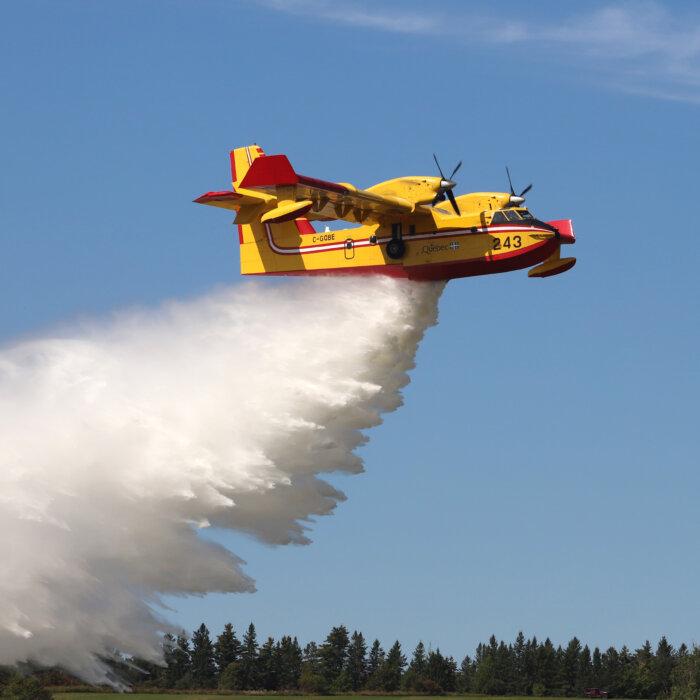
Aircraft from Quebec and Alaska have been helping fight the fires in Saskatchewan, according to Saskatchewan Public Safety Agency president Marlo Pritchard.
As of May 30 at 10 a.m. there were 16 active fires in the province with seven of those categorized as out of control. Sixteen communities are under evacuation orders, impacting more than 4,000 people.
Manitoba Fires
Manitoba also declared a state of emergency in the province on May 28 due to wildfires.Premier Wab Kinew said 17,000 people have been evacuated from several communities and First Nations due to the wildfires so far.
An evacuation order was issued for the community of Flin Flon this week after a fire that started in Saskatchewan near Creighton jumped the border into Manitoba.
The mayor of Flin Flon has said that shifting winds could see some of the buildings in the city burn.
Public buildings in Winnipeg have been made available for evacuees fleeing the wildfires.
McGuinty said the military would be “providing airlift and logistics support to assist in the evacuation of residents.”
Premier Kinew said that the province is experiencing “the largest evacuation in many Manitobans’ living memory.” He said that significant resources and co-operation would be needed from all levels of government.
As of May 29, there were 22 active wildfires in the province, the government said. There have been 103 wildfires in the province this year to date, compared to an average of 80.
Hiking trails and water routes in provincial parks have been closed, and the province has issued a full fire ban in all parks.