Thirty years ago this month, the Dayton Agreement ended more than three years of civil war in the former Yugoslav republic of Bosnia and Herzegovina, which killed 100,000 people.
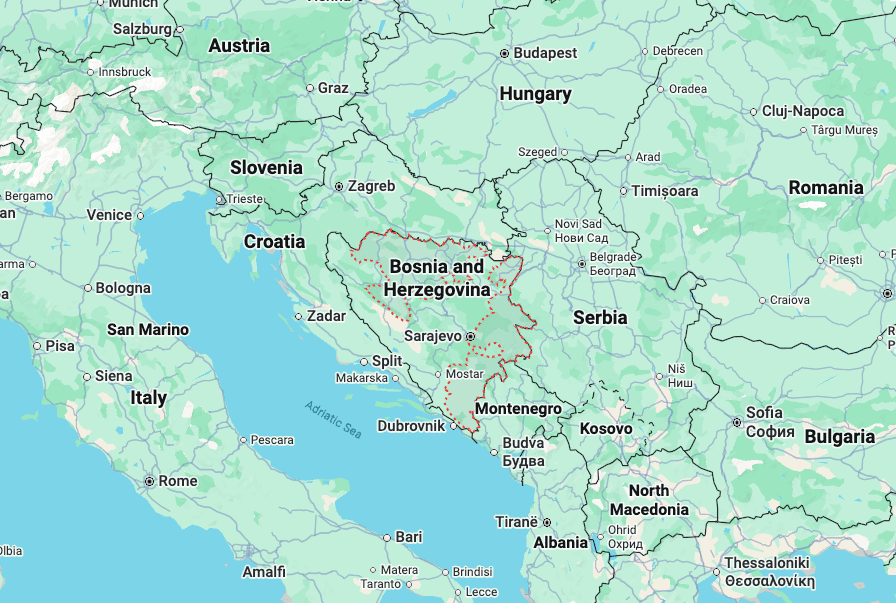
The agreement maintained the single state of Bosnia and Herzegovina but divided it into the ethnic Serb Republic—Republika Srpska—and a Muslim-Croat-populated Federation of Bosnia and Herzegovina.
The Western Balkans is strategically important, as Croatia, an EU member, has a border with Bosnia-Herzegovina and Serbia that is exploited by networks that traffic people into the EU.
On Oct. 22, the UK government imposed sanctions on two trafficking groups based in Kosovo and Croatia.
The office said Seferovic procured false passports, which were then sold to organized crime groups, including the Skaljari and Kavac gangs, which are based in Montenegro.
Bosnian Serb Grievances
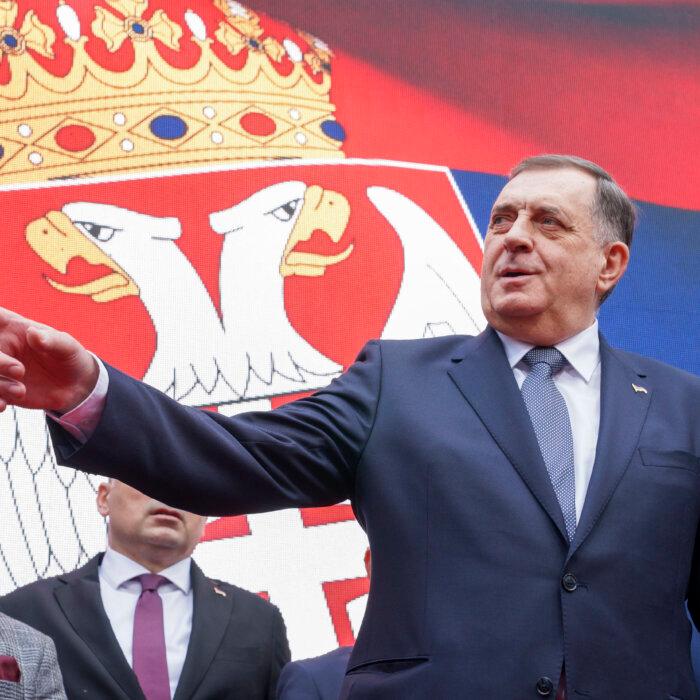
Christian Schmidt, the high representative for Bosnia and Herzegovina and a former German government minister, was appointed by the European Union in 2021 but has repeatedly clashed with Dodik, who wants the Republika Srpska to break away and join neighboring Serbia.Dodik, elected president of the Republika Srpska in November 2022, met Russian President Vladimir Putin several times this year, and Moscow has consistently voted in support of the Bosnian Serb leader at the U.N. Security Council.
At the time, Kremlin spokesman Dmitry Peskov condemned the sentence and said it could have “very negative consequences” for the Balkans.
“We believe that this persecution of Dodik is absolutely political in nature and is directed not only against Dodik personally, but also, in fact, against all patriotic Serbian forces. This is also unacceptable,” Peskov said.
“No decision by a high representative can ever be democratic, as the position itself lacks any democratic legitimacy. By definition, it is anti-democratic,” he told The Epoch Times.
Grbic accused both the EU and NATO of having exhibited bias against the Serbs in the past 30 years and said that the decisions of OHR “have consistently come at the expense of the Serbs.”
In an interview with The Sunday Times published on Oct. 25, Schmidt said, “My mandate is to defend Dayton and to take this very, very seriously.”
Schmidt also accused Dodik of being a “piece used” by Russian President Vladimir Putin.
Russia’s Role and Potential Interests
Religious intolerance has been at the heart of the conflict.While Bosnian Serbs are overwhelmingly Orthodox Christians, Bosnian Croats are Catholic, and Bosniaks are Muslims.
Russia, as an Orthodox Christian superpower, has long seen itself as the protector of the Serbs, dating back beyond 1914, when World War I began in the wake of the assassination of Austria-Hungary’s Archduke Franz Ferdinand in Sarajevo by Gavrilo Princip, a Bosnian Serb.
Denis Dzidic, executive director and editor of the Balkan Investigative Reporting Network in Bosnia and Herzegovina—which receives funding from the governments of several EU countries—told The Epoch Times that Schmidt was “spot on” in his assessment of Dodik.
“He’s someone who is directly influenced by the Kremlin, and a lot of his moves, especially destabilizing, come with the clear knowledge that Russia will support [them],” Dzidic said.
Ron Slye, a professor of law at Seattle University, told The Epoch Times that Putin sees Russia as having a strategic interest in the region and “is looking to unbalance, destabilize the West or Europe, and ... the former Yugoslavia would be one part of that.”
Slye said there is currently a lot of tension globally between the ideas of a “more pure, ethnical national state” and a more “multicultural ... immigrant-rich vision.”
“My guess is that among the Bosnian Serb population, you probably have a diversity of opinions on this, some wanting to be aligned with Greater Serbia, and some maybe not wanting to be aligned with Greater Serbia,” he said.
Dzidic similarly said the Kremlin sees the western Balkans as a “playground” for destabilization.
“I don’t think Russia necessarily wants a conflict, but it wants to destabilize Bosnia and Herzegovina,” he said.
The Dayton Agreement
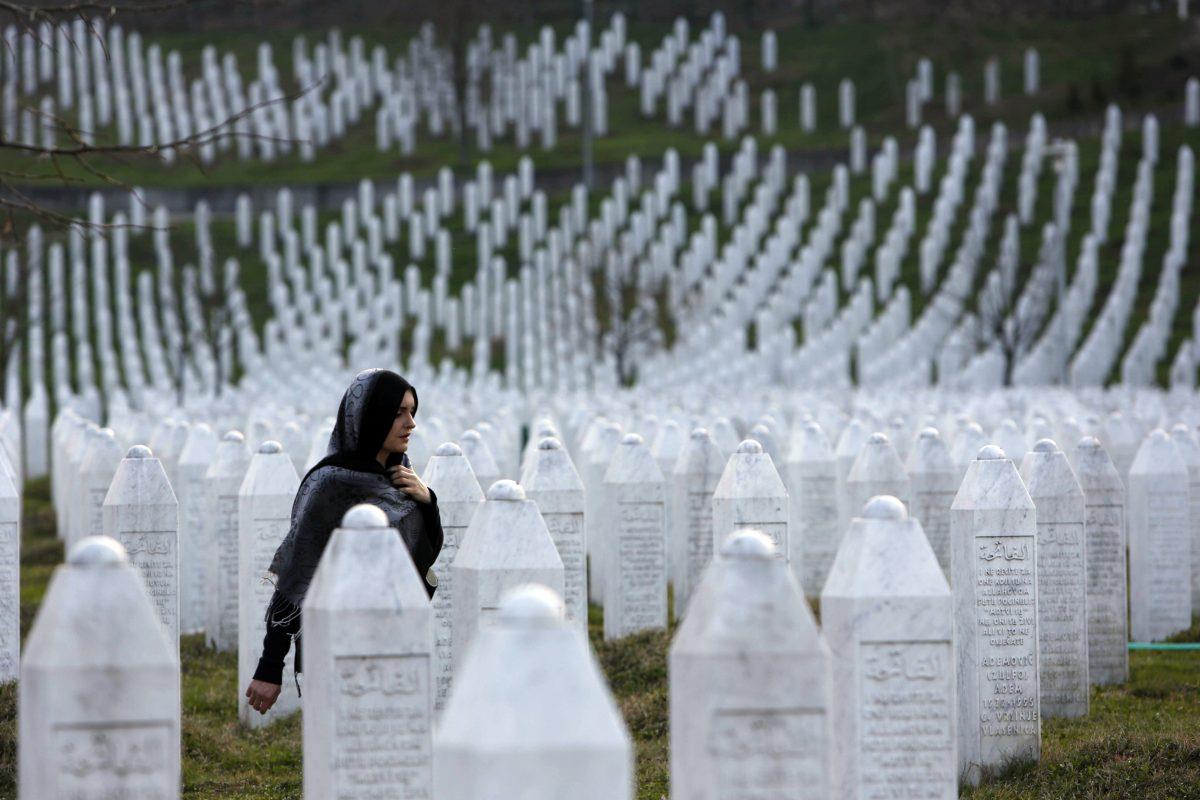
The Dayton Agreement was initialled on Nov. 21, 1995, and signed on Dec. 14, 1995, by the Republic of Bosnia-Herzegovina, the Republic of Croatia, and the Federal Republic of Yugoslavia, which signed “on behalf of the Republika Srpska.”It was agreed four months after the Srebrenica massacre, when up to 8,000 Bosniak males were killed by Bosnian Serb forces.
The agreement was witnessed—but not guaranteed—by the United States, Britain, France, Germany, and Russia.
Two years after the Dayton Agreement, the high representative in Sarajevo was given the so-called Bonn Powers, which allowed him, according to his judgment, to unseat elected officials, impose legislation, impose judicial reform, and even annul constitutional court decisions.
“Schmidt began to exercise the so-called ‘Bonn Powers’ more vigorously, which only intensified the initial conflict between him and Milorad Dodik,” Grbic said. “Facing political pressure and potential prosecution in this struggle, Dodik announced that he would retaliate accordingly.”
Dzidic said that “Russia has been quite clear about the fact that it views the EU now in the same manner as it does NATO, as an enemy.”
He said the EU wanted to incorporate the Western Balkans but Moscow wanted them to be “very fragmented, destabilized, ethically charged” and to become potentially a “time bomb within the EU.”

Yugoslavia split into Serbia and Montenegro in 2003, two years after Slobodan Milosevic, the former president of Serbian-dominated Yugoslavia, was arrested in Belgrade and extradited to The Hague to face a war crimes tribunal.
The agreement said Bosnia-Herzegovina would consist of two entities, the Federation of Bosnia and Herzegovina and the Republika Srpska.
There are no border crossings between the two entities, and Sarajevo is the capital.
Institutionalized Segregation?
Grbic said, “Difficulties emerged later, as two institutions created by the agreement—the Constitutional Court and the Office of the High Representative, both heavily influenced by Western political elites—significantly reshaped its provisions, to the point where the original arrangement became almost unrecognizable.”He said voting was dependent upon being of a particular ethnicity and living in a particular area.
“It seemed to institutionalize keeping different ethnic groups separate, as opposed to encouraging intermingling, and my understanding and talking to people who were involved in the negotiations was that this was just pragmatic and realistic,” Slye said.
He said the Dayton negotiators thought they were not going to get an agreement unless there was some sort of protection for groups who wanted a degree of “segregation.”
Grbic said the Serbs are not “seeking to overturn Dayton.”
“Rather, Serbian frustration stems from the interventions of the high representative and the Constitutional Court [with foreign judges], which have repeatedly altered the Agreement from its original form, taking away competencies of the Republic of Srpska,” he said.
Dzidic said that in terms of a peace agreement, Dayton had been a resounding success, but “in terms of the actual structure it created to run a democratic state, it creates a very impractical system.”
Grbic said that Dodik and Serbian President Aleksandar Vucic appeared to be quite close and that it is “entirely natural for Belgrade to support the Serbs in Bosnia and Herzegovina.”
“After all, they are the same people,” he said.
But Grbic said he would not overstate the likelihood of conflict in Bosnia and Herzegovina: “For now, it seems to me highly implausible.”
The Epoch Times has contacted the OHR in Sarajevo and Dodik’s office for comment but did not receive a response.