When Will BC Get Hit by ‘The Big One’ and How to Prepare?

Save
When Will BC Get Hit by ‘The Big One’ and How to Prepare?
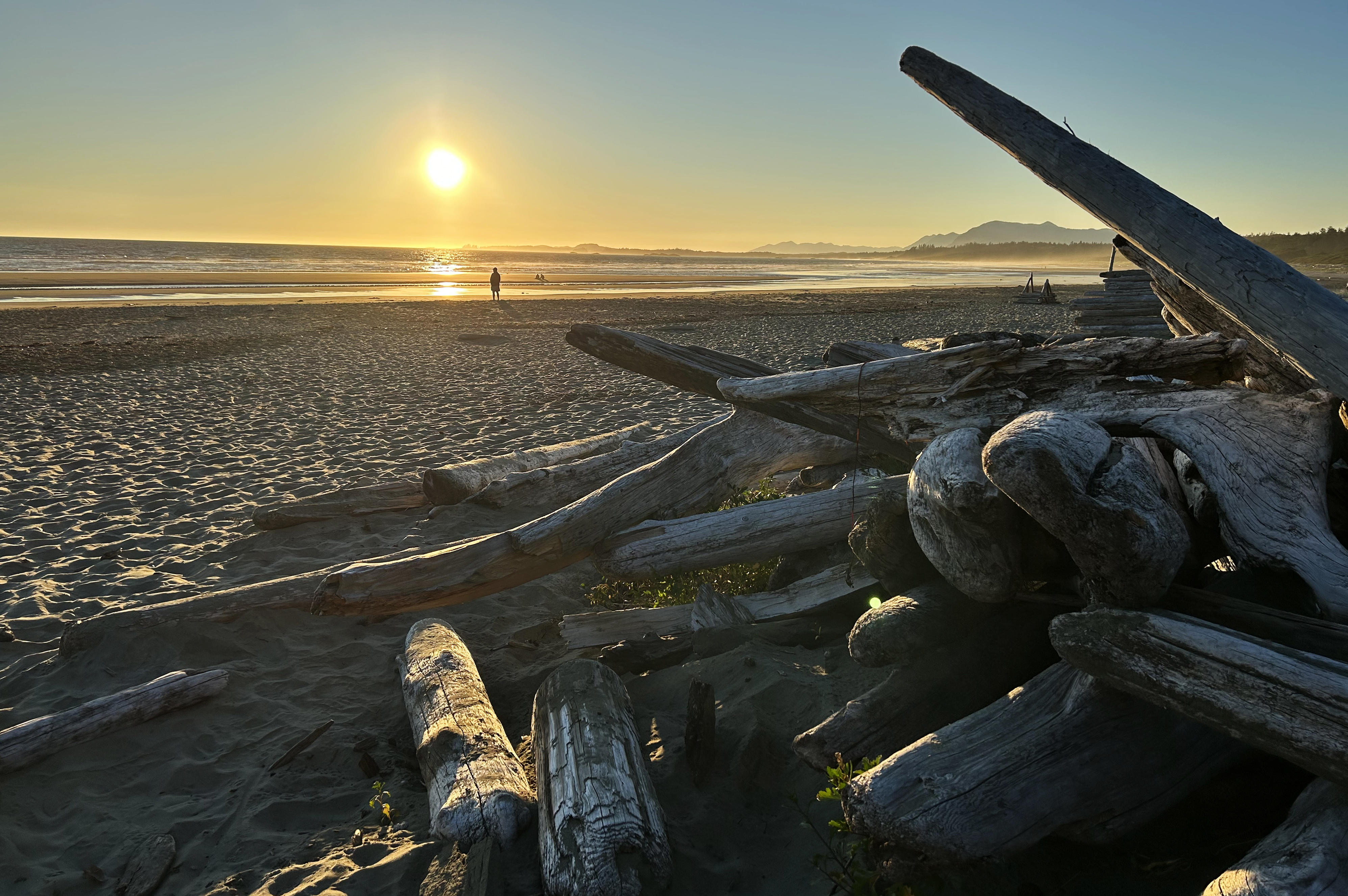
A couple walk along Whiffin Spit Park following a tsunami warning in Sooke, B.C., on Jan. 23, 2018. The Canadian Press/Chad Hipolito
Shortly after Japan’s 2011 Tōhoku earthquake and tsunami, there was increased awareness that a similar disaster could happen in British Columbia. This concern was reinforced again by the 8.8-magnitude earthquake that occurred off the coast of Russia on July 29, which led to a tsunami advisory in some B.C. coastal regions.
These events have served as a reminder of what seismologists have long forecast: At an unknown date in the future, B.C. is likely to experience what’s called a megathrust earthquake, up to magnitude 9.4, followed by a major tsunami sweeping areas of Vancouver Island and the B.C. coast.
These types of earthquakes occur every few hundred years, and the last one happened 325 years ago, Shahin Dashtgard, a professor of earth sciences at Simon Fraser University in Burnaby, B.C., told The Epoch Times.
“We know that they happen every 200 to 800 years. So there’s a fairly consistent record of that going back in 5,000 years of history,” he said in an interview. 
B.C.’s last megathrust earthquake, an estimated magnitude 9, occurred on Jan. 26, 1700. Dashtgard said this means “anywhere from now until 500 years from now, we should be getting a big, megathrust earthquake." 
The B.C. government says the highest-risk regions in the province are along the west coast, which is also under threat of a large tsunami hitting in the wake of a megathrust earthquake.
Southwestern B.C. is located in the Cascadia Subduction Zone, an area that runs 1,000 kilometres from northern California to northern Vancouver Island. This area is the boundary between two tectonic plates—the small oceanic Juan de Fuca Plate to the west of part of North America, and the North American Plate that contains North America as well as part of the Atlantic Ocean.
The two tectonic plates, which are large segments of the Earth’s crust, shift against each other continually, building up pressure and agitation. When the stress becomes too great, it can be expected to eventually result in a sudden rupture—a massive megathrust earthquake above 9 on the Richter scale.
Such an earthquake, colloquially known in B.C. as “the Big One,” would be likely to trigger a subsequent tsunami, as Vancouver Island’s west coast sinks one to two metres below its current level, exposing the island and low-lying areas of the mainland coast to significant floods and damage. 
“If you’re talking about the outer shelf of Vancouver Island dropping by one or two metres, that would generate a large volume of space, which would then create a fairly large tsunami which hits Vancouver Island,” Dashtgard said. “Think of that like almost pushing down water in a bathtub; you generate a wave to fill that space.”
Japanese soldiers conduct a search operation in a small village beside the Onagawa nuclear plant in Onagawa in Miyagi prefecture on March 21, 2011. (Toshifumi Kitamura/AFP via Getty Images)
Japanese soldiers conduct a search operation in a small village beside the Onagawa nuclear plant in Onagawa in Miyagi prefecture on March 21, 2011. Toshifumi Kitamura/AFP via Getty Images

Previous Earthquakes

In terms of serious earthquakes, Vancouver Island experienced a highly destructive 7.3 earthquake in 1946, with the epicentre near the communities of Courtenay and Campbell River. Significant tremors were felt as far away as Portland, Oregon, and Prince Rupert, B.C. The event, Canada’s largest historic onshore earthquake, saw an enormous amount of property damage and two fatalities: one due to a drowning when a small boat capsized, and one from a heart attack.
However, as Dashtgard notes, the 1946 earthquake occurred higher up inside the crust of the North American Plate. This isn’t the same type as the megathrust earthquake that seismologists anticipate will occur when the North American Plate, the Juan de Fuca Plate, and the Pacific Plate clash violently and produce an earthquake followed by a tsunami. The Pacific Plate, which lies under most of the Pacific Ocean basin, is the Earth’s largest tectonic plate. 

Dashtgard said a tsunami would likely result in the Victoria area being hit by a direct wave, whereas Vancouver would receive some smaller direct waves but would likely be buffered due to the city being built on softer rock, which can absorb more of the wave’s energy.

Seismology professor Michael Bostock at the University of British Columbia cautions those living along Vancouver Island’s western coast to be particularly prepared for a tsunami. He cited the 1964 tsunami that washed into Port Alberni on the island as a result of the 9.2-magnitude Great Alaska Earthquake. Travelling over 2,200 kilometres before it reached Vancouver Island, the tsunami struck at nighttime and flooded many houses and businesses, destroying various structures, although no fatalities were reported. 
“It’s really the people on the west-facing outer coast that are most concerned, in particular those up inlets like Port Alberni, the site of a significant tsunami even from distant earthquakes,” Bostock said in an interview.
He added that in the event of a major tsunami, those in coastal areas should flee for higher ground 20 to 40 metres above sea level. 
Volunteers plant mangrove seedlings at a beach that was devastated by the 2004 Indian Ocean earthquake and tsunami at Kajhu on the outskirts of Banda Aceh on June 26, 2025. (Chaideer Mahyuddin/AFP via Getty Images)
Volunteers plant mangrove seedlings at a beach that was devastated by the 2004 Indian Ocean earthquake and tsunami at Kajhu on the outskirts of Banda Aceh on June 26, 2025. Chaideer Mahyuddin/AFP via Getty Images

‘A Wake-Up Call’

The 2004 Indian Ocean Tsunami, triggered by a 9.1-magnitude earthquake that occurred off the west coast of Indonesia, killed over 280,000 people and affected millions of people across over a dozen countries from Thailand to India. One of the deadliest natural disasters on record, the event led nations around the world to take tsunami preparedness more seriously in terms of funding and updates to warning and evacuation systems. 
This was followed seven years later by Japan’s 2011 Tōhoku earthquake and tsunami event, which was caused by a 9.0-magnitude megathrust earthquake that led to over 20,000 fatalities and widespread damage to coastal ports and towns, displacing hundreds of thousands of people. Waves cresting at nearly 40 metres reached 10 kilometres inland and caused reactor meltdowns at the Fukushima Daiichi nuclear power plant, resulting in the release of radioactive contaminants into the surrounding environment. Japan’s 2011 quake and tsunami held important lessons for B.C., including in the areas of seismic building retrofits, vertical evacuation structures, and modular temporary housing, according to a study by U.B.C. geography professor David Edgington published in 2022. 
Debris from Japan’s tsunami began washing ashore in B.C. in the subsequent years, with boats, household items, and even a motorcycle coming ashore. The Japanese government said an estimated 1.5 million tonnes of debris went into the Pacific Ocean in the event’s aftermath. 
In addition to consulting with Japan to return some of the found items and protect against invasive species entering B.C. waters, Ottawa also accepted around $1 million from the Japanese government in 2013 to help with debris cleanup along the B.C. west coast.
This year’s July 29 undersea earthquake near the Kamchatka Peninsula in Russia also led to tsunami advisories up and down B.C.’s west coast, as well as warnings for Japan, New Zealand, Alaska, Hawaii, numerous Pacific islands, and the west coast of the United States. Although no damage or large waves occurred, the event was a reminder to B.C. to be ready.
A couple walk along Whiffin Spit Park following a tsunami warning in Sooke, B.C., on Jan. 23, 2018. (The Canadian Press/Chad Hipolito)
A couple walk along Whiffin Spit Park following a tsunami warning in Sooke, B.C., on Jan. 23, 2018. The Canadian Press/Chad Hipolito

Preparedness

While there have been various efforts to retrofit schools and buildings in Victoria and Vancouver to be more durable during a quake, including through the province’s Seismic Mitigation Program (SMP), many privately owned buildings remain vulnerable to a strong earthquake. The SMP has already led the province to spend more than $1.9 billion to conduct seismic assessments for making school buildings more earthquake-proof, with approximately $1 billion approved since September 2017. 
The B.C. government’s “Earthquake and Tsunami Preparedness Guide” also offers guidance, cautioning residents to have at least two weeks of food per person stored, as well as enough water, medicine, and essentials for several weeks that don’t require electricity or working utilities. In addition, residents are urged to keep a “grab-and-go bag” that can be quickly grabbed in case of evacuation. 
The guide advises residents to “drop, cover and hold on” when an earthquake first hits and then relocate to higher ground when possible to avoid a possible incoming tsunami.
Bostock notes that the advice people may have heard decades ago about standing in a doorway is no longer recommended. He says the best course of action, to avoid being exposed while the shaking occurs, is to duck under a table or desk and hold on to it in case it shifts.
A person holds a cellphone showing an earthquake alert in a file photo. (The Canadian Press/Ian Young)
A person holds a cellphone showing an earthquake alert in a file photo. The Canadian Press/Ian Young
In the event of an earthquake, Canada’s Earthquake Early Warning system will put out alerts on television, radio, and smartphones about any earthquake or tsunami danger. 
“We’ve got that system now in place,” Bostock said, adding that “there’s still bugs being ironed out.”
For his part, Dashtgard recommends being prepared for the Big One but not focusing on it too much. 
“Have your preparedness kit and [be] ready to go,” Dashtgard advised. “But it’s one of those things that I don’t lose sleep over, because when it happens, it’s going to happen.”
AD