Although a Hobart councillor’s bid to alter the timing of the council’s Indigenous Acknowledgement of Country was unsuccessful, several colleagues did voice reservations about how the practice has evolved.
The Hobart City Council regularly performs an Acknowledgement of Country during official meetings, a common practice across Tasmania’s 29 councils.
However, on July 28, Councillor Louise Elliot attempted to move the ceremony to before the start of meetings, so people have a chance to opt out.
Welcome to ... Antarctica?
Councillor Will Coats said the procedure had become ubiquitous.“Often it’s not as much about what you’re doing, but how you go about doing it,” he said.
Coats has a background in IT and works with the government-backed Australian Antarctic Division, and revealed even Welcome to Countries were featured during meetings for that group.

“I mean this is an anecdote, but I tend to the market briefing for the Australian Antarctic Division—I’m doing the flights to Antarctica—so customers from all over the world are connecting in ... a good chunk of the limited time available is spent doing Acknowledgement of Country for a service to go to Antarctica,” he told council.
Coats also said the ceremonies had become increasingly politicised with themes of invasion and dispossession.
Councillor Elliot Says Ceremony Has Become ‘Quasi-Religious’
On July 28, Councillor Elliot presented the motion to council chambers (pdf), arguing the ceremony had become “quasi-religious” and did not apply to most Australians.“Up until several years ago, each council meeting used to start with the Lord’s Prayer,” she told Hobart City Council’s ordinary meeting.
“This religious belief has been replaced with a new quasi-religious and political belief described as an Acknowledgement of Country.
“Similarly, council events typically also include a Welcome to Country early in proceedings.
“Many Australians do not subscribe to the sentiment behind and often the explicit language of an Acknowledgement of Country or Welcome to Country.”
Motion Fails, Suggestion for Workshop Also Fails
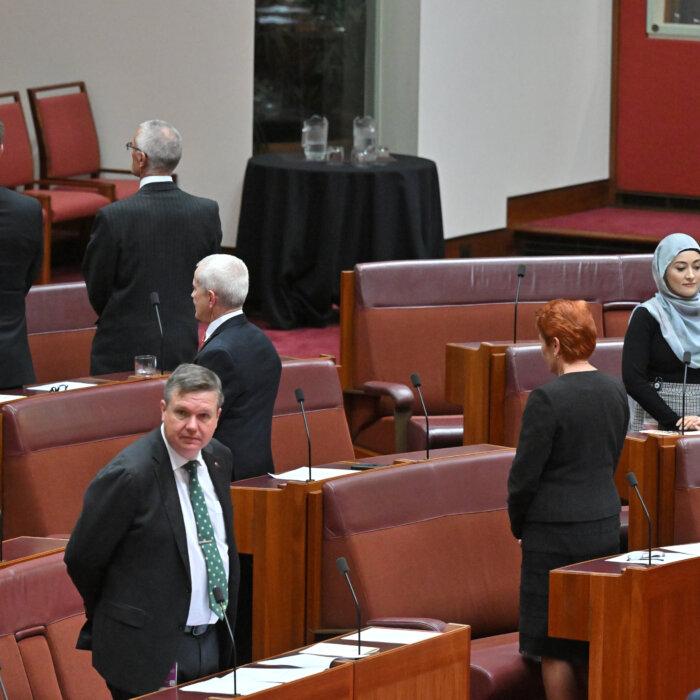
Deputy Lord Mayor Dr. Zelinda Sherlock, wearing an Aboriginal-style shirt, noted that councillors were not compelled to perform the Acknowledgement and Elliot was “not forced to do it at all.”“If you refuse to acknowledge the murders of innocent men, women and children, that’s your choice,” she said.
In conceding that the motion was likely to be unsuccessful, Councillor Marti Zucco proposed an addition to the motion—for councillors to hold a closed-door workshop on the topic, rather than elicit media attention through an open debate.
Some Councillors Support the Welcome, but Says the Situation Can be Improved
Alderman Bloomfield said she supported the rituals, but felt they had lost their way.She described a recent ceremony she attended as “beautiful” but she felt the meaning of Welcome to Country events had been lost “to some extent.”
Calling for unity, she suggested a form of the ceremony that is delivered “in a way that doesn’t judge, but simply shares.”
“I sincerely hope to see some commonality and that we can all walk together again,” she said.
Councillor Bill Harvey accused grassroots campaign group, Advance Australia, of funding and starting a “deliberate campaign” to ensure that it becomes “popularised that Acknowledgements of Country are bad for Australia.”
Councillor Says Elliot Stoking ‘Culture Wars’
Councillor Ben Lohberger took his argument against the motion a step further, accusing Elliot of emulating conservative politicians and the “culture wars.”“It is political grandstanding reminiscent of the culture war politics we get from the likes of One Nation and Donald Trump and it doesn’t belong in this room,” he said.
“So I think when we do Acknowledgement of Country, it’s got to be in the right context. It shouldn’t be said at every single meeting, whenever you land on a plane as some sort of genuflexion,” said federal WA Liberal MP Andrew Hastie.