This copy is for your personal, non-commercial use only. Distribution and use of this material are governed by our Subscriber Agreement and by copyright law. For non-personal use or to order multiple copies, please contact The Epoch Times Reprints.
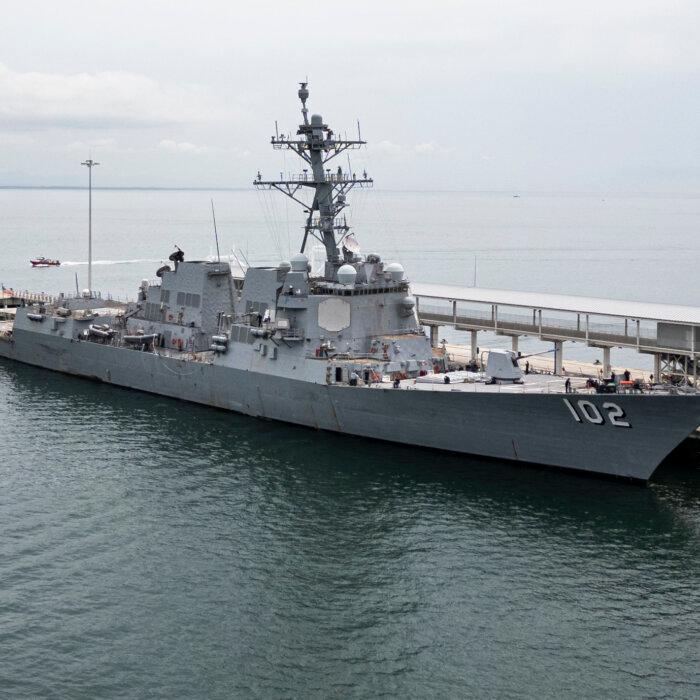
The U.S. Navy warship USS Sampson (DDG 102) docks at the Amador International Cruise Terminal in Panama City on Sept. 2, 2025. Martin Bernetti/AFP via Getty Images
Venezuelan Defense Minister Vladimir Padrino said Sept. 7 that more troops would be sent to states along the country’s Caribbean coast to combat drug trafficking, five days after the U.S. military killed 11 people aboard a boat allegedly carrying narcotics from Venezuela.
Padrino said Venezuelan leader Nicolás Maduro had ordered the deployment of 15,000 additional troops.
He said they would be sent to the Guajira region of the state of Zulia and the Paraguaná Peninsula in the state of Falcon.
The Guajira region, near the city of Maracaibo in northwestern Venezuela, borders Colombia, and the northern end of the Paraguaná Peninsula lies just 18 miles from Aruba in the Dutch Antilles.
In a video uploaded to social media, Padrino said: “No one is going to come and do the work for us. No one is going to step on this land and do what we’re supposed to do.”
Padrino said the Venezuelan military would also expand its presence in Nueva Esparta, an island in the northeast, and in Sucre and Delta Amacuro, near Margarita Island and Trinidad and Tobago, respectively.
On Sept. 3, Trinidadian Prime Minister Kamla Persad-Bissessar welcomed the U.S. attack on the Venezuelan boat.
“The pain and suffering the cartels have inflicted on our nation is immense,” he said. “I have no sympathy for traffickers. The U.S. military should kill them all violently.”
Tensions between the United States and Venezuela have grown since U.S. President Donald Trump stepped up the fight against the inflow of illegal narcotics when he returned to the White House in January.
Trump signed an executive order on Jan. 20 designating the Tren de Aragua cartel as a foreign terrorist organization, giving the U.S. government power to go after the group’s finances, target those who supply them with weapons, and carry out military strikes against their facilities.
The Sept. 2 strike at sea came after the U.S. government doubled the reward for information leading to Maduro’s arrest to $50 million.
The U.S. military also dispatched air and naval assets to the southern Caribbean Sea to counter drug trafficking.
Last week, the United States deployed 10 fighter jets to Puerto Rico to protect warships carrying out operations against Tren de Aragua and other drug cartels, following an incident in which a U.S. warship encountered two Venezuelan aircraft in international waters.
Maduro has accused the United States of seeking regime change. During a Sept. 1 news conference, he said his country was at “maximum preparedness” and that if it were attacked, he could constitutionally declare a “republic in arms.”
In a post on Truth Social on Sept. 2, Trump said Tren de Aragua “is a designated Foreign Terrorist Organization, operating under the control of Nicolas Maduro, responsible for mass murder, drug trafficking, sex trafficking, and acts of violence and terror across the United States and Western Hemisphere.”
Trump Denies Discussing Regime Change
On Sept. 5, the U.S. president said that regime change in Venezuela was not a topic of conversation.
Following a 2024 presidential election and the Venezuelan National Electoral Council’s announcement of Maduro’s victory, the United States said Maduro “clearly lost ... and has no right to claim the presidency.”
A Dec. 2024 report by the Caracas-based insurance company Venepandi said Venezuela “has historically been a critical point in drug trafficking, especially due to its strategic location between Colombia, the world’s largest producer of cocaine, and the Caribbean.”
“Over the years, the country has seen an increase in narcotrafficking activities, with criminal groups operating in various regions, exploiting political and economic instability,” Venepandi’s report stated.
François Cavard, a human rights activist who has spent years investigating the drug trade in Central and South America, previously told The Epoch Times that Tren de Aragua started growing under the auspices of Tareck El Aissami, who was a senior figure in the ruling United Socialist Party of Venezuela who became the country’s vice president and was part of Maduro’s inner circle, before falling from grace in 2023.
El Assaimi was charged in absentia by the United States in 2019 for violations of the Foreign Narcotics Kingpin Designation Act.
In April 2024, the Venezuelan government announced that he had been arrested on charges that include treason, money laundering, and criminal association. Attorney General Tarek William Saab did not say when El Aissami was arrested.
Reuters and The Associated Press contributed to this report.